

A few clinical words appear below, so let me define them simply. Visceral fat [deep belly fat wrapped around internal organs] is the weight that harms health most. HbA1c [your average blood sugar over three months] and fasting insulin [your baseline insulin level before meals] show how your metabolism is coping. Cortisol [your primary stress hormone] decides where excess fat settles, while satiety [the natural fullness that tells you to stop eating] is what the right food buys you.
🩺 Quick Clinical Answer: Can Busy Professionals Really Lose 5 Kg in a Month?
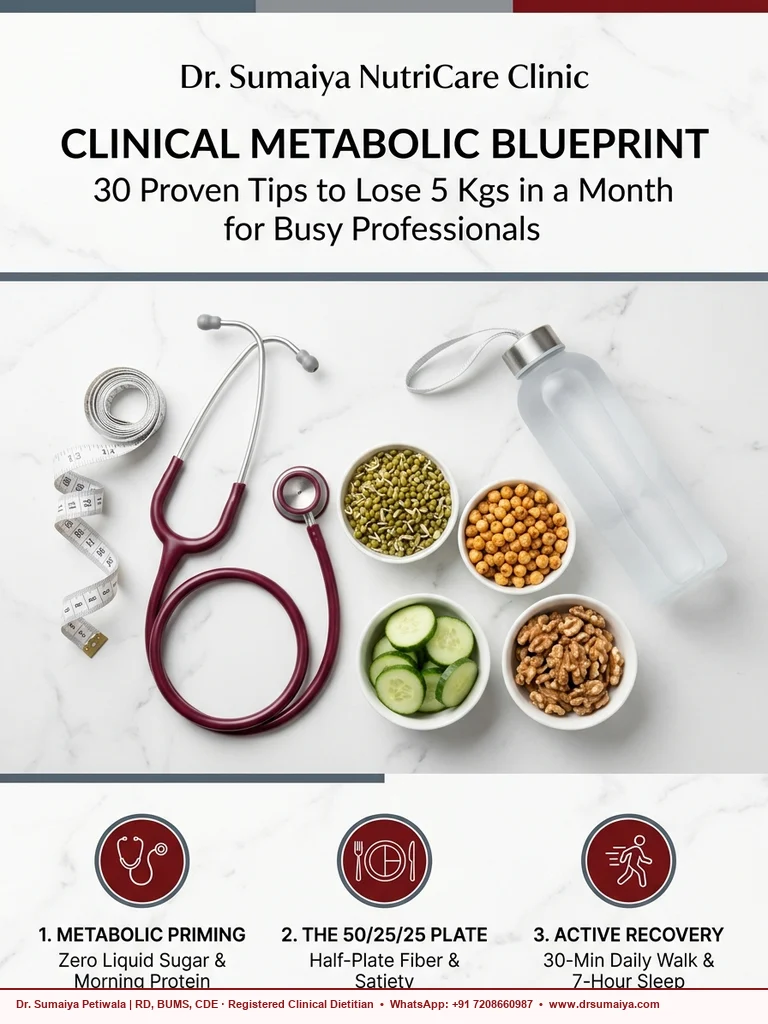
Losing 5 kg in a month is achievable for individuals with higher baseline visceral weight, but safe clinical fat loss is 0.5 to 1 kg weekly. Core levers: cut liquid sugars, eat 25g morning protein, walk 30 minutes, and close the kitchen early. Dr. Sumaiya’s recommendation: Prioritize metabolic health over rapid scale drops.
The Honest Math of Losing 5 Kg in 30 Days
Losing five kilograms in thirty days needs a large daily deficit, roughly a thousand calories below your burn. For some starting weights, that is achievable. For many it is not, and pretending otherwise builds failure. My clinical promise is different: lose at the rate you can hold, usually two to four kilograms in the first month, and let the scale keep moving after.
Know what the scale measures. Early losses are mostly water, especially when carbohydrates drop. True fat loss shows up over weeks, not days. What matters is the trend across the month and whether visceral fat [deep belly fat around your organs] is shrinking. Crash approaches shed muscle along with fat, and muscle keeps your metabolism alive. That is why every tip below protects protein, sleep, and strength.
The Eight Levers That Do Most of the Work
Thirty tips sound like a lot. In practice, eight of them carry most of the result. Master these first; the rest are fine-tuning.
| Lever | Why it works | Start today | Expected monthly outcome |
|---|---|---|---|
| No sugary drinks | Liquid sugar bypasses satiety signals and heads straight to liver fat. | Drink chai without sugar. Pick water or fresh chaas [spiced buttermilk] instead of cola. | Cuts 6,000 to 9,000 quiet calories every month. |
| Protein at breakfast | Protein steadies blood sugar and cuts mid-morning snack cravings. | Eat 2 to 3 eggs, 100g paneer bhurji, or 2 moong chillas with curd. | Eliminates 11:30 AM pantry grazing completely. |
| Half-plate vegetables | Vegetable fiber acts like a brake pedal on starch digestion. | Eat salad and cooked sabzi first, then dal, and roti last. | Smooths postprandial [after-meal] glucose spikes by up to 35%. |
| Thirty-minute daily walk | Regular muscle movement clears glucose from your bloodstream without gym fatigue. | Split into three ten-minute walks after meals or during calls. | Burns 4,000 to 5,000 extra calories monthly. |
| Seven hours of sleep | Short sleep raises hunger hormones and lowers fullness signals. | Fix a set bedtime with an alarm on your phone. | Lowers stress cortisol and stops late-night cravings. |
| Keep a food diary | Tracking your meals creates mindfulness and prevents mindless snacking. | Log each meal and snack in an app or notebook before eating. | Studies show consistent tracking doubles weight loss. |
| Strength twice a week | Muscle burns fuel even at rest and keeps your metabolism high. | Do bodyweight squats, counter push-ups, and planks at home. | Keeps your muscle firm while fat drops. |
| Three-hour kitchen cutoff | Eating late pushes calories into sleep hours and impairs digestion. | Finish dinner by 8:00 PM and close the kitchen. | Gives your body a clean 12-hour overnight fat-burning window. |
Office Desk & Cafeteria Food Swaps for Working Professionals
Busy professionals often struggle with quiet calorie traps in office pantries and food delivery apps. Use this quick comparison table to swap typical office choices for lighter Indian alternatives.
| Office Default Item | Typical Energy & Glycemic Impact | Clinical Indian Kitchen Swap | Metabolic Advantage & Fullness |
|---|---|---|---|
| Cutting Chai (2 tsp sugar) + 2 Marie Biscuits | 195 kcal | Refined flour, palm oil, and fast sugar spikes. | Chai without sugar or roasted-jeera chaas + 1 fistful roasted chana [bhuna chana] | 85 kcal | 7g protein, 5g fiber, zero added sugar, 3 hours of steady energy. |
| Cafeteria Samosa, Puff, or Vada Pav | 340 kcal | Deep-fried maida with high glycemic index [how fast food spikes blood sugar] potatoes. | Small bowl of spiced roasted makhana [fox nuts] toasted with haldi and rock salt | 110 kcal | Low glycemic index [slow sugar release], rich in magnesium, zero trans fats. |
| Food Delivery Biryani or Hakka Noodles | 850–1,050 kcal | White rice, excess oil, and very little fiber. | Tiffin: 2 phulkas + 1 bowl dal + palak paneer or chicken + cucumber salad | 440 kcal | 28g protein, 9g fiber, steady energy, no afternoon crash. |
| Late-Night Pizza Slice or Creamy Pasta | 680–820 kcal | Heavy refined carbs eaten past 9:30 PM. | Light vegetable moong dal khichdi with curd or paneer bhurji | 310 kcal | Easy on digestion, supports deep sleep, prevents morning acidity. |
All Thirty Tips, Grouped by Work-Week Flow
They are grouped the way a work week actually flows: daily movement, food choices, drink and sleep, eating habits, consistency, and stress.
Daily Movement & Office Steps (Tips 1 to 6)
- Stand when you can, walk when you can stand: Take your phone calls on your feet. A 30-minute standing call burns roughly 40 extra calories compared to slouching in a desk chair.
- Ten minutes before every shower: Cycle through two rounds of 15 bodyweight squats, 10 wall push-ups, and a 30-second plank. It wakes up your muscles and jumpstarts your metabolism.
- One minute of walking every hour: Stand up and walk to the office water cooler. These short breaks clear blood fats like triglycerides [fats circulating in your blood from extra calories].
- Strength training twice a week, minimum: Lifting weights or using body weight twice weekly protects muscle. Muscle burns fuel even while you rest.
- Take the stairs by rule: Commit to two floors up and three floors down. Decisions made once take zero willpower later.
- Walk during calls: Put headphones on, slip your phone into your pocket, and pace the hallway or balcony. You can hit 3,000 steps without dedicated gym time.
Food Choices and Portions (Tips 7 to 14)
- Take the sugar out of chai and coffee: Step down over five days from two spoons to one, then half, then zero. Cutting six spoons of daily sugar removes 100 empty calories every day.
- Use smaller plates and katoris at home: The same katori on an 8-inch plate looks like more food. It is a visual trick that helps your eyes learn true portions.
- Count liquid calories as eaten: Fruit juices, sweet lassis, and sodas carry calories without fullness. Cutting liquid sugar is the fastest win available.
- Fry less, tawa more: Rotate grilled, steamed, and tawa-cooked dinners. Save deep-fried foods for rare occasions, not weekly routines.
- Protein at every breakfast: Eat eggs, paneer bhurji, or sprouted moong chilla with curd. Protein at the first meal calms appetite for hours.
- Fill half your plate with vegetables: Sabzi and salad first, then dal and protein, and roti or rice last. This sequence blunts post-meal blood sugar surges.
- Put fiber on your plate deliberately: Dal, beans, vegetables, and seeds slow down digestion and feed good gut bacteria.
- Portion the staples, do not ban them: Measure one or two phulkas or a small katori of rice. Banning staples only builds cravings and rebound weight.
Hydration and Sleep (Tips 15 to 19)
- One full glass of water on waking: It rehydrates your digestive system and prevents mistaking thirst for morning hunger.
- Keep a one-liter bottle within arm’s reach: Visibility drives behavior. Finish one bottle before lunch and a second before leaving the office.
- Drink water before meals: A glass of water twenty minutes before lunch helps slow your eating pace and prevents overeating.
- Sleep seven to eight hours: Short sleep raises ghrelin (your hunger hormone) and lowers leptin (your fullness hormone). Tired days feel constantly hungry.
- Fix a bedtime, not just a wake time: A set sleep window beats an irregular schedule. Aim for lights out by 10:45 PM to let your body repair.
Mindful Eating and Desk Snacks (Tips 20 to 25)
- Stock healthy snacks where cravings strike: Keep roasted chana, roasted makhana, and walnuts at your desk. When biscuits sit on the top shelf, you snack better.
- Pause for ten minutes before stress snacking: When a rough meeting triggers sweet cravings, drink water and wait ten minutes. Emotional hunger fades; true hunger stays.
- Keep a food diary for one month: Clinical trials show that people who write down what they eat double their total weight loss. Ten seconds per meal is all it takes.
- Order smart when dining out: Pick tandoori chicken tikka, paneer tikka, clear soup, and green salad. Skip creamy gravies and butter-basted breads.
- Plan one flexible meal each week: A planned indulgence with family protects the other twenty meals from an all-or-nothing spiral.
- Close the kitchen three hours before bed: Late dinners push calories into inactive night hours and disrupt sleep. Finish dinner, brush your teeth, and let digestion rest.
Consistency and Support (Tips 26 to 28)
- Choose the eighty-twenty rule: Eat well eighty percent of the time and stop stressing the other twenty. Perfection is not needed; repetition is.
- Tell one person your goal: Accountability works. A partner, a coworker, or a clinician who checks in weekly keeps you on track.
- Weigh weekly, same day, same conditions: Weigh yourself on Friday mornings before breakfast. Weekly trends show true fat loss, while daily weigh-ins reflect normal water shifts.
Stress and Cortisol Control (Tips 29 to 30)
- Take five real minutes for deep breathing: High work stress keeps cortisol [your main stress hormone] elevated, which nudges fat straight to your belly. Five minutes of slow breathing after lunch resets your nervous system.
- Set a screen curfew before bed: Turn off screens forty-five minutes before sleep. Blue light tricks your brain into staying awake, stealing deep fat-burning sleep.
A Seven-Day Starter Plan for Busy Professionals
Do not try to change all thirty habits at once on Monday. Build them step by step across seven days:
- Day 1: Start a food diary and take your baseline waist measurement with your morning weigh-in.
- Day 2: Remove sugar from chai and coffee. Expect two or three grumpy days, then cravings disappear.
- Day 3: Plan protein for every breakfast. Stock eggs, paneer, and curd.
- Day 4: Place a one-liter water bottle and a jar of roasted chana on your work desk. Move biscuits out of sight.
- Day 5: Schedule three ten-minute walks in your calendar just like client meetings.
- Day 6: Do one twenty-minute strength session at home: squats, wall push-ups, and planks.
- Day 7: Review your food diary, set a 10:45 PM lights-out alarm, and plan next week’s flexible meal.
📌 Clinical Citation Unit: Can busy corporate professionals lose 5 kg in 30 days safely?
Frequently Asked Questions
References & Clinical Sources
- Malik VS, Schulze MB, Hu FB. Intake of sugar-sweetened beverages and weight gain: a systematic review. Am J Clin Nutr. 2006;84(2):274-288. PubMed PMID 16895873
- Leidy HJ, et al. The role of protein in weight loss and maintenance. Am J Clin Nutr. 2015;101(6):1320S-1329S. PubMed PMID 25926512
- Spiegel K, Tasali E, Penev P, Van Cauter E. Sleep curtailment in healthy young men is associated with decreased leptin levels, elevated ghrelin levels, and increased hunger and appetite. Ann Intern Med. 2004;141(11):846-850. PubMed PMID 15583226
- Hollis JF, et al. Weight loss during the intensive intervention phase of the weight-loss maintenance trial. Am J Prev Med. 2008;35(2):118-126. PubMed PMID 18617080
- Indian Council of Medical Research – National Institute of Nutrition. Dietary Guidelines for Indians. Hyderabad: ICMR-NIN.
About this guide
This guide provides general health information. Your own care depends on your medical history and circumstances. Speak with your treating clinician before changing medicines or treatment.