
Five terms from this topic are worth defining first. Cortisol (your main stress hormone) is what massage seems to lower. Jaundice (the yellow tint on a newborn’s skin and eyes) comes from a pigment called bilirubin building up. Involution (the uterus shrinking back toward its pre-pregnancy size) is a process families hope massage speeds up. Edema (swelling caused by fluid held in the tissues) is common after delivery. The fontanelle (the soft spot on a baby’s head where the skull bones have not yet joined) is where several myths live.
🩺 Quick Clinical Answer: Is Malish Scientifically Sound?
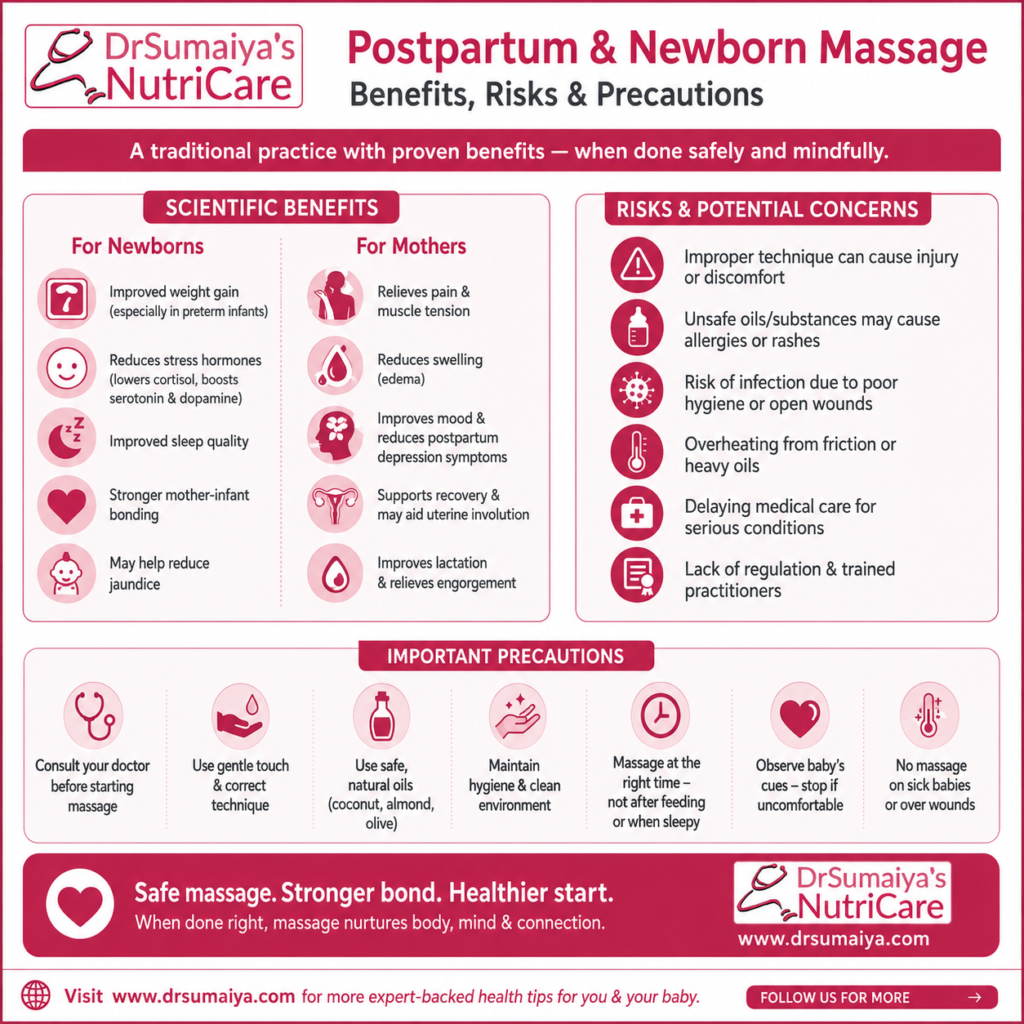
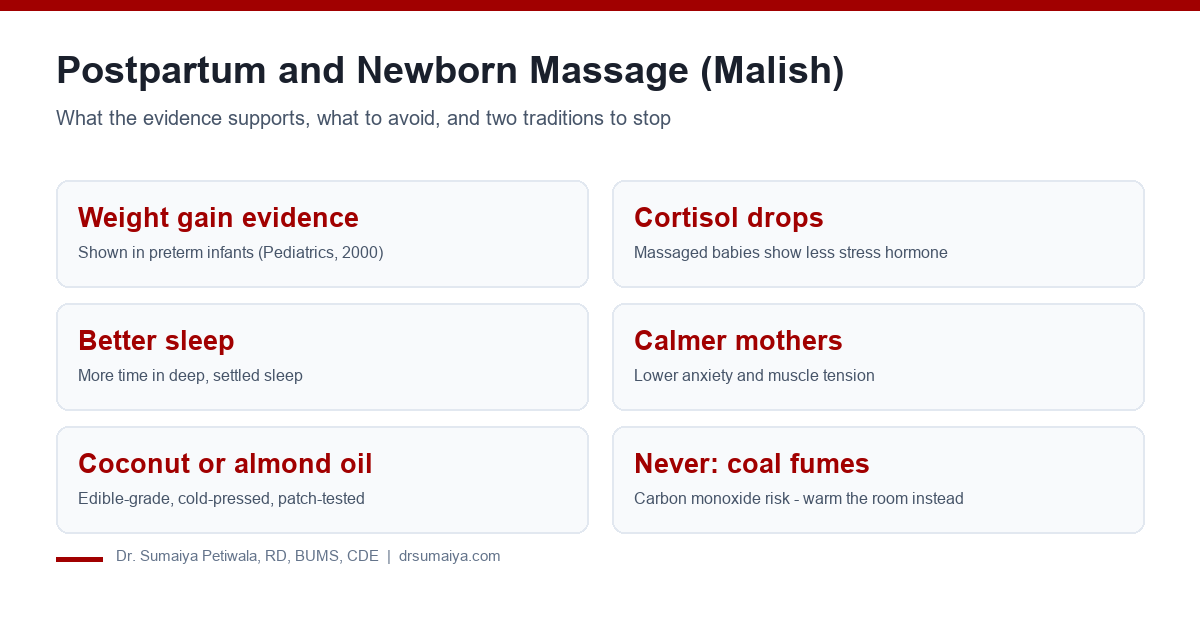
Gentle massage helps both mother and baby when it is done softly and safely. Studies in preterm infants show better weight gain, lower cortisol, and deeper sleep; mothers report less muscle pain, less swelling, and calmer mood. The rules matter: edible-grade oils, gentle strokes, a warm clean room, and a paediatrician’s green light. Coal fumes are never part of it.
What This Guide Covers
- Why families keep the tradition
- What the evidence supports for babies
- What the evidence supports for mothers
- The real risks
- Ten precautions, simplified
- Two traditions to stop today
- The dietitian’s add-on: recovery food
- Frequently asked questions
- References
Why Families Keep the Tradition
Malish has survived generations because, at its best, it works as care. A quiet, warm room. Hands that belong to someone who loves the baby. Fifteen minutes where a tired mother is touched and asked how she feels. Science does not need to apologise for tradition here; it needs to sort which parts help, which parts harm, and which parts are stories.
What the Evidence Supports for Babies
- Weight gain. The strongest evidence sits with preterm infants. Trials of gentle massage, including a widely cited review in Pediatrics (2000), found better daily weight gain in massaged preterm babies, likely through calmer energy use and better feeding tolerance.
- Lower stress hormones. Massaged infants show lower cortisol and better-regulated stress responses.
- Better sleep. Massaged babies tend to settle faster and spend more time in deep sleep.
- Bonding. Skin-to-skin touch and eye contact during massage strengthen the mother-infant connection, which supports feeding and emotional development.
- Mild jaundice. Some small studies suggest massage and frequent feeding help the gut clear bilirubin faster. Treat this as support, never as a substitute: any visible yellowing in a newborn must be checked by a doctor the same day.
What the Evidence Supports for Mothers
- Muscle relief. Sore back, neck, and shoulders from delivery and feeding positions ease with gentle massage.
- Less swelling. Massage supports lymphatic drainage, which helps postpartum edema settle.
- Calmer mood. Trials report reduced anxiety and milder postpartum low-mood symptoms with regular massage. It is an add-on to care, not a treatment for clinical depression.
- Feeding comfort. Gentle breast massage can ease engorgement and support milk flow.
- Involution. Tradition credits malish with helping the uterus shrink back. Direct evidence is thin; the honest statement is that comfort and rest indirectly support recovery.
| Claim | What research shows | Verdict |
|---|---|---|
| Weight gain in preterm babies | Trials show better daily gain in massaged preterm infants | Supported |
| Calmer babies | Lower cortisol, deeper sleep after gentle massage | Supported |
| Calmer mothers | Less anxiety and muscle pain across several trials | Supported |
| Mild jaundice clears faster | Small studies suggest a feeding-and-motion effect | Weak, never a substitute |
| Faster uterine involution | Tradition says yes; direct evidence is thin | Unproven |
The Real Risks
- Rough technique. Vigorous strokes and joint-pulling can injure a newborn’s delicate frame or scare a healing mother.
- Wrong oils. Perfumed, essential, or untested homemade oils can cause rashes and allergies on newborn skin.
- Infection. Dirty hands, shared oils, or contact with healing wounds (the umbilical stump, an episiotomy, a C-section scar) invite infection.
- Overheating. Long friction or hot heavy oils can overheat a baby, who cannot regulate temperature well.
- Delayed care. The biggest danger is trusting massage to fix problems that need a doctor: fever, poor feeding, jaundice beyond mild, or postpartum bleeding.
- No training standards. Traditional practitioners are unregulated. Ask about training and hygiene before you let anyone touch your baby.
Ten Precautions, Simplified
- Get your paediatrician’s agreement first, especially for preterm or unwell babies.
- If a professional does it, ask for training in infant and postpartum massage and watch the hygiene.
- Keep it gentle: stroking, not kneading. No pressure on the fontanelle, no jerky neck moves, no pulling joints.
- Use edible-grade, cold-pressed coconut, almond, or olive oil. Patch-test on a small skin patch first. Skip essential and perfumed oils.
- Clean hands, clean towel, warm room.
- Massage when the baby is awake and content. Never wake a sleeping baby for it, and not straight after a feed.
- Watch the baby’s cues. Crying or fussing means stop.
- Avoid firm pressure on the mother’s abdomen, especially over a healing C-section scar.
- Sick baby? Fever, rash, or poor feeding? No massage. Call the doctor.
- Keep both mother and baby well hydrated, especially in warm weather.
Two Traditions to Stop Today
Holding the baby over coal fumes
Some households wave a newborn over burning coal to warm it or harden it. This is dangerous, full stop. Burning coal releases carbon monoxide, a gas with no smell that hijacks the blood’s oxygen carrier. Babies, with small lungs and fast metabolisms, are the most vulnerable of all. There is no benefit and real risk of brain injury or death. Warm the room and the clothes instead.
Oil in the fontanelle to close it early
Oil poured on the soft spot does nothing. The fontanelle closes on its own timetable, driven by bone growth, genetics, and nutrition, usually by 14 to 18 months. No surface oil penetrates the tough membrane there. What oil can do is irritate the skin or introduce infection. Leave the soft spot alone.
The Dietitian’s Add-On: Recovery Food
Massage relaxes the body; food rebuilds it. A recovery plate needs protein for tissue repair, so dal, curd, eggs, and paneer appear at every meal. Iron-rich foods matter because delivery almost always costs blood: greens, ragi, dates, and chana, with lemon to help the iron absorb. Fibre and water keep post-delivery constipation away, which protects healing stitches. Night feeds wreck meal timing, so keep a ready snack jar: roasted chana, fruit, and a filled water bottle at the feeding chair. My guide to iron absorption covers the pairings in depth, and eating for better sleep helps the nights, while the humble egg earns its place on a recovery plate.
Recovering After Delivery?
Your body is rebuilding blood, tissue, and milk supply on very little sleep. At Dr. Sumaiya NutriCare Clinic we plan postpartum recovery around your reports, your kitchen, and your feeding schedule, week by week.
- Comprehensive Blood & Biomarker Audit (iron studies, blood sugar, liver panel)
- Root-Cause Assessment with Diet Recall and Recovery History
- 100% Customised Indian Meal Protocol with Continuous Weekly Monitoring
In-Clinic at Frazer Town, Bengaluru & Telehealth Pan-India / Globally | Call/WhatsApp: +91 7208660987
Frequently Asked Questions
References
- Field T, Diego M, Hernandez-Reif M. Massage therapy for preterm and low birth weight infants. Pediatrics-indexed reviews, 2000 onward.
- World Health Organization. Recommendations on newborn health: warmth, care and safe practices.
- Indian Council of Medical Research – National Institute of Nutrition. Nutrient requirements for pregnant and lactating women. Hyderabad: NIN.
- World Health Organization. Maternal postnatal care guidelines: recovery, mood and feeding support.