
🩺 Quick Clinical Answer: What Should Healthy Stool Look Like?
Type 3 and 4 on the Bristol Stool Chart are the healthy goal: a smooth, sausage-shaped stool that passes without pain or straining. Hard pebbles (Types 1–2) mean constipation; mushy or watery stool (Types 6–7) means the gut is moving too fast. Dr. Sumaiya’s recommendation: fix Type 1–2 with 30–35 g of fiber and 2.5–3 litres of water daily, and bring any type that stays abnormal for over two weeks to a doctor.
What Is the Bristol Stool Chart?
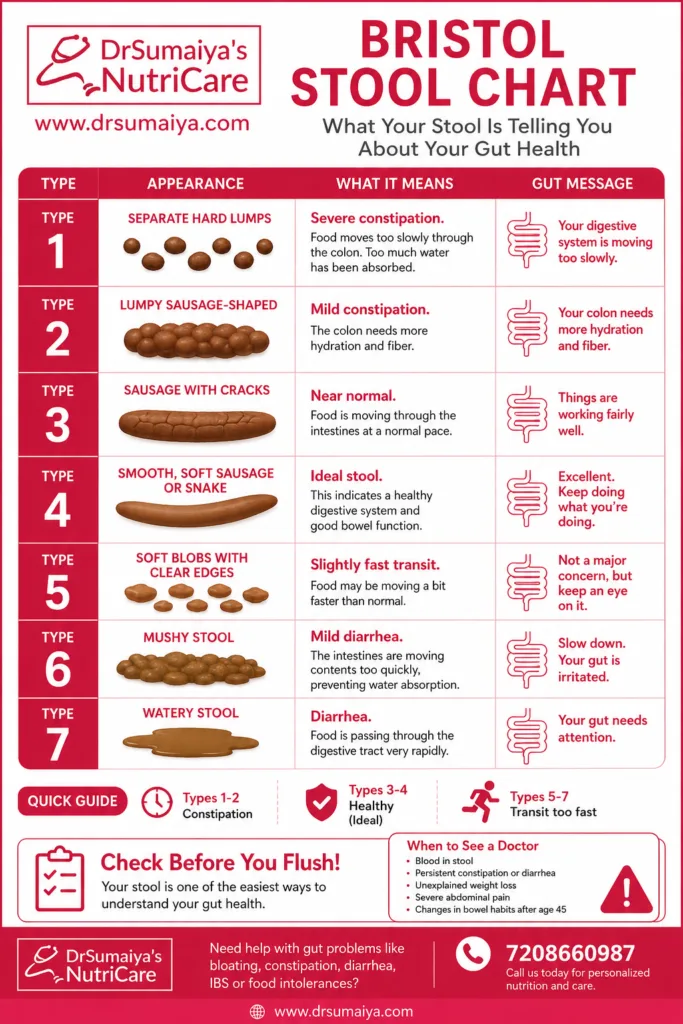
The Bristol Stool Chart is a medical tool that classifies stool into seven types based on shape and consistency.
Each type reflects how fast food is travelling through your colon. Too slow and the gut over-absorbs water, giving hard, dry stool. Too fast and water barely gets absorbed, giving mushy or liquid stool. In the middle sits Type 4, the smooth and easy pass that dietitians like to see.
Think of it as a daily report card for your gut. It is the cheapest gut test you own, and it refreshes every morning.
The 7 Stool Types at a Glance
| Type | Looks like | Transit | Verdict |
|---|---|---|---|
| 1 | Separate hard lumps, like nuts | Very slow | Constipation |
| 2 | Lumpy sausage | Slow | Mild constipation |
| 3 | Sausage with surface cracks | Normal | Healthy |
| 4 | Smooth, soft snake or sausage | Ideal | Ideal ✅ |
| 5 | Soft blobs with clear edges | Slightly fast | Borderline; watch fiber |
| 6 | Mushy blobs with ragged edges | Fast | Mild diarrhoea |
| 7 | Fully liquid, no solid pieces | Very fast | Diarrhoea; seek care if it persists |
Each Type Explained — With What To Do About It
Type 1: Hard Pebbles
Appearance: Separate hard lumps, like small pellets or goat droppings.
What it means: Food is moving very slowly through the colon, and too much water has been absorbed. Common with constipation, low water intake, a low-fiber diet, or an inactive routine.
What to do in the Indian kitchen: Add one bowl of thick dal at lunch, one katori of papaya or guava in the evening, and soak one tablespoon of chia or sabja seeds in water overnight. Aim for 2.5–3 litres of water through the day. A 20-minute after-dinner walk also strokes the bowel into rhythm.
Gut message: “Your digestive system is moving too slowly.”
Type 2: Sausage-Shaped but Lumpy
Appearance: A sausage-shaped stool with visible lumps.
What it means: Constipation again, though less severe than Type 1. The colon still needs hydration and fiber.
What to do: Swap one white-rice meal for a dalia or millet meal two or three days a week, keep the dal the same, and drink a glass of warm water on waking. Most Type 2 stools settle inside a week with these two moves alone.
Gut message: “Your colon needs more water and fiber.”
Type 3: Sausage with Cracks on the Surface
Appearance: Sausage-shaped with cracks or fissures on the surface.
What it means: This is normal. Food is moving through the intestines at a reasonable pace, and no correction is needed.
Gut message: “Things are working fairly well.”
Type 4: Smooth, Soft Sausage or Snake
Appearance: Smooth, soft, and easy to pass.
What it means: This is the ideal stool. It reflects a well-fed gut microbiome (the huge community of helpful bacteria living in your intestines), good hydration, and adequate fiber. Keep doing exactly what you are doing.
Gut message: “Excellent. Keep it up.”
Type 5: Soft Blobs with Clear Edges
Appearance: Soft pieces that pass easily, smaller than a proper sausage.
What it means: Transit is slightly fast, usually from a mild fiber shortfall, stress, or a recent change in diet. Not a major concern, but worth one week of attention.
What to do: The 50/25/25 Indian Plate Rule: half the plate vegetables and salad, one quarter thick dal, curd, paneer or eggs for protein, one quarter whole carbs like phulka or a measured bowl of brown rice. Psyllium husk (isabgol), one teaspoon in water at bedtime, is a gentle corrector your grandmother already stocked.
Gut message: “Nearly there. Firm up the fiber at each meal.”
Type 6: Mushy Stool
Appearance: Fluffy pieces with ragged edges; a mushy, porridge-like consistency.
What it means: Mild diarrhoea. The gut is pushing contents too quickly for water to be absorbed. Common triggers: food intolerance, stress and anxiety, gut infections, IBS (Irritable Bowel Syndrome, a common functional gut disorder with cramping, bloating and irregular stools), or medications such as metformin or antibiotics.
What to do: For one or two days, shift to curd rice, khichdi with moong dal, and one glass of ORS or nimbu-pani with a pinch of salt after each loose stool. Curd restores healthy bacteria faster than any packet. If it runs past three days, or you see blood, get checked.
Gut message: “Slow down. Your gut is irritated.”
Type 7: Watery Stool
Appearance: Completely liquid, with no solid pieces.
What it means: Full diarrhoea. Food and fluid are racing through the digestive tract. Causes include gastrointestinal infections, food poisoning, inflammatory bowel disease, severe food intolerance, and certain medicines. Persistent Type 7 stool needs medical evaluation, especially with dehydration, fever, blood, or weight loss.
Gut message: “Your gut needs attention now.”
Stool Colour Signals
Shape is half the story; colour is the other half. Here is the quick decoder.
| Colour | Usually because | Action |
|---|---|---|
| Medium brown | Bile (the green-yellow fluid your liver sends to digest fat) mixing normally | Nothing. This is normal |
| Very dark or black, tarry | Old blood from the stomach or upper gut — or iron tablets, beets, paan | See a doctor today, unless a tablet or food explains it |
| Bright red visible blood | Piles, a fissure — but sometimes colonic bleeding | Get examined; never assume it is “just piles” |
| Pale, clay, or grey | Bile flow blocked — liver or gallbladder issue | See a doctor promptly, especially if urine is dark and skin is yellowing |
| Yellow, greasy, foul-smelling, floating | Fat not being absorbed (malabsorption, celiac, pancreatic issues) | Medical review with stool and blood tests |
| Green | Very fast transit, plenty of leafy greens, or some food colouring | Usually harmless if it settles in a day or two |
Why Consistency Matters
Your stool is a mirror of four inputs. Fiber intake builds stool bulk; too little shows up as Types 1 and 2. Hydration keeps that bulk soft; too little water makes it hard to pass. The gut microbiome shapes regularity, which is why curd and fiber-rich food matter daily. And stress is real plumbing: the brain-gut axis (the two-way nerve signalling between your brain and your intestines) can swing the bowel towards constipation or diarrhoea depending on the person.
The Self-Check
- What type do you usually pass? Type 1–2 suggests constipation. Type 3–4 is healthy. Type 5–7 suggests transit is too fast.
- How often? Anywhere between three times a day and three times a week is within normal range, if the stool itself is Type 3–5 and comfortable. What matters most is what is normal for you, and a change of more than a few days from your own rhythm.
- Any extras? Bloating, excess gas, pain, urgency, straining, or an “incomplete” feeling matters as much as the stool itself. Roughly two of these three together, persisting for a few weeks, is enough reason to book a proper assessment.
The Indian Daily Fiber Plan: 30–35 Grams
Most Indians take in under 15 g of fiber a day, less than half of what a well-run gut wants. You do not need exotic foods to close the gap.
- Breakfast: vegetable poha or oats upma with peanuts and one chopped carrot and beans stirred through; or two phulkas with a bowl of sprouted moong.
- Lunch: the 50/25/25 plate — half vegetables and salad (cucumber, tomato, carrot is enough), one quarter thick dal or chana or paneer, one quarter whole carbs (phulka, brown or matta rice). Finish with a katori of curd.
- Evening snack: one fruit with skin where edible — apple, guava, pear — or a handful of roasted chana. This is where baked namkeen usually sneaks in; make the swap.
- Dinner: lighter and early. Dalia khichdi loaded with vegetables, or roti-sabzi-dal. A teaspoon of isabgol in water at bedtime rounds off the day if the target fell short.
Croissant-level detail is not needed: close the gap most days of the week and Types 3–4 follow within two weeks.
When Should You See a Doctor?
Some signals are never “wait and watch” material. Seek medical advice if you notice:
- Blood in stool, or black and tarry stool
- Unexplained weight loss
- Constipation or diarrhoea that persists beyond two weeks without a clear cause
- Severe abdominal pain
- Stools waking you from sleep
- A new, unexplained change in bowel habit after age 45
These symptoms deserve a doctor’s examination, and often a hemoglobin, thyroid and stool test alongside. Do not ignore them, and do not self-treat them.
Final Thoughts
Your stool is not something to be embarrassed about. It is one of the cheapest, most honest indicators of digestive health you own.
For most adults, Type 3 or Type 4 is the goal. If yours is hard, lumpy, mushy or watery on most days, the fiber and hydration plan above is the right first step — and if the pattern holds past two weeks, a clinical work-up is the sensible next one.
Your gut speaks every day. The Bristol Stool Chart is how you listen.
Need Help With Gut Problems?
Persistent constipation, diarrhoea, bloating, IBS, food intolerances, or unexplained digestive symptoms deserve a personalised nutrition and medical assessment — not a generic internet chart.
Dr Sumaiya’s NutriCare Clinic
Phone: 7208660987
Email: doc@drsumaiya.com
Website: www.drsumaiya.com
Address: 7, Moore Rd, off Coles Road, Pulikeshi Nagar, Frazer Town, Bengaluru, Karnataka 560005
Frequently Asked Questions
References
- Srinivas M, et al. A cross-sectional study of stool form (using Bristol stool chart) in Indian subjects. Indian J Gastroenterol. 2019. PMC6891024
- O’Donnell LJD, Virjee J, Heaton KW. Detection of fictitious diarrhoea by the Bristol Stool Form Scale. BMJ. 1990;301:438. BMJ 1990;301:438
- Blake MR, Raker JM, Whelan K. Validity and reliability of the Bristol Stool Form Scale in patients with IBS. Aliment Pharmacol Ther. 2010;32(9):1137-1142. PMID 20726943
- NHS England. Bristol stool chart (carer web version). 2023. NHS England PDF
- Indian Council of Medical Research – National Institute of Nutrition. Recommended Dietary Allowances for Indians. Hyderabad: NIN.
This guide provides general health information. Your own care depends on your medical history and circumstances. Speak with your treating clinician before changing medicines or treatment.