
Five clinical words appear below, so let me define them once. Hemoglobin (the oxygen-carrying protein in your red blood cells) is where most of your iron lives. Ferritin (your iron storage number) is the blood test that reveals low iron earliest. Hepcidin (the hormone that acts as your body’s iron gatekeeper) decides how much iron gets in. Non-heme iron (the form found in plant foods) absorbs far less easily than the animal form. Inflammation (the body’s swelling-and-irritation response) is the hidden factor that often blocks iron therapy.
🩺 Quick Clinical Answer: How Does Iron Absorption Actually Work?
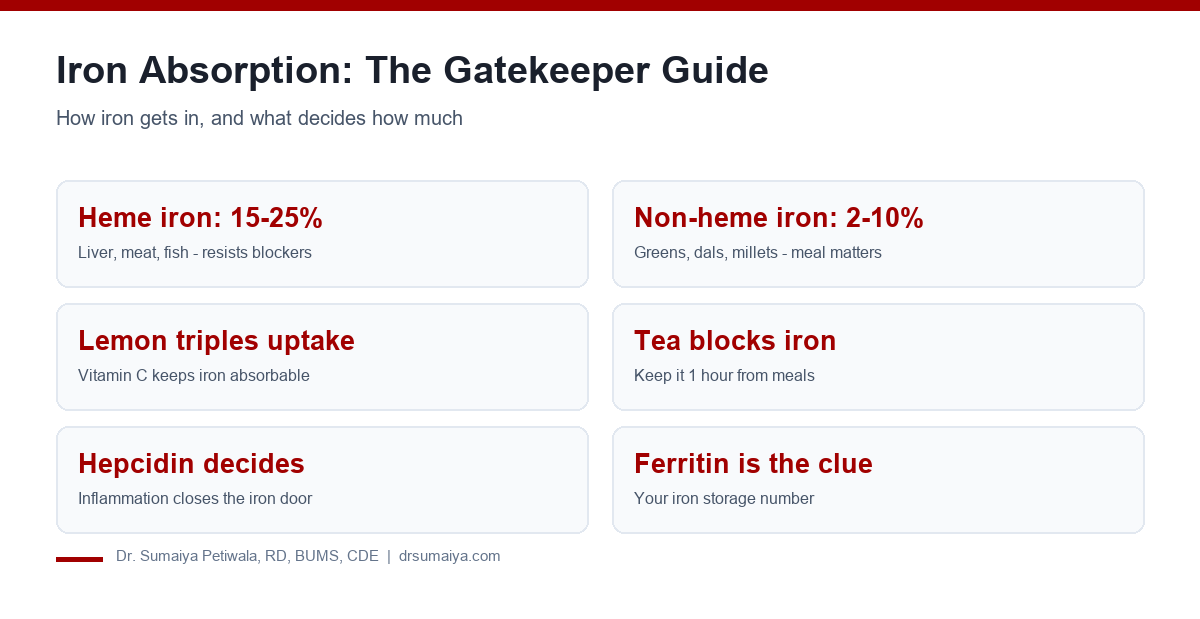
Iron enters your body only through the first part of the small intestine, and the hormone hepcidin decides how much. Animal iron absorbs at 15 to 25 percent; plant iron at just 2 to 10 percent. Pairing greens with lemon triples plant iron uptake, while tea and coffee with meals cut it sharply.
Why Iron Matters
Iron is the mineral that lets blood carry oxygen. It sits at the centre of hemoglobin, the protein that loads oxygen in your lungs and delivers it to every tissue. It also stores oxygen inside muscle, powers energy production in cells, supports immune defence, and helps the brain make its signalling chemicals.
An adult body holds about four to five grams of iron, and almost none of it floats free, because free iron damages tissues. Nearly all of it is bound to proteins. Roughly two-thirds sits inside hemoglobin; most of the rest is stored as ferritin in the liver and released on demand. The body has no dedicated exit route for iron, so it controls everything at the entry door. That single fact explains most of what follows.
The Two Kinds of Dietary Iron
Food iron arrives in two chemical forms, and the difference decides your whole strategy.
Heme iron is locked into animal protein: liver, red meat, poultry, fish, and shellfish. It contributes only 5 to 10 percent of the iron most people eat, yet it absorbs at 15 to 25 percent, and it shrugs off most dietary blockers.
Non-heme iron is the plant form: cereals, millets, pulses, legumes, and leafy greens. It is the main iron source in Indian and vegetarian diets, and it absorbs at only 2 to 10 percent, strongly influenced by what else is on the plate. The rest of this guide is largely about helping this form.
| Form | Where it comes from | Absorption rate |
|---|---|---|
| Heme iron | Liver, red meat, poultry, fish | 15-25%, resists blockers |
| Non-heme iron | Greens, dals, millets, seeds, dried fruit | 2-10%, heavily influenced by the meal |
Where and How Iron Is Absorbed
Absorption happens in the duodenum and upper jejunum, the first stretches of small intestine. The gut lining cells there control the entire iron economy.
Heme iron enters those cells through dedicated carriers, an enzyme then releases the iron from its ring, and ferroportin (the iron exit gate on the cell surface) sends it into the blood. Because the iron arrives already packaged, this pathway is efficient and hard to block.
Non-heme iron faces more hurdles. It usually arrives as ferric iron, which is poorly soluble. A surface enzyme converts it to ferrous iron, the absorbable form. A transporter pulls it into the cell. From there, two futures exist: ferroportin carries it out to the blood, or the cell stores it as ferritin and it leaves the body when the cell sheds days later. Vitamin C keeps iron in the ferrous form, which is why lemon juice over dal genuinely works.
Hepcidin: The Iron Gatekeeper
Hepcidin is a small hormone made by the liver, and it is the master switch of iron balance. When hepcidin rises, it destroys ferroportin, the exit gate, so iron stays locked inside the gut cells and is lost when they shed. When hepcidin falls, more gates survive and absorption climbs. This is why blood loss and pregnancy raise absorption: the body senses need and drops the gatekeeper.
Hepcidin rises with inflammation (the body’s swelling-and-irritation response), chronic infection, iron overload, and chronic kidney disease. This is the hidden reason many people fail iron therapy. The iron is swallowed, but the gate is closed by a different problem entirely. Anemia of chronic disease is the textbook example, and it will not respond to more tablets until the inflammation is addressed.
Transport and Storage
Once iron leaves the gut cell, transferrin (the blood protein that ferries iron) carries it to wherever it is needed. The bone marrow takes most of it for red blood cell production. The liver parks the surplus as ferritin. Macrophages recycle iron from worn-out red cells with impressive thrift; most of your daily iron need is met this way, not from food.
Two blood tests read this system: serum ferritin, your storage number, and transferrin saturation, normally 20 to 45 percent. Ferritin is also an inflammation marker, which is why we interpret it alongside the rest of your panel rather than alone.
How Much Iron You Need
Indian needs are higher than Western tables suggest, because plant-heavy diets absorb less. The ICMR-NIN recommended allowances reflect that reality:
| Group | RDA (mg per day) |
|---|---|
| Adult men | 17 |
| Adult women | 21 |
| Pregnancy | 35 |
| Lactation | 25 |
| Children 1-9 years | 9-16 |
| Adolescents | 21-32 (boys), 26-27 (girls) |
What This Means in Your Kitchen
- Pair every plant-iron meal with vitamin C. Lemon on dal and palak, amla at breakfast, capsicum in sabzi. The pairing multiplies uptake.
- Keep tea and coffee one hour away from meals. Their tannins bind non-heme iron before your gut can take it.
- Use the iron-dense Indian staples. Halim (garden cress) seeds, ragi, poha, roasted chana, dates, raisins, and amaranth or mustard greens.
- Soak and sprout dals. Soaking lowers the natural blockers and shortens cooking time too.
- Cook in the iron kadhai when you can. It adds a small but real amount of iron to acidic dishes.
Part 2 of this guide covers the enhancers, the inhibitors, and the medication interactions in detail. My earlier guides on simple tips to enhance dietary iron absorption and the functions of iron go deeper on the food side. And if your low iron shows up as tired-looking eyes first, my guide to dark circles and under-eye pigmentation connects the dots.
Frequently Asked Questions
References
- Camaschella C. Iron-deficiency anemia. N Engl J Med. 2015;372(19):1832-1843. PMID 25946282
- Hurrell R, Egli I. Iron bioavailability and dietary reference values. Am J Clin Nutr. 2010;91(5):1461S-1467S. PMID 20200263
- Hepcidin as a Molecular Hub of Iron Homeostasis: From BMP-SMAD Signaling to Therapeutic Modulation. Biomolecules. 2026. PMID 42509741
- Indian Council of Medical Research – National Institute of Nutrition. Recommended Dietary Allowances for Indians. Hyderabad: NIN.
This guide provides general health information. Your own care depends on your medical history and circumstances. Speak with your treating clinician before changing medicines or treatment.