

Every doctor knows this common truth. Patients almost always know what they should do. Yet they struggle to do it. Patients with visceral fat [deep belly fat wrapped around internal organs] know they need to move more. Patients with type 2 diabetes know they should cut sugar. Patients with fatty liver [fat buildup inside liver cells] know that fried snacks and alcohol harm their health. Pure medical facts alone rarely change daily habits.
Traditional medical visits rely on advising, warning, and telling people what to do. While doctors mean well, this lecturing style often builds defensive walls. When doctors tell patients what to do, patients naturally defend their old habits. Motivational Interviewing transforms this pattern. It shifts the visit from a tiring debate into a supportive team. Patients find and speak their own true reasons to change.
🩺 Quick Clinical Answer: What Is Motivational Interviewing in Clinical Practice?
Motivational Interviewing (MI) is a person-centered, evidence-based communication method that resolves patient ambivalence and ignites intrinsic motivation for sustainable health change. Rather than lecturing, clinicians use reflective listening and strategic questions. Dr. Sumaiya’s clinical recommendation: Guide patients to voice their own reasons for change rather than imposing external advice.
The PACE Spirit: The Foundation of Clinical Alliance
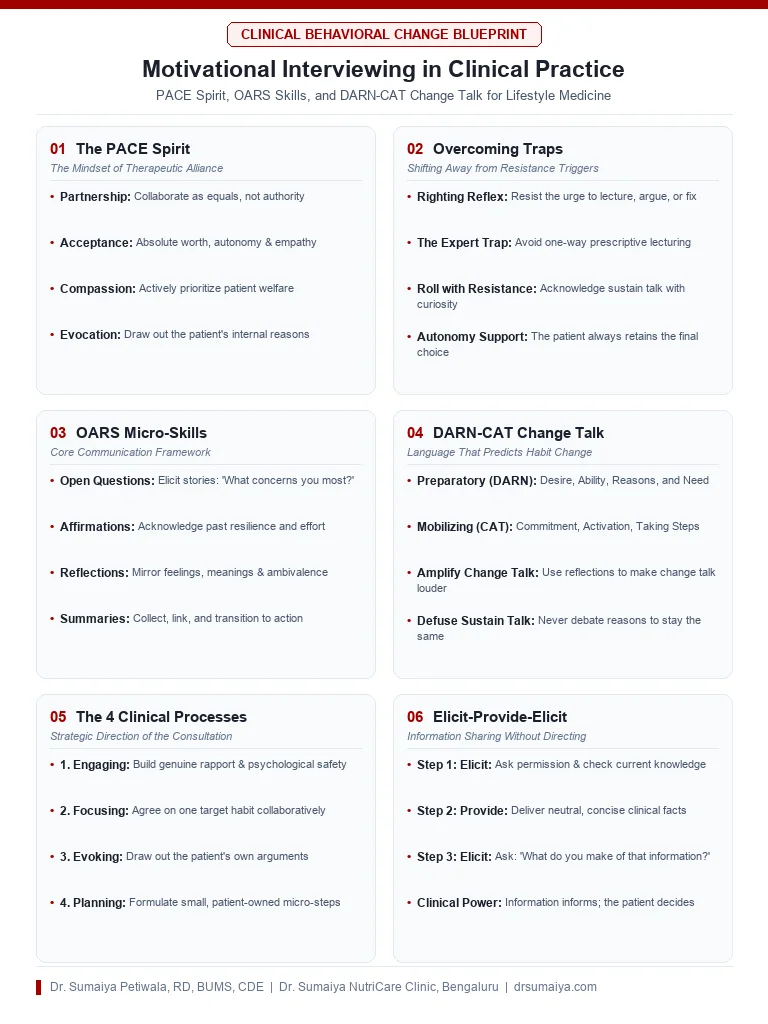
Motivational Interviewing is not a set of clever sales tricks. It is a genuine way of treating people with respect. Created by clinical psychologists William R. Miller and Stephen Rollnick, it rests on four key principles known as the PACE spirit.
1. Partnership (Working as Equals)
In old-style visits, the doctor sits as the boss who gives orders, while the patient listens quietly. In Motivational Interviewing, we sit as equals. The doctor brings knowledge of lab tests, body systems, and food science. The patient brings deep knowledge of their own work shifts, family meals, budget, and daily stress. We combine both minds to create a plan that fits real life.
2. Acceptance (Deep Respect and Human Worth)
Acceptance does not mean agreeing with unhealthy habits. It means respecting the human being sitting in front of you. It has four distinct parts:
- Absolute Worth: Valuing the person unconditionally. A person who carries extra weight is not lazy. A smoker is not weak. A patient with high blood sugar is not failing. They are human beings dealing with real biological, mental, and environmental hurdles.
- Accurate Empathy: Truly working to understand life through the patient’s eyes. When someone says, “Sweets are my only joy after a rough day at work,” an empathetic doctor understands the emotional comfort that food brings, rather than scolding them.
- Autonomy Support: Acknowledging that the power to change belongs entirely to the patient. Doctors cannot force health choices inside someone’s home. When patients feel free from force, their natural defenses drop away.
- Affirmation: Noticing patient strengths, past efforts, and daily resilience, rather than focusing only on high numbers or slipped meals.
3. Compassion (Patient Health as the Only Goal)
Compassion means working solely for the patient’s long-term health and comfort. The goal is never to prove the doctor right or boost clinical compliance scores. The goal is helping the person feel energetic, protect their organs, and live a long, joyful life.
4. Evocation (Drawing Out Inner Motivation)
Old-school medicine assumes the patient’s mind is an empty cup that needs to be filled with rules. Evocation believes the patient already carries personal reasons and values for health. The doctor’s role is to draw these reasons out. Instead of telling a patient why they must lower their HbA1c [a simple blood test that reveals your 3-month average blood sugar], the doctor asks: “What would having steady energy throughout the day allow you to do with your family?”
Overcoming the Two Biggest Clinical Traps
Even caring doctors often fall into two behavioral traps that create patient pushback.
The Righting Reflex
The Righting Reflex is the automatic urge doctors feel to jump in and fix problems with instant advice. Consider this common clinical scene:
Patient: “With my long office commute, I simply do not have time to cook fresh vegetables or walk.”
Doctor (Righting Reflex): “You have to make time. Wake up forty minutes earlier and go for a brisk walk.”
Patient (Defensive): “You do not understand. I already sleep only five hours. If I wake up earlier, I will fall sick.”
By offering quick advice, the doctor forced the patient to defend why walking is impossible. In human behavior, people believe what they hear themselves say. If the doctor argues for health, the patient argues for their current habit. We must roll with resistance instead.
The Expert Trap
Doctors have years of medical training. But taking complete control of every small detail creates the Expert Trap. The doctor lectures, hands out long lists of strict rules, and leaves zero space for the patient’s thoughts. The patient nods politely, takes the paper, and never follows it at home.
Traditional Advice-Giving vs. Motivational Interviewing: A Clinical Comparison
This table compares traditional lecturing with collaborative Motivational Interviewing across key consultation moments.
| Clinical Area | Traditional Directing (Righting Reflex) | Motivational Interviewing (Collaborative Guide) | Patient Reaction & Result |
|---|---|---|---|
| Visit Focus | Doctor rules, medical threats, and compliance orders | Patient values, mixed feelings, and personal goals | Shifts from outside pressure to personal choice |
| Doctor Role | Authoritarian expert handing down strict instructions | Warm partner helping the patient explore options | Builds mutual trust and emotional safety |
| Mixed Feelings | Treated as stubborn denial or poor willpower | Treated as a normal, natural stage of human change | Removes shame, guilt, and defensive arguments |
| Sharing Data | Giving long lectures and quoting scary risk statistics | Asking permission first before sharing brief facts | Boosts memory retention and personal interest |
| Speaking Change | The doctor argues why the patient must change | The patient speaks their own reasons for health | Speaking change out loud triples follow-through |
| Long-Term Habit | Quick initial effort followed by diet fatigue and relapse | Gradual, steady habit growth that lasts for years | Leads to steady blood markers and healthy metabolism |
The OARS Framework: Core Micro-Skills in Daily Practice
To turn the PACE mindset into daily conversations, clinicians use four core communication skills known as OARS.
1. Open-Ended Questions (O)
Closed questions trap patients into one-word answers like “yes” or “no.” Open questions invite thoughts, stories, and feelings:
- “What worries you most about your recent blood test numbers?”
- “What does a normal day of eating look like from morning tea to dinner?”
- “What steps have helped you feel energetic in past years?”
- “How might your workdays feel if your blood sugar stayed steady after lunch?”
2. Affirmations (A)
Affirmations are sincere words of praise that notice patient strengths and real effort. They build personal confidence. Good affirmations praise character, honesty, and small steps:
- “Even with your long work hours, you packed a home lunch three days this week. That shows real care for your health.”
- “It took genuine honesty to share how difficult it feels to cut down evening sweets.”
- “You have handled tough family challenges in the past, and that same inner strength will support you here.”
3. Reflective Listening (R): The Heart of Good Care
Reflections prove that the doctor is truly listening. Good clinicians offer two reflections for every question they ask. There are five main types of reflections:
- Simple Reflection: Repeating or lightly rephrasing the patient’s exact words.
Patient: “I always snack on fried items around five in the evening.”
Doctor: “Late afternoon is when snacking happens almost without thinking.” - Complex Reflection: Naming the deeper meaning or pattern behind the habit.
Patient: “I always snack on fried items around five in the evening.”
Doctor: “By five o’clock, work stress is high, and warm snacks feel like your main way to rest before heading home.” - Feeling Reflection: Naming the patient’s emotional state.
Patient: “I have tried four different meal plans and my weight always climbs back.”
Doctor: “You feel worn out and discouraged, wondering if lasting health is even possible.” - Double-Sided Reflection: Highlighting both sides of mixed feelings, using the word ‘and’ rather than ‘but’.
Patient: “I know sweet tea spikes my sugar, but having tea with office friends is my only social break.”
Doctor: “Enjoying tea with your coworkers is a warm part of your day, and at the same time, you worry about how that sugar affects your HbA1c.” - Amplified Reflection: Gently exaggerating the patient’s stance so they step back and see a middle ground.
Patient: “There is zero chance I can ever walk on weekdays.”
Doctor: “So there is not even a single five-minute window anywhere in your day where you could move your body.”
Patient (Self-Correcting): “Well… I suppose I could walk for ten minutes on the terrace after dinner.”
4. Summaries (S)
Summaries tie key points together, show deep attention, and move the talk smoothly forward:
- Collecting Summary: Bringing together a few related ideas (“So far, you mentioned that your fasting insulin [your baseline insulin hormone level before eating] is high, afternoon fatigue slows your work, and dinner timing feels rushed.”).
- Linking Summary: Connecting current thoughts to past goals (“Earlier, you said your children inspire you to stay healthy. Now you mention that lowering blood fats will give you stamina to play with them.”).
- Transitional Summary: Shifting the focus toward action (“We have talked about why late snacks feel comforting, as well as why steady blood sugar matters to you. Would it make sense to explore one small step you feel ready to try this week?”).
Change Talk vs. Sustain Talk: The DARN-CAT Matrix
In every lifestyle visit, patients speak in two distinct ways: Change Talk (words favoring healthy steps) and Sustain Talk (words favoring old comforts). Medical trials show that the more a patient speaks Change Talk out loud, the higher the chance they will take real action.
Change talk grows in two steps: Preparatory Talk (known as DARN) and Mobilizing Talk (known as CAT).
| Language Group | Talk Stage & Meaning | Patient Statement Example | Doctor Reflective Response |
|---|---|---|---|
| Preparatory Change Talk (DARN) | Desire (D): Wishes and hopes for health | “I really want to feel light on my feet and fit comfortably into my clothes.” | “Feeling light and energetic in your body matters deeply to you.” |
| Ability (A): Belief in personal strength | “I managed to walk every morning during my holiday last month.” | “When your schedule allows space, you have the stamina to move daily.” | |
| Reasons (R): Logical benefits of a swap | “If my triglycerides [blood fats circulating from excess calories] drop, my doctor can cut my medicine.” | “Lowering your blood lipids means greater freedom from extra pills.” | |
| Need (N): Urgency and importance | “I must reverse this fatty liver [fat buildup inside liver cells] before it causes harm.” | “You realize that protecting your liver health cannot wait any longer.” | |
| Mobilizing Change Talk (CAT) | Commitment (C): Clear promise to act | “I will stop adding white sugar to my morning tea starting tomorrow.” | “You have chosen a clear, practical first step for your mornings.” |
| Activation (A): Getting ready for action | “I am ready to clean out the biscuits from my desk drawer today.” | “You are setting up your workspace so healthy choices become simple.” | |
| Taking Steps (T): Recent positive action | “Yesterday, I ate cucumber slices and roasted chana instead of fried puffs.” | “You put your goal into practice and proved you can make that swap.” |
The Four Sequential Steps of an MI Visit
A full Motivational Interviewing consultation flows through four natural steps:
- Engaging: Creating a warm, respectful connection. Without trust, no advice works. We build rapport before opening medical files or lab charts.
- Focusing: Picking one clear topic together. Rather than trying to change breakfast, lunch, gym, water, sleep, and stress all at once, doctor and patient pick one key habit (such as evening tea snacks).
- Evoking: The emotional center of the visit. The doctor uses open questions to draw out the patient’s own reasons, desires, and arguments for health.
- Planning: Setting simple, practical steps only when the patient shows clear readiness (more change talk, relaxed posture, asking practical questions). Rushing into planning too early creates resistance.
Sharing Medical Information: The Elicit-Provide-Elicit (EPE) Method
Doctors often wonder: “If I cannot give orders, how do I teach my patients?” We use the simple Elicit-Provide-Elicit method:
- Step 1: Elicit (Ask Permission & Check Knowledge):
“Would it be all right if we spent two minutes looking at how food order shapes blood sugar spikes after meals?” or “What have you heard about how dietary fiber helps insulin resistance [when your muscle and liver cells stop responding smoothly to insulin]?” - Step 2: Provide (Share Clear, Simple Facts):
Deliver neutral, helpful facts without preaching: “Medical studies show that eating vegetable salad and dal before roti or rice forms a gentle fiber mesh in your stomach. This slows glucose absorption and smooths postprandial [after-meal] glucose spikes by up to 35%.” - Step 3: Elicit (Ask for the Patient’s Thoughts):
Give the conversation back to the patient: “What do you think about that idea?” or “How might that plate order look at your dinner table?”
Practical Clinical Scenarios in Indian Metabolic Medicine
Here is how Motivational Interviewing works inside real Indian medical visits.
Scenario 1: Type 2 Diabetes & The Traditional Grain Dilemma
Background: Mr. A, aged 50, has type 2 diabetes with an HbA1c of 8.6%. A previous doctor told him to completely ban rice and roti. He felt miserable and quit after four days.
Doctor: “What role does rice currently play in your daily family meals?” (Open question)
Mr. A: “Doctor, I have eaten rice my whole life. My family eats rice for both lunch and dinner. When I was told to stop, I felt completely lost.”
Doctor: “Rice is deeply tied to your home comfort, and being told to cut it out felt impossible to live with.” (Accurate empathy reflection)
Mr. A: “Exactly. But I also know my sugar is high, and I want to avoid diabetic nerve pain like my brother.” (Change talk: Reason & Need)
Doctor: “Protecting your nerves and future health is your main goal. Would it be okay if we looked at how we can keep rice in your meals while keeping blood sugar safe?” (Elicit permission)
Mr. A: “Yes, please tell me how that works.”
Doctor: “Instead of banning rice, we use the 50/25/25 plate rule. We fill half your plate with cucumber salad and sabzi like bhindi or palak, one quarter with thick dal or paneer, and the last quarter with one small katori of rice. Eating the vegetables and dal first acts like a brake pedal on sugar absorption.” (Provide concise clinical facts)
Doctor: “How does that sound compared to giving up rice completely?” (Elicit reaction)
Mr. A: “That sounds doable! I can easily enjoy a big bowl of salad and dal first if I know my katori of rice is still there.” (Commitment talk)
Scenario 2: Grade 2 Fatty Liver & Office Evening Fatigue
Background: Mrs. K, aged 44, has Grade 2 fatty liver and elevated SGPT [a liver enzyme that leaks when liver cells are stressed by fat]. She struggles with evening fatigue and office snacks.
Doctor: “What concerns you most when you look at your liver scan and blood reports?” (Open question)
Mrs. K: “I worry about liver damage. But when I finish my banking shift at seven in the evening, I am exhausted. I open the cupboard and eat fried snacks with sweet tea.”
Doctor: “You want to protect your liver, but exhausting workdays leave you craving quick comfort.” (Double-sided reflection)
Mrs. K: “Yes! I want to clear this liver fat, but gym visits do not fit my life.” (Change talk: Desire)
Doctor: “What small step in your evening hours feels so easy that it would not add any stress to your day?” (Focusing & Evoking)
Mrs. K: “I could keep roasted chana and walnuts in my desk drawer. If I eat those with green tea at five o’clock before leaving work, I will not arrive home starving.” (Mobilizing change talk: Planning)
Doctor: “You spotted the exact hunger window and found a practical swap that shields your liver without draining your willpower.” (Affirmation)
📌 Clinical Citation Unit: How does Motivational Interviewing improve chronic disease outcomes?
Frequently Asked Questions
References & Clinical Sources
- Miller WR, Rollnick S. Motivational Interviewing: Helping People Change and Grow. 4th ed. New York: Guilford Press; 2023.
- Rubak S, Sandbaek A, Lauritzen T, Christensen B. Motivational interviewing: a systematic review and meta-analysis. Br J Gen Pract. 2005;55(513):305-312. PubMed PMID 15826439
- Frost H, Campbell P, Maxwell M, et al. Effectiveness of motivational interviewing on adult behaviour change in health and social care settings: a systematic review of reviews. PLoS One. 2018;13(10):e0204890. PubMed PMID 30335777
- American Diabetes Association. Facilitating positive health behaviors and well-being to improve health outcomes: Standards of Care in Diabetes—2026. Diabetes Care. 2026;49(Suppl. 1):S67-S88. ADA Clinical Guidelines
- Indian Council of Medical Research – National Institute of Nutrition. Dietary Guidelines for Indians. Hyderabad: ICMR-NIN; 2024.
About this guide
This guide provides general health information. Your own care depends on your medical history and circumstances. Speak with your treating clinician before changing medicines or treatment.