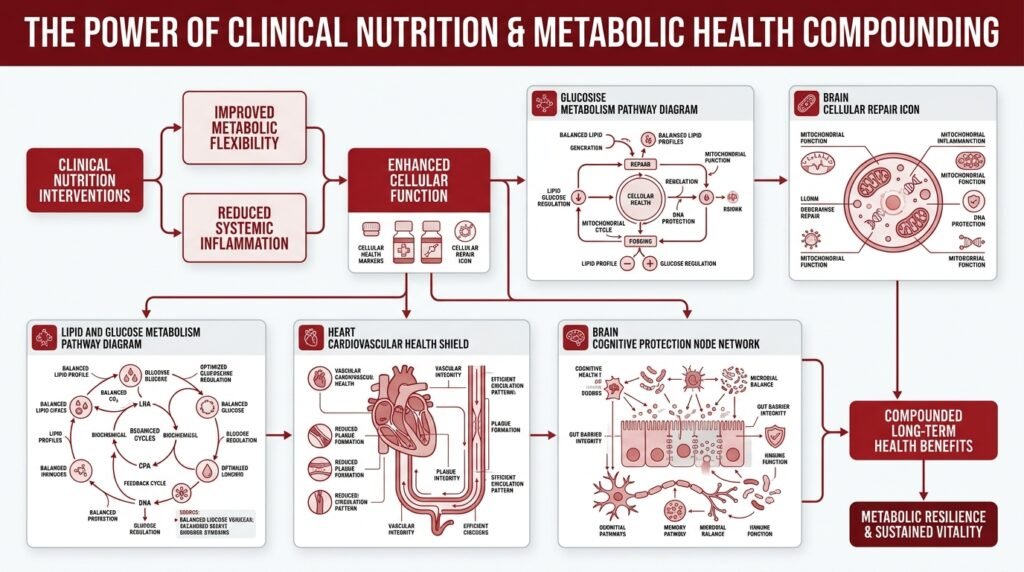

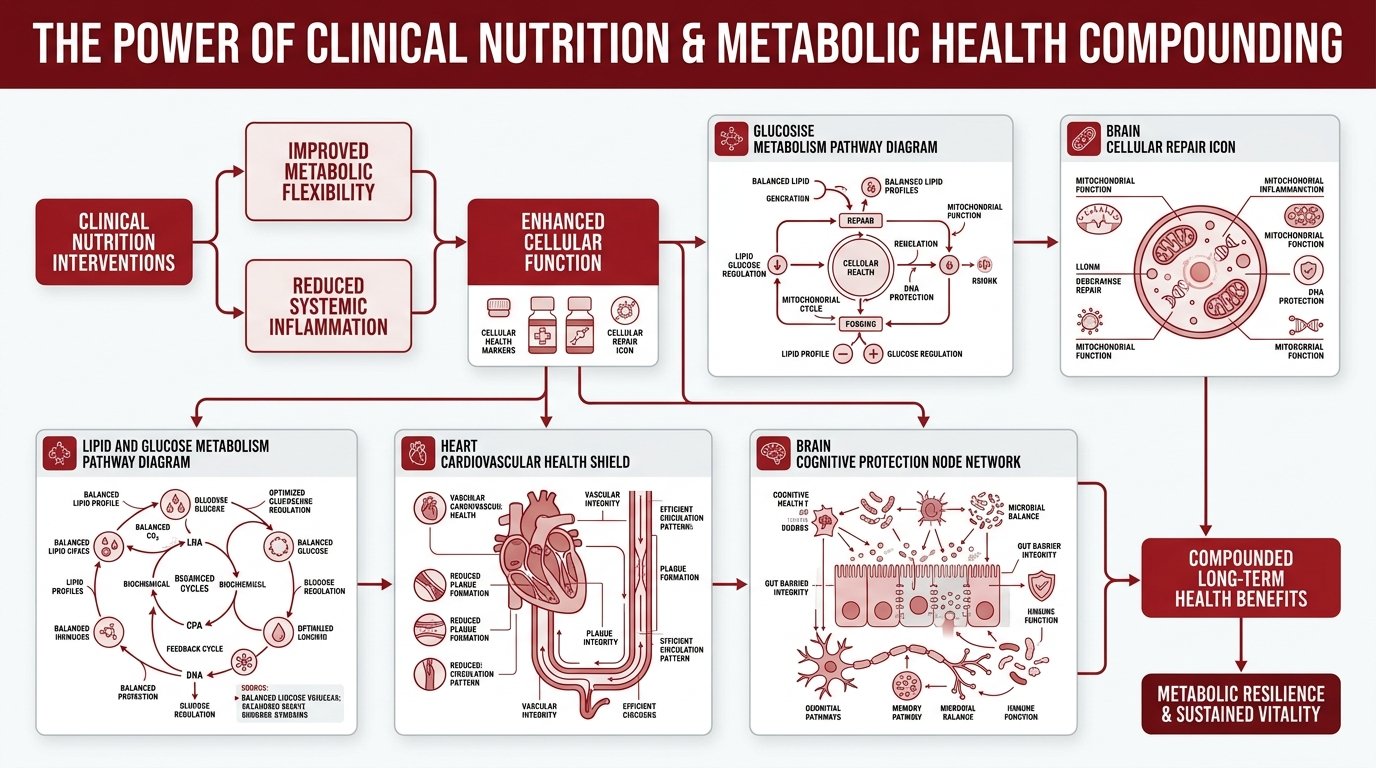
Food is much more than fuel or a way to count calories—it is daily instructions for your body’s cells. Every balanced meal quietly repairs your blood vessels, liver, muscles, and brain. For Indian readers this matters even more, because health risks like diabetes and heart disease can begin at a lower body weight. Think of good nutrition as a fixed deposit: small deposits every day, compounding into lifelong health.
What is the “Silent Power” of Good Nutrition?
The Silent Power of Good Nutrition is the way healthy food quietly repairs your body with every meal—long before the weighing scale shows it. It calms hidden inflammation (a slow, silent irritation inside blood vessels), improves insulin sensitivity (how well your cells respond to the sugar-clearing hormone insulin), and lowers your lifetime risk of heart disease, Type 2 diabetes, and fatty liver. Dr. Sumaiya’s recommendation: build every meal around vegetables, protein, and whole grains, and let the benefits compound like a fixed deposit.
What You’ll Learn in This Guide
- 1. More Than Calories: How Food Talks to Your Genes
- 2. How Good Food Helps Each Organ
- 3. Why Indians Face Higher Health Risks
- 4. Blood Tests That Prove Your Diet Is Working
- 5. The Healthy Indian Plate: A Simple Formula
- 6. When Will You See Results? A Timeline
- 7. Frequently Asked Questions
- 8. Scientific References
1. More Than Calories: How Food Talks to Your Cells & Genes
In gyms and diet advertisements, food is usually reduced to one simple equation: calories in versus calories out. Calories do matter for weight gain or loss—but this view misses something far more powerful: food is not just fuel; food is information.
Every meal sends thousands of natural plant and food compounds into your bloodstream. These compounds “talk” to your cells—they switch important chemical processes up or down, feed the trillions of friendly bacteria in your gut (your gut microbiome), and even influence which of your genes stay active or quiet. Scientists call this field nutrigenomics (the study of how food affects the behaviour of your genes). In simple words: your fork writes instructions for your body every single day.
🔋 Your Cellular Batteries Get Upgraded
Mitochondria (tiny power plants inside every cell that convert food into energy) become healthier and more efficient when you eat polyphenols (protective plant compounds found in colourful vegetables, spices, and green tea), omega-3 fats (from fish, flaxseed, and walnuts), and key vitamins and minerals like B vitamins and magnesium.
🔥 Hidden “Fire” Inside the Body Calms Down
Low-grade inflammation (a slow, invisible irritation inside blood vessels that damages them over years) is a root cause of most chronic diseases. Fibre-rich foods and micronutrients (vitamins and minerals needed in small amounts) switch off this inflammation at its source, lowering harmful signals like high-sensitivity C-reactive protein (hs-CRP, a blood marker doctors use to measure this hidden inflammation).
2. How Good Food Helps Each Organ (Your Body’s Return on Investment)
Most medicines act on one specific target. Good food works differently—it protects every organ at the same time, like a single investment paying dividends (returns) across your whole body:
❤️ A. Your Heart & Blood Vessels
The inner lining of your arteries (called the endothelium) produces nitric oxide (a natural gas molecule that keeps blood vessels relaxed and elastic). Beetroot, spinach, other leafy greens, and potassium-rich foods help your body make more of this “relaxation gas”—keeping blood pressure in check and preventing cholesterol from hardening into artery-blocking plaque (fatty deposits that narrow blood vessels). This is exactly how a heart attack or stroke silently begins, and how good food helps prevent it.
🩸 B. Your Pancreas & Blood Sugar Control
Every big sugar spike after a meal forces your pancreas (the organ that makes insulin, the hormone that clears sugar from your blood) to work overtime. Years of overwork tire these insulin-producing cells out. But when meals are built with enough fibre, slow-digesting (low-glycemic) carbohydrates, and adequate protein, blood sugar rises gently, insulin is used efficiently, and even prediabetes and early diabetes can go into remission—without starving the cells that protect you.
C. Your Liver & Gut
Too much sugar and refined flour (maida) forces your liver to convert the extra calories into fat—a process that leads to fatty liver (fat stored inside liver cells, now called MASLD/NAFLD, and increasingly common in young Indians). The fix is nutritional, not medicinal: choline (a nutrient in eggs and lentils that helps the liver export fat), fibre, and resistant starch (a type of starch that feeds good gut bacteria) let those bacteria produce healing compounds called short-chain fatty acids, which seal and strengthen the gut lining. A strong gut lining keeps harmful toxins out of your bloodstream. Read our clinical guide on optimizing gut health and digestion.
🧠 D. Your Brain & Memory
Your brain uses about 20% of all the energy you burn at rest. Unstable blood sugar and hidden inflammation can irritate brain cells, showing up as “brain fog” (poor focus and mental tiredness). Omega-3 fats (especially DHA, found in fish), lutein (a pigment in leafy greens and egg yolks), and magnesium support BDNF (a fertiliser-like protein that helps brain cells grow new connections)—protecting memory and thinking skills as you age.
💪 E. Your Muscles & Bones
Muscle is not just for movement—it is where most blood sugar is burned and stored. After age 35, adults who don’t eat enough protein lose 1–2% of their muscle every year (a condition called sarcopenia), which slows metabolism and worsens blood sugar control. Adequate protein (especially leucine, an amino acid that triggers muscle building) preserves muscle, bone strength, and independence for life.
3. Why Indians Face Higher Health Risks (The “Thin-Fat” Body Type)
Here is something every Indian reader should know: research published in The Lancet Diabetes & Endocrinology shows that South Asians develop diabetes and heart disease differently from Western populations—even at a “normal-looking” body weight. Researchers call this the “Thin-Fat” profile (a normal weight on the outside, but higher hidden fat around the organs inside, with less protective muscle).
What This Means for You in Practical Terms:
- You can be “slim” and still at risk: Indians tend to store more deep belly fat (visceral fat, the harmful fat wrapped around internal organs) even at lower body weights.
- The healthy weight targets are lower for us: For Indians, WHO and ICMR guidelines flag overweight starting at a BMI (Body Mass Index—a height-to-weight ratio) of 23 (not 25 as in the West), and obesity at BMI 25 (not 30).
- Diabetes arrives earlier: The insulin-producing cells of the pancreas tend to weaken earlier, and heart disease appears 10–15 years earlier than in Western populations.
- Our traditional plate is carb-heavy: Typical Indian meals get 65–75% of calories from refined grains like polished white rice and maida, with too little protein—perfect conditions for the problems above.
The good news? All four of these risks respond remarkably well to the right nutrition. That is why a personalized Indian diet plan is not a luxury—it is prevention.
4. Blood Tests That Prove Your Diet Is Working
You don’t have to take nutrition’s benefits on faith—your own lab reports will prove them. These five routine blood markers show measurable, compounding improvement when nutrition improves:
| Blood Test | ⚠️ Concerning Level | ✅ Healthy Target | What It Tells You |
|---|---|---|---|
| Fasting Insulin | > 10 µIU/mL | 2.0 – 6.0 µIU/mL | The earliest warning sign of insulin resistance—rises years before blood sugar does. |
| HbA1c | > 5.7% (5.7–6.4% = prediabetes; 6.5%+ = diabetes) | < 5.4% | Your average blood sugar over the past 3 months—one test, no fasting needed. |
| Triglyceride / HDL Ratio | > 3.0 | < 1.8 (Ideal < 1.5) | A powerful hint about the most dangerous type of cholesterol particles (small, dense LDL). |
| hs-CRP | > 2.0 mg/L | < 0.8 mg/L | Directly measures the hidden inflammation inside your blood vessels. |
| ALT / SGPT (Liver) | > 35 U/L (Men), > 25 U/L (Women) | 12 – 22 U/L | Rises when liver cells are irritated—often the first lab clue of fatty liver. |
5. The Healthy Indian Plate: A Simple 50-25-25 Formula
Eating better does not mean giving up dal-roti-sabzi or buying expensive imported “superfoods.” It simply means rearranging the plate you already eat. Here is the evidence-based formula we use in clinic:
The 50 : 25 : 25 Plate Formula
Half your plate: raw salads (cucumber, carrots, radish), cooked greens (palak, methi, moringa/drumstick leaves), gourds (lauki, tori, ash gourd), bhindi, beans, and cabbage.
Vegetarian: Sprouted moong/chana, fresh paneer, sattu, edamame, tofu, thick Greek-style curd, dal combinations.
Non-Veg: Whole eggs, fish, skinless chicken.
Grains with their fibre coat intact: ragi, jowar, foxtail millet, hand-pounded red or brown rice, and whole-wheat roti (add psyllium husk/isabgol or wheat bran to the dough for extra fibre).
Three Kitchen Tricks That Multiply the Benefits:
- Fix your cooking oil: Avoid ultra-processed and repeatedly heated refined seed oils. Use cold-pressed mustard oil or groundnut oil, or small amounts of pure cow ghee—keeping total added fats to roughly 15–20 ml (3–4 teaspoons) a day.
- Soak and sprout your dals: Soaking rajma, chana, and whole dals for 8–12 hours removes natural compounds (like phytic acid) that block mineral absorption—so you actually absorb more iron, zinc, and magnesium from the same food.
- Eat in the right order: Have your vegetables and protein first, and the rice or roti last. It costs nothing—yet clinical trials show this simple habit can cut the after-meal blood sugar spike by up to 35–40%.
6. When Will You See Results? The Compounding Timeline
Just like a fixed deposit, nutrition starts paying small returns immediately—and the real wealth builds over years:
Dr. Sumaiya Petiwala
Dr. Sumaiya Petiwala combines medical diagnostics with personalized clinical nutrition therapy at Dr. Sumaiya NutriCare Clinic in Bengaluru. She specializes in evidence-based management of obesity, diabetes reversal, PCOS, thyroid disorders, NAFLD, and cardiovascular risk reduction through sustainable dietary science.
Ready to Transform Your Metabolic Health?
Do not leave your future health to chance. Get a nutrition plan built around your blood reports, lifestyle, and goals—available In-Clinic in Bengaluru and through Global Online Consultations.
Direct Phone: 7208660987 | Email: doc@drsumaiya.com
7. Frequently Asked Questions
Q1: How quickly will I start feeling the benefits of better nutrition?
Faster than most people expect. Blood sugar swings and insulin spikes begin settling within 24–48 hours of better-balanced meals. Inflammation in blood vessels and blood pressure improve within 2–4 weeks. The bigger, structural wins—lower HbA1c, a clearing fatty liver, shrinking visceral fat—typically show up on lab reports within 8–12 weeks.
Q2: Can I get enough protein on a traditional Indian vegetarian diet?
Yes—with smart planning. Combining sprouted dals, roasted sattu, low-fat paneer, thick curd, edamame, and grain-plus-dal pairs (like dal-chawal or dal-roti eaten together) gives your body all the muscle-building amino acids it needs. Most patients can comfortably reach the clinical target of 1.2–1.6 g of protein per kg of ideal body weight without excess starch.
Q3: Is simply eating less enough to reverse fatty liver disease?
No. Crash dieting often fails to clear liver fat and can even speed up muscle loss. True reversal needs three things working together: removing the drivers of liver fat (sugary drinks, juices, refined flour), restoring insulin sensitivity with balanced meals, and including liver-supporting nutrients like choline (eggs, lentils) and omega-3s—so the liver can export the stored fat safely. This is best done under professional supervision.
Q4: How do I choose between in-clinic and online consultation?
Both offer the same standard of evidence-based medical nutrition therapy. Patients in Bengaluru can visit our Frazer Town clinic for in-person body composition analysis, while working professionals across India and abroad receive complete lab reviews, weekly tracking, and personalized diet protocols digitally via WhatsApp and secure tele-health. Choose whichever fits your schedule—clinical quality is identical.
8. Scientific References & Clinical Guidelines
- ICMR-National Institute of Nutrition (NIN) (2024): Dietary Guidelines for Indians. Hyderabad, India.
- American Diabetes Association (ADA) (2024): Standards of Care in Diabetes—Comprehensive Medical Nutrition Therapy. Diabetes Care, 47(Suppl. 1): S77–S110.
- Misra, A., et al. (2021): Consensus statement for diagnosis of obesity, abdominal obesity and the metabolic syndrome for Asian Indians. Journal of the Association of Physicians of India, 57: 163–170.
- World Health Organization (WHO) (2023): Global report on hypertension: The race against a silent killer. Geneva: World Health Organization.
- Rinella, M. E., et al. (2023): A multi-society Delphi consensus on new fatty liver disease nomenclature. Hepatology, 79(6): 1542–1556.
Looking for a Personalized Clinical Nutrition Protocol?
Managing your health requires addressing your unique metabolic biomarkers, digestive transit, and root causes. Dr. Sumaiya provides individualized medical nutrition therapy tailored to your lifestyle.
- Comprehensive Blood & Biomarker Audit (HbA1c, Fasting Insulin, Lipid Ratios, Thyroid/Liver)
- Root-Cause Metabolic Mapping & Dietary Assessment
- 100% Customized Indian Meal Protocol with Continuous Weekly Monitoring
In-Clinic at Frazer Town, Bengaluru & Telehealth Pan-India / Globally | Call/WhatsApp: +91 7208660987