

The markers your dietitian will be watching appear throughout this guide, so let me define them. HbA1c (your average blood sugar over roughly three months) tracks the last three months. Fasting insulin (your insulin level after an overnight fast) shows how your body handled yesterday, and insulin resistance (when your cells stop responding properly to insulin) is what makes it run high. Visceral fat (fat stored deep around your organs) and a fatty liver (extra fat stored in the liver) both shrink when those numbers improve. Your thyroid (the neck gland that sets your metabolism) determines how fast you recover from a disrupted week.
🩺 Quick Clinical Verdict: Does One Festive Meal Ruin Weeks of Progress?
No. Gaining a single kilogram of real body fat needs about 7,700 calories of surplus, which one meal cannot deliver. A 1 to 2 kg jump is glycogen and the water it holds, which clears in 48 to 72 hours. Never fast or over-exercise to compensate. Return to your usual plate at the very next meal.
You signed up. You started tracking. You began moving more. And then a wedding, a deadline, a fever, or a family visit arrived and knocked the routine sideways. Now a quiet voice says you have ruined everything, and you will restart properly when life calms down. If that sounds familiar, read the rest of this before you decide.
Here is the honest clinical reality. Life is never normal for long. There is always another celebration, another busy season, another tired week. Missing your routine during those moments is not failure. It is a speed breaker, and there is a well-proven way to cross one.
Table of Contents
- Two Ways to Handle a Disruption
- The 4 Rules for Crossing Speed Breakers
- Why One Disruption Cannot Ruin You
- What To Do in Real Situations
- Do Not Make It a U-Turn
- Frequently Asked Questions
Two Ways to Handle a Disruption
| How you respond | The all-or-nothing trap | The speed-breaker approach |
|---|---|---|
| Reaction to the meal | Guilt, and belief the whole week is lost | Enjoy it mindfully, treat it as a bump |
| The next day | Skipping meals or punishing cardio | Back to normal meals, no penance |
| When the scale jumps | Panic, assuming it is all fat | Recognise water, and wait 48 to 72 hours |
| Effect on hormones | Chronic stress hormone rise, binges follow | Steady hormones and preserved flexibility |
| Outcome at two months | Yo-yo cycling and giving up | Habits that actually hold |
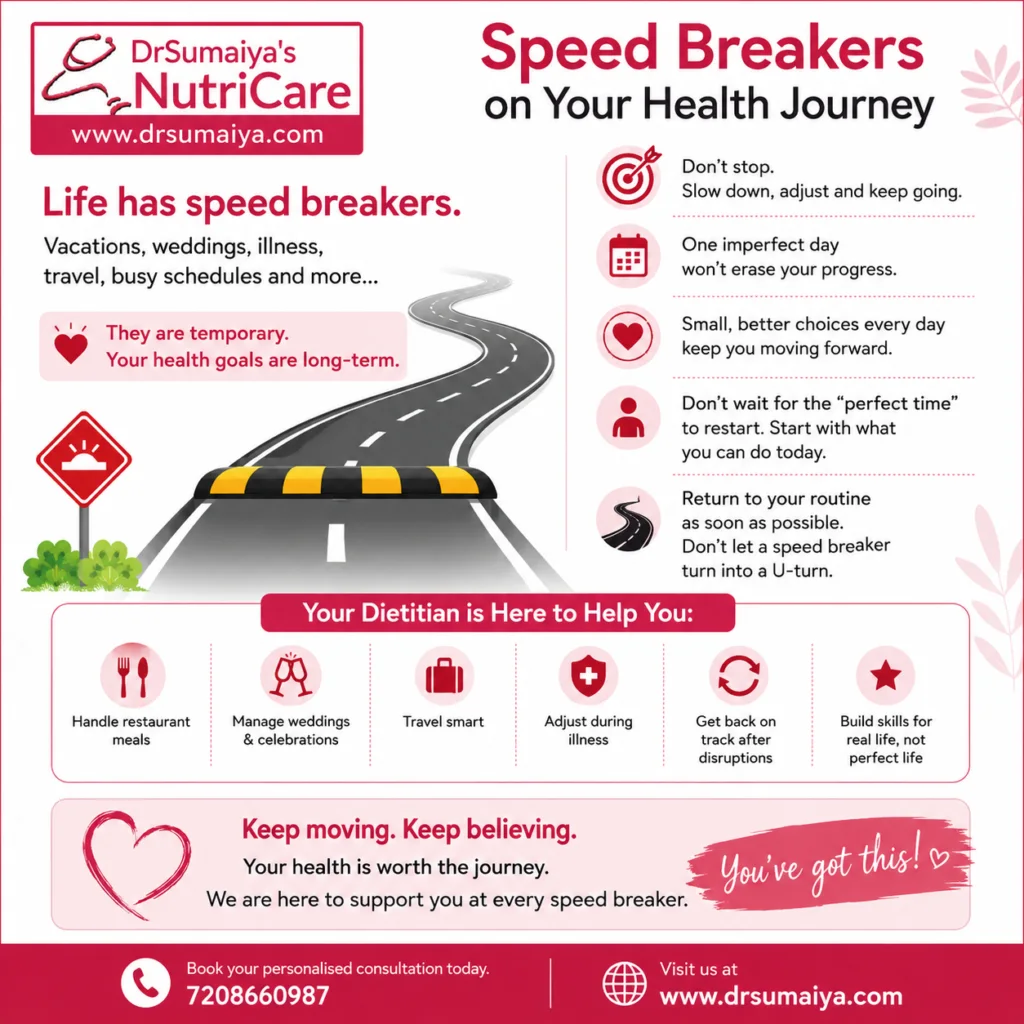
The 4 Rules for Crossing Speed Breakers
- Slow down, do not stop. When life gets busy, cut back to your basic anchors rather than abandoning everything. Progress looks different during a hard week, but it does not vanish.
- No next-day penance. Never starve yourself or skip meals to compensate. Punishment raises stress hormones and guarantees rebound cravings.
- Avoid the Monday trap. Do not wait for a clean calendar date. Make the best available choice at your very next plate.
- Think in years. Your heart, liver, and metabolic health are decided by your twelve-month trend, never by one weekend.
When you hit a speed breaker in a car, you do not abandon the vehicle on the roadside. You lift off the accelerator, cross slowly, and speed back up. Your health journey works the same way.
Why One Disruption Cannot Ruin You
In clinic, I meet patients in real distress after a single feast, convinced they gained kilos of fat overnight. Here is what the arithmetic actually says.
The Scale Is Showing Water, Not Fat
To store one kilogram of real fat, you need to eat roughly 7,700 calories more than you burn. No single festive dinner comes close to that. What the scale shows instead is glycogen with its water: every gram of carbohydrate stored holds about 3 to 4 grams of water, and a high-sodium meal adds more fluid on top. Return to normal eating and hydration and it clears within 48 to 72 hours.
The Real Danger Is the Mindset
The threat was never the meal. It is the story you tell yourself afterwards. If you conclude that you have ruined everything, you give yourself permission to abandon the rest of the week. Worse, extreme restriction the next day lifts your stress hormones sharply, which suppresses your fullness signals and slows thyroid activity. That is what sets up the evening binge.
Explore Related Clinical Guides
- Personalized Wellness: Your Path to Better Health — what a genuinely individual programme looks like.
- How to Choose Quality Clinical Care — what to look for in a registered dietitian.
- Weight Loss Myths Busted — the beliefs that quietly undermine your plan.
- Frequently Asked Questions to Dr. Sumaiya — process, biomarkers, and what to expect.
Struggling With Burnout or Rebound Guilt?
Rigid diets break at the first sign of real life. At Dr. Sumaiya NutriCare Clinic we build metabolic resilience, teaching the practical nutrition skills that survive weddings, travel, and busy seasons.
- Comprehensive Biomarker Audit (fasting insulin, HbA1c, lipid subfractions, liver enzymes and visceral fat)
- Metabolic Flexibility Calibration so your cells can switch easily between burning carbs and fat
- Real-Life Indian Kitchen Blueprint built for weddings, family dinners and daily life
In-Clinic at Frazer Town, Bengaluru & Telehealth Pan-India / Globally | Call/WhatsApp: +91 7208660987
What To Do in Real Situations
The useful question is never when will I restart. It is: what is the single kindest thing I can do right now, given where I actually am?
- Travelling. Choose grilled paneer or dal over fried snacks, drink two extra glasses of water, and walk through the terminal instead of sitting at the gate.
- At a wedding. Start with protein-rich starters such as tandoori chicken, paneer tikka, or sprout salad, then take modest portions of sweets and savour every bite without guilt.
- During a heavy work phase. You may not have 45 minutes for a workout, but three ten-minute walks keep your insulin receptors active.
- During illness. Rest, hydrate, and eat warm broths. Come back to your routine gently once your energy returns. Immunity is the priority.
A good dietitian is not building a sterile plan that only works in a laboratory. They are teaching you metabolic flexibility, which is your cells’ healthy ability to switch between burning carbohydrate and burning stored fat. That skill is what survives a bad week.
Do Not Make It a U-Turn
A temporary disruption should never make you abandon a permanent goal. So do not starve the day after a party. Do not spend hours on punishing cardio to cancel out a meal. Do not skip meals or drink only juices to “reset.” And do not label yourself as someone who lacks discipline.
Instead, sit down at your next meal and eat a balanced, colourful plate of Indian whole foods. The faster you return to your routine, the smaller the detour becomes. Your blood vessels and liver cells do not judge you over one Saturday evening. They respond to the pattern of your choices over months and years.
Frequently Asked Questions
References
- Hall KD, et al. Energy balance and its components: implications for weight maintenance. American Journal of Clinical Nutrition. 2011;94(6):1501-8.
- Sayer EA, et al. Effects of physical and psychological interventions on weight loss maintenance. Nutrition Reviews. 2015;73(2):100-10.
- World Health Organization. Guidelines on Physical Activity and Sedentary Behaviour. Geneva: WHO; 2020.
- American Psychological Association. Managing Stress Healthily.
- Indian Council of Medical Research. Recommended Dietary Allowances for Indians. National Institute of Nutrition, Hyderabad.