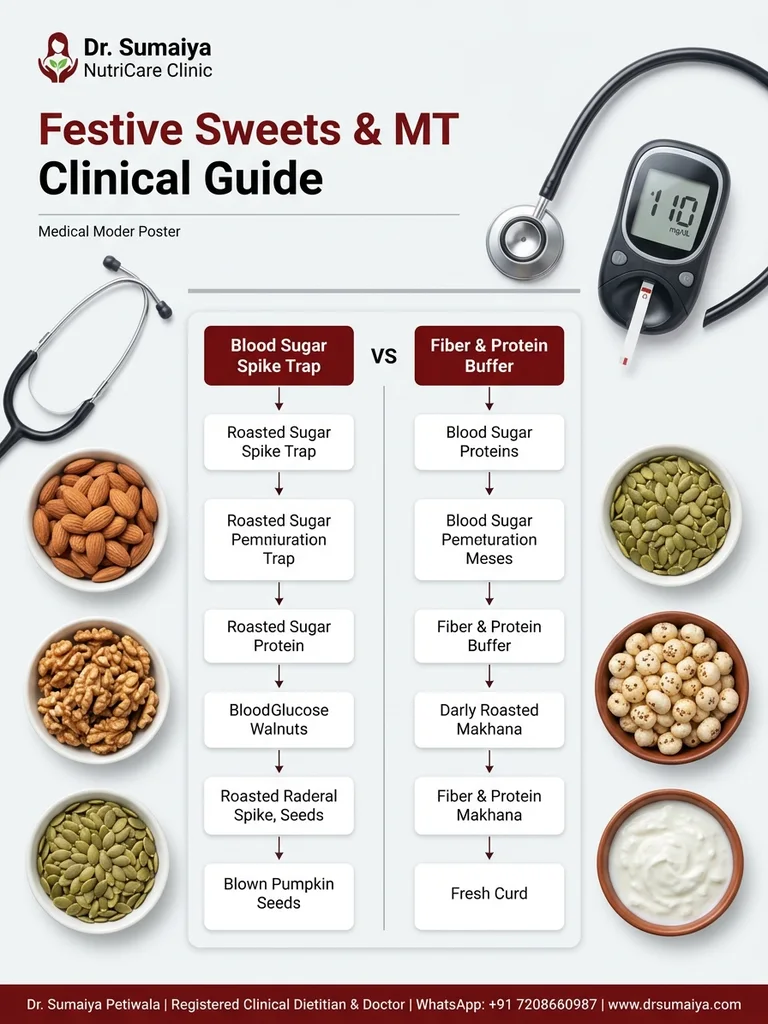
Festive Sweets 3-Step Metabolic Shield Clinical Guide Infographic - Dr. Sumaiya NutriCare

How to Avoid Sweets in Festive Season: A Doctor’s Guide

🩺 Medically Verified & Evidence-Based | Authored by Dr. Sumaiya Petiwala, RD, BUMS, CDE (Registered Clinical Dietitian & Certified Diabetes Educator). Clinical Focus: Metabolic Medicine & Preventive Health. Updated: September 2026.

Festive celebrations in India are expressions of joy, gratitude, and community bonding. And at the beating heart of every Indian celebration sits a box of handcrafted mithai.

Yet for millions of Indian adults living with Type 2 Diabetes, Prediabetes, Insulin Resistance, Fatty Liver Disease (NAFLD/MASLD), Polycystic Ovary Syndrome (PCOS), or visceral weight struggles, the arrival of the festive calendar triggers acute psychological anxiety.

You are torn between two punishing extremes: absolute social isolation by attempting to “resist everything,” or succumbing to an uncontrolled sugar binge followed by days of self-reproach, punishing liquid detoxes, and skipped meals.

As a clinical doctor and registered dietitian specializing in South Asian metabolic disorders, my clinical advice is unequivocal: Willpower is a fragile psychological defense against evolutionary biology. You do not need to live like an ascetic, nor should you sacrifice your hard-earned metabolic health. What you need is an evidence-based clinical strategy—rooted in nutrient biochemistry, glycemic pacing, and practical Indian kitchen swaps.

The Festive Sugar Spike: What Happens Inside Your Cells?

To master your festive nutrition, you must first understand the unique pathophysiology of commercial Indian sweets. Traditional festive delicacies are not merely “sweet foods”—they represent a concentrated metabolic cocktail composed of high-fructose sucrose (refined table sugar), refined wheat flour (maida), and oxidized saturated or hydrogenated vegetable fats (vanaspati or degraded cooking oils).

When you consume this triad on an empty stomach or at the conclusion of an already carbohydrate-heavy feast, four distinct biochemical events occur simultaneously:

  1. Hepatic Overload & Rapid Fat Storage: Commercial sugar contains 50% glucose and 50% fructose. While glucose can be utilized by every cell in your body, fructose is metabolized almost exclusively by the liver. A sudden flood of festive sweets rapidly saturates hepatic glycogen reserves, shunting the excess fructose directly into De Novo Lipogenesis (the liver’s biochemical process of turning excess dietary sugar into newly formed fat). This rapidly drives acute Hepatic Steatosis (fat accumulation inside liver cells) and produces an immediate spike in blood triglycerides and ApoB or Apolipoprotein B (a critical particle carrying plaque-forming bad cholesterol through your blood vessels).
  2. Postprandial Glucose Surge & Insulin Lockdown: Without protective fiber or intact cellular matrices to slow digestion, refined sugar and maida enter systemic circulation within 15 to 25 minutes. This creates massive Postprandial Glucose Spikes (blood sugar surges right after meals), frequently exceeding 200 to 240 mg/dL in prediabetic individuals. In response, your pancreas dumps emergency quantities of insulin, inducing severe Hyperinsulinemia (high insulin levels constantly circulating in the blood). Crucially, high circulating insulin completely deactivates lipolysis—physiologically locking your adipose tissue and preventing fat breakdown for up to 12 hours.
  3. The Reactive Hypoglycemia & Dopamine Trap: Because the insulin surge is so aggressive, blood sugar does not simply glide down—it plummets beneath baseline within 90 to 180 minutes. This triggers Reactive Hypoglycemia (a sharp, sudden blood sugar crash occurring a few hours after eating high-glycemic foods). Your brain interprets this steep drop as an existential energy crisis, releasing adrenaline and cortisol. The clinical result? Sudden fatigue, brain fog, anxiety, and an uncontrollable biological craving to seek out yet another sweet item.
  4. Cellular Inflammation & Glycation: Elevated spikes of circulating glucose interact with vascular proteins and enzymes, generating Advanced Glycation End-products or AGEs (toxic inflammatory compounds formed when excess blood sugar irreversibly binds to proteins and fats). This causes transient endothelial irritation, water retention, and systemic low-grade inflammation.

Nutritional Breakdown: Indian Festive Sweets Comparison Matrix

Not all Indian sweets impact your metabolic machinery in the same manner. Understanding their composition empowers you to make informed, damage-limiting choices during family visits and gatherings.

Mithai Item (Serving)Core IngredientsCalories & Est. GIMetabolic & Glycemic ImpactClinical Verdict & Strategy
Gulab Jamun
(2 pieces, ~90g)
Mawa (condensed milk solids), refined flour (maida), fried in oil/ghee, soaked in 65% sugar syrup.~320 kcal
GI: 75–80 (High)
GL: ~24 (High)
Extreme glucose surge; high refined sugar and oxidized trans-fat load; rapid liver de novo lipogenesis. Red Tier (Avoid / Limit): Squeeze out excess syrup completely if consuming; limit strictly to a single piece at the end of a fiber meal.
Jalebi / Imarti
(100g serving)
Fermented maida batter, deep-fried in commercial vanaspati/oil, dipped in boiling sugar syrup.~380–420 kcal
GI: 82–85 (Very High)
GL: ~28 (Very High)
Immediate spike in blood glucose; severe reactive hypoglycemia within 90 minutes; highest AGE formation. Red Tier (Avoid): Maximum glycemic disruption with zero protein or fiber matrix. Skip entirely if diabetic.
Kaju Katli
(2 pieces, ~40g)
Cashew nut paste (ground cashews), sugar syrup, trace silver leaf (vark).~180 kcal
GI: 52–56 (Moderate)
GL: ~12 (Moderate)
Moderate glycemic impact. Natural cashew monounsaturated fatty acids and plant protein blunt the glucose peak. Amber Tier (Acceptable): Superior to syrup sweets. Practice mindful 1-piece portioning after protein meals.
Besan Laddoo
(1 piece, ~45g)
Roasted chickpea/gram flour (besan), traditional cow ghee, bura/sugar, cardamom.~210 kcal
GI: 48–53 (Low-Mod)
GL: ~11 (Moderate)
Legume fiber and protein from besan combined with cow ghee fatty acids substantially slow gastric emptying. Green-Amber Tier: Excellent festive choice if prepared at home with pure cow ghee and reduced unrefined sweetener.
Rasgulla / Sandesh
(2 pieces, ~90g)
Fresh cow milk chenna (curd/paneer), light sugar syrup or saffron (Sandesh is baked/steamed).~150–170 kcal
GI: 58–62 (Moderate)
GL: ~9 (Low if squeezed)
Chenna provides complete dairy protein (casein and whey). High satiety factor; minimal saturated fat. Green Tier (Best Clinical Option): Firmly press and squeeze out the sugar syrup between two spoons. Excellent protein delivery.
Roasted Nut & Seed Chikki
(30g square)
Almonds, walnuts, roasted sesame (til), pumpkin seeds, bound with minimal jaggery.~140 kcal
GI: 40–45 (Low)
GL: ~5 (Very Low)
Rich in zinc, magnesium, alpha-linolenic acid (ALA), and insoluble fiber; minimal postprandial glycemic excursion. Green Tier (Gold Standard Swap): Nutritious festive gift and host swap that stabilizes insulin sensitivity.
Festive Sweets 3-Step Metabolic Shield Clinical Guide Infographic - Dr. Sumaiya NutriCare

📊 Visual Summary: The 3-Step Metabolic Shield for Indian Festive Sweets — Dr. Sumaiya NutriCare Clinic.

The 5-Pillar Clinical Blueprint: How to Avoid Sweet Overload Without Deprivation

Managing festive treats is not a test of moral fortitude; it is a physiological chess match. When you deploy the correct biological buffers, you can participate in festivities with family and colleagues while safeguarding your glycemic curve and liver health.

Pillar 1: Deploy the “Fiber & Protein Shield” (Nutrient Preloading)

The single most catastrophic mistake patients make is attending a festive gathering or wedding on an empty stomach. When your gastric chamber is empty, liquid sugars and refined flour empty into the duodenum within minutes, maximizing alpha-glucosidase activity and triggering sharp glucose peaks.

The Clinical Protocol: Exactly 15 to 30 minutes before leaving home or sitting down for festive sweets, consume a targeted “metabolic shield”:

  • Option A: 1 small bowl of fresh homemade curd or Greek yogurt mixed with 1 tablespoon of chia seeds or freshly ground flaxseeds.
  • Option B: A small bowl of sprouted green moong or boiled kala chana chaat dressed with lemon juice, cucumber, and roasted cumin.
  • Option C: 12–15 whole raw almonds and walnuts alongside 1 hard-boiled egg or 40g of lightly grilled paneer cubes.

The Biochemical Mechanism: Soluble viscous fiber binds with water to create a semi-permeable gel mesh along the intestinal lining. This slows Gastric Emptying (the rate at which food moves from the stomach into the small intestine) and delays carbohydrate absorption. Concurrently, amino acids and healthy lipids stimulate the secretion of Satiety Hormones (gut hormones like GLP-1 and Peptide YY that signal to your brain that you are full). Clinical data shows this simple meal sequence blunts post-meal glucose excursions by 30% to 45%.

Pillar 2: Master the “Rule of One” & Neuro-Sensory Savoring

Neurobiological research reveals a fascinating truth about hedonic feeding: your tastebuds and brain experience 85% to 90% of the total dopamine reward during the first two mindful bites of any dessert. By the fourth or fifth bite, sensory adaptation sets in; you are no longer tasting the sweet with heightened pleasure—you are merely eating on biological autopilot.

The Clinical Protocol: Never graze mindlessly from sweet boxes left open on office desks or living room tables. Instead, practice conscious selection:

  • Survey the entire spread and pick your single favorite artisanal sweet of the day.
  • Place it on a separate small quarter plate—never eat directly from a box.
  • Sit down, turn away from digital screens, and eat it slowly over 5 full minutes, savoring the aroma, saffron, and texture.
  • Once consumed, rinse your mouth with warm water or green tea to immediately clear residual sugar and break the sensory feedback loop.

Pillar 3: The 15-Minute Post-Meal Muscle Sponge (Shatapadi)

In classical Indian lifestyle medicine, the ancient practice of Shatapadi refers to taking 100 gentle steps following a meal. Modern exercise physiology has validated this timeless wisdom with extraordinary biochemical clarity.

When you remain seated or recline on a sofa after eating sweets, glucose accumulates in your bloodstream, requiring massive pancreatic insulin secretion. However, when your large leg muscles—particularly the soleus and quadriceps—contract during light walking, they trigger the translocation of GLUT4 Transporters (special cellular gates that pull glucose from your bloodstream directly into muscle cells without requiring insulin).

The Clinical Protocol: Within 20 minutes of finishing a meal that included a festive treat, take a comfortable, non-strenuous 10 to 15-minute walk. Do not engage in high-intensity running or heavy workouts immediately after meals (which causes gastrointestinal distress); a relaxed, continuous stroll is sufficient to clear up to 25% of circulating postprandial glucose directly into muscle glycogen stores.

Pillar 4: Navigating Social Pressure & Family Elders with Grace

In Indian households, offering food is an expression of deep affection and hospitality. Refusing a sweet offered by a relative or elder is frequently misinterpreted as rejection. To maintain your health without causing social offense, rely on assertive, respectful communication strategies:

  • The Medical Anchor Script: “Aunty / Uncle, my doctor is currently monitoring my recent blood reports and liver markers very closely on strict instructions. The sweet looks magnificent—let me take just a tiny celebratory bite so I can honor your hospitality!” Framing your boundary around clinical lab guidance instantly defuses personal offense.
  • The Take-Home Technique: “This looks so special and fresh, I really want to enjoy it properly after my dinner tonight rather than rushing it right now. May I wrap it to take home?” Once home, you can control the timing, portion size, or share it with family members.
  • Gift Health Forward: When visiting relatives or friends, break the cycle of gifting commercial sugar boxes. Gift boxes of premium roasted California almonds, walnuts, roasted spiced makhana (fox nuts), organic herbal teas, or cold-pressed oils.

Pillar 5: Next-Day Metabolic Recovery (Strictly No Crash Detoxes)

If you did overindulge in sweets at a late-night festival dinner, the single worst decision you can make the next morning is punishing yourself with extreme measures: fasting for 24 hours, drinking raw commercial “detox” green juices, or engaging in grueling 2-hour gym cardio sessions.

Why Post-Binge Starvation Fails: Severe calorie deprivation after a sugar binge sends cortisol levels soaring, triggers muscle protein breakdown, and causes a flood of free fatty acids into an already stressed liver. Inevitably, by 4:00 PM the next afternoon, severe neuro-glucopenia hits, resulting in an even more violent rebound binge.

Dr. Sumaiya’s Evidence-Based Recovery Protocol:

  1. Morning Cellular Rehydration: Drink 500 mL of warm water infused with a squeeze of fresh lemon, crushed mint leaves, and half a teaspoon of soaked fenugreek seeds (methi dana). Fenugreek contains 4-hydroxyisoleucine, an amino acid that upregulates insulin sensitivity naturally.
  2. A Dense, Savory Protein Breakfast: Never skip breakfast. Opt for 2 whole-egg vegetable omelets cooked with a touch of cold-pressed oil, or 2 savory moong dal chillas stuffed with grated paneer and spinach. Protein stabilizes morning glucagon and halts cravings.
  3. Adequate Potassium & Magnesium Intake: Excess sodium and sugar cause temporary cellular fluid retention. Consume potassium-rich Indian foods—such as tender coconut water, steamed spinach sabzi, and unsalted pumpkin seeds—to restore fluid equilibrium naturally.

🩺 Personalized Metabolic Care: Dr. Sumaiya NutriCare Protocol

Are you worried that this festive season will derail your HbA1c, spike your fasting insulin, or aggravate your fatty liver? At Dr. Sumaiya NutriCare Clinic, we replace restrictive food anxiety with precision clinical nutrition through our proven 3-Step Medical Correction Process:

  1. Comprehensive Biomarker Analysis: We analyze your complete diagnostic panel—including Fasting Insulin, HbA1c, Liver Function Tests (SGPT/SGOT), Lipid Subfractions, and Ultrasound reports.
  2. Root-Cause Metabolic Mapping: We identify your specific insulin sensitivity threshold, hormonal imbalances, and cellular bottlenecks to determine your exact carbohydrate tolerance.
  3. Tailored Indian Nutritional Prescription: You receive a sustainable, 100% home-cooked meal plan tailored to traditional Indian kitchen staples, festival social pacing, and weekly clinical monitoring—strictly without starvation or commercial meal shakes.
💬 Consult Dr. Sumaiya on WhatsApp: +91 7208660987

📍 In-Clinic Consultations at Frazer Town, Bengaluru & Telehealth Pan-India / Globally

Frequently Asked Questions (FAQs)

Can people with diabetes eat any Indian festive sweets at all?

Yes, individuals with well-managed diabetes can consume sweets judiciously, provided they avoid eating them on an empty stomach or as a standalone snack. The key is choosing sweets rich in dairy protein or healthy fats (such as chenna-based Rasgulla with the sugar syrup firmly squeezed out, or homemade besan and nut laddoos) and consuming them immediately following a meal high in soluble fiber and protein. Always test your 2-hour postprandial blood glucose to understand your individual glycemic response.

Is jaggery (gur) or raw honey truly healthier than refined white sugar for blood sugar?

From a metabolic and glycemic standpoint, no. While traditional jaggery and raw honey contain trace minerals like iron, potassium, and antioxidants, their carbohydrate composition consists of 70% to 85% sucrose, glucose, and fructose. Once digested, jaggery has a Glycemic Index of approximately 80 to 84—virtually identical to refined white table sugar. For individuals with diabetes, insulin resistance, or fatty liver, excessive jaggery triggers the exact same insulin spike and hepatic de novo lipogenesis as white sugar.

Are commercial “sugar-free” or diabetic mithais completely safe?

Not necessarily. While commercial “sugar-free” sweets replace sucrose with artificial sweeteners or polyols (sugar alcohols like maltitol or sorbitol), the base of the sweet is still frequently made with refined maida, condensed milk solids, and commercial hydrogenated fats. Consuming large quantities of maltitol can also trigger severe gastrointestinal distress, bloating, and osmotic diarrhea. Homemade treats sweetened with moderate amounts of pure stevia or monk fruit are a significantly safer choice.

What should I do if I end up eating too many sweets during an evening celebration?

Do not panic, and strictly avoid punishing yourself with next-day starvation or extreme detoxes. Instead, take a 15-minute gentle stroll before going to bed, drink plenty of water to assist your kidneys in clearing excess glucose, and wake up to a hearty, savory protein-and-fiber breakfast (such as vegetable paneer moong dal chilla or boiled eggs with sauteed greens). Re-establishing your balanced meal routine immediately at the very next meal is the fastest way to reset your insulin sensitivity.

Why do I crave even more sweets 2 hours after having a festival treat?

This is caused by reactive hypoglycemia. When high-glycemic sweets are consumed without fiber or protein, they produce a steep blood sugar spike, prompting the pancreas to oversecrete insulin. This massive surge clears glucose out of the blood too rapidly, causing circulating sugar levels to crash below baseline within 90 to 120 minutes. Your brain interprets this rapid drop as an energy emergency and triggers intense hunger and sugar cravings.

Medically Reviewed by Dr. Sumaiya

RD, CDE, General Physician (BUMS)

With over 18 years of experience and 80,000+ successful health transformations, Dr. Sumaiya combines medical expertise with nutritional science. As both a Registered Dietitian and qualified physician, she specializes in holistic health management through integrated medical nutrition therapy.

Learn More About Dr. Sumaiya