
Five food-science words appear below, so let me define them once. An antioxidant (a compound that protects your cells from damage) is what vitamins C and E act as. Polyphenols (protective plant compounds with antioxidant roles) are what berries and greens carry. Blanching (a quick steam or hot-water dip before freezing) is the step that locks vegetables in. A prebiotic (fiber that feeds your good gut bacteria) is what peas and beans supply. Ultra-processed (industrially made products with long ingredient lists) is what frozen pizzas are, and plain frozen peas are not.
🩺 Quick Clinical Answer: Is Fresh Always More Nutritious Than Frozen?
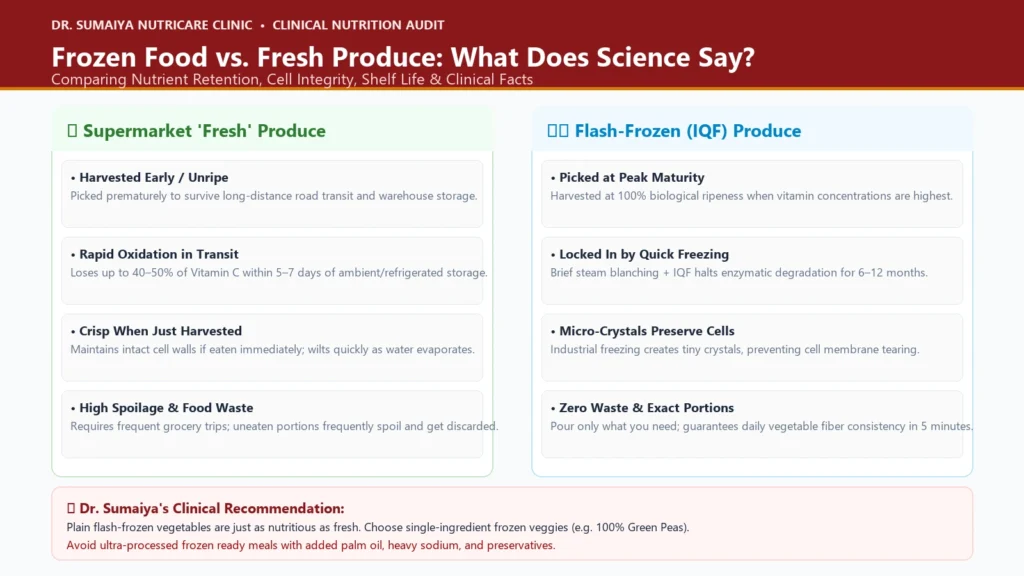
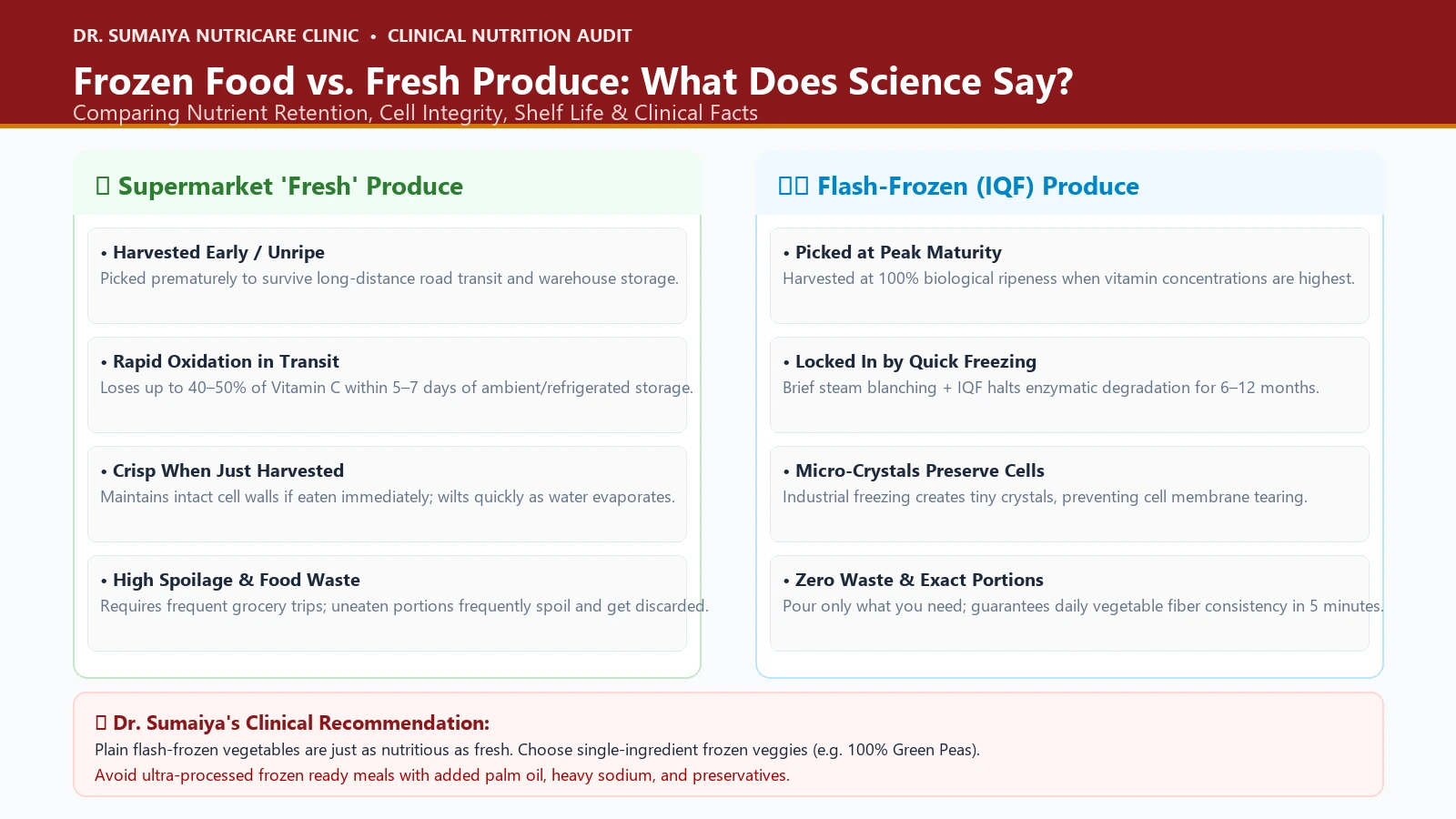
No. Flash-frozen vegetables are picked ripe and frozen within hours, so they hold their vitamins well. Supermarket fresh often travels for five to fourteen days first, losing vitamin C along the way. Buy fresh for the next two or three days, and keep plain frozen peas, corn, and spinach as everyday staples.
What This Guide Covers
- Why fresh is not a simple word
- The head-to-head comparison
- The freezing science in brief
- Frozen versus ultra-processed
- Four buying and cooking rules
- The consistency win for diabetes and liver health
- A seven-day starter plan
- Frequently asked questions
- References
Why Fresh Is Not a Simple Word
We treat fresh as a single idea, but the word hides three questions. When was it picked? How long did it travel? How has it been stored since? A spinach leaf picked unripe, trucked for a week, and displayed for five more days has very different nutrition from one picked yesterday at a farm near your city.
Vitamin C is the sensitive one. It is water-soluble, heat-sensitive, and it fades with every hour of storage. Frozen peas picked at peak ripeness and processed the same day often carry more vitamin C after three months in your freezer than fresh peas carry after a week in your fridge. Studies comparing the two side by side have repeatedly found the gap is small, and sometimes it favours frozen.
The Head-to-Head Comparison
| Factor | Supermarket fresh | Flash-frozen plain vegetables |
|---|---|---|
| Harvest timing | Often picked unripe to survive transit | Picked at peak ripeness, frozen within hours |
| Vitamin C and B vitamins | Fades during transport and display | Small blanching loss, then stable for months |
| Fibre and minerals | Fully intact | Fully intact; freezing does not touch them |
| Shelf life and waste | Three to seven days; wilting is common | Six to twelve months; portion exactly what you need |
| Additives | None | None in plain packs; sauces and ready meals differ |
| Cost per serving | Higher out of season | Stable all year; less spoilage waste |
The Freezing Science in Brief
Speed decides quality. In a slow home freezer, water inside plant cells forms large, jagged ice crystals that tear cell walls, which is why thawed vegetables turn mushy. Industrial flash-freezing runs at around minus thirty to forty degrees, forming microscopic crystals that leave the cell structure intact.
Before freezing, vegetables are blanched. The brief heat costs some vitamin C, around ten to twenty percent, but it deactivates the enzymes that would otherwise cause browning, off-flavours, and steady vitamin loss through months of storage. That trade is what makes the freezer a preservation device rather than a slow degradation chamber.
Frozen Versus Ultra-Processed: The Real Line
The freezer is not what makes a food healthy or unhealthy. The ingredient list is. Plain frozen peas read one word: peas. That is a whole food, and it belongs on your plate. Frozen pizzas, fried snacks, and cheese-laden pasta boxes sit in the same aisle but belong to a different category entirely, with refined flour, excess salt, and long ingredient lists.
My rule for patients is the single-ingredient rule: the label should name only the vegetable. If the pack carries a sauce, a seasoning, or a flavouring list, it is a different purchase with a different place in your week.
Four Buying and Cooking Rules
- Feel the bag. If the vegetables form a solid brick, the packet thawed and refroze somewhere on its journey. Texture and nutrients both suffer. Loose pieces mean a clean cold chain.
- Steam, never boil. Boiling leaches water-soluble vitamins into the water you pour away. Steam, microwave with minimal water, or sauté straight from frozen.
- Seal against freezer burn. Take what you need and clip the bag shut. Exposed surface dries out and oxidises.
- Cook from frozen. No thawing needed for most vegetables; it preserves texture and saves time.
The Consistency Win for Diabetes and Liver Health
The hardest part of any therapeutic diet is not knowledge. It is repetition on a busy Tuesday. Fresh vegetables spoil exactly when work gets heavy, and the plan collapses. A freezer stocked with peas, corn, chopped spinach, and mixed beans removes that failure mode: a fibre-rich vegetable portion is five minutes away, every day, all year.
For blood sugar control, that vegetable portion before roti or rice matters as much as what the vegetable is. For fatty liver (fat buildup inside the liver, common with weight gain), the daily fibre load does quiet, cumulative work. In both cases, the vegetable you actually eat beats the superior vegetable still sitting in the fridge, or worse, in the bin. My guide to meal sequencing for better blood sugar control covers the order side of that habit.
One caution belongs here: frozen vegetables are staples, not the whole diet. Seasonal fresh produce carries flavour, variety, and textures that a freezer bag cannot. The winning kitchen uses both, deliberately.
A Seven-Day Starter Plan
- Day 1: audit your freezer. Note what is plain vegetable and what is ultra-processed.
- Day 2: buy three staples: green peas, chopped spinach, mixed beans. Check the label reads single ingredient.
- Day 3: feel each bag. Return any solid bricks at the next trip.
- Day 4: cook spinach from frozen by steaming, not boiling. Note the texture difference.
- Day 5: build one dinner entirely from freezer plus pantry in under fifteen minutes.
- Day 6: track what fresh produce you threw away this week. Compare with the freezer waste, which should be zero.
- Day 7: settle your split: fresh for the next three days, frozen for the busy nights.
Struggling to Eat Vegetables Consistently?
Consistency, not information, is where metabolic health is won. At Dr. Sumaiya NutriCare Clinic we build plans around your actual kitchen and schedule, fresh and frozen together, so your targets survive busy weeks.
- Comprehensive Blood & Biomarker Audit (blood sugar, liver panel, iron studies)
- Root-Cause Assessment with Diet Recall and Kitchen-Reality Audit
- 100% Customised Indian Meal Protocol with Continuous Weekly Monitoring
In-Clinic at Frazer Town, Bengaluru & Telehealth Pan-India / Globally | Call/WhatsApp: +91 7208660987
Frequently Asked Questions
References
- Bouzari A, Luo D, Barrett DM. Vitamin retention in eight fruits and vegetables: a comparison of refrigerated and frozen storage. J Agric Food Chem. 2015;63(3):957-962. PMID 25526594
- Bouzari A, Luo D, Barrett DM. Mineral, fiber, and total phenolic retention in eight fruits and vegetables: a comparison of refrigerated and frozen storage. J Agric Food Chem. 2015;63(3):951-956. PMID 25525668
- Favell DJ. A comparison of the vitamin C content of fresh and frozen vegetables. Food Chemistry. 1998;62(1):59-64.
- Indian Council of Medical Research – National Institute of Nutrition. Recommended Dietary Allowances for Indians. Hyderabad: NIN.