

Fit, Active, but Carrying an Extra 10-12 kgs of fat? Here is the Truth About Your Health
In my clinic, I see a very specific, incredibly common type of patient. They sit across from me and say:
“Dr. Sumaiya, I eat whole foods. I work out four to five times a week. My stamina is great, I can run, I can lift weights, and I sleep well. But I still have this extra 10-12 kilos of fat that just won’t budge. Am I unhealthy?”
Very often, the patients in this exact scenario have actually already achieved something incredible: They have successfully lost 10 to 20 kilos. But now, the scale is frozen. They have hit the dreaded weight-loss plateau.
If you are reading this and nodding your head, you are not alone. It can be incredibly frustrating to put in the hard work, build healthy habits, and feel like the scale isn’t reflecting your effort.
But health is not a single number on a scale. It is a broad, dynamic spectrum. Today, let’s talk about what is actually happening inside your body, why your healthy habits are saving your life (even if you aren’t losing weight), and why gently shedding that extra weight is the final puzzle piece to long-term vitality.
The Invisible Health Upgrades (Beyond the Scale)
When society equates “thinness” with “health,” it completely ignores biology.
If you are carrying an extra 10kg, but you exercise regularly and eat a nutrient-dense diet, your body is undergoing profound internal upgrades that a mirror cannot show you. Here is what your healthy lifestyle is doing for you right now:
You are building a bulletproof heart: Regular cardio and strength training strengthen your heart muscle, lower your resting heart rate, and improve your blood vessels’ elasticity. Your stamina is proof of a highly efficient cardiovascular system.
You are protecting your bones and muscles: Lifting weights and staying active increases bone density and preserves lean muscle mass. This is your greatest defense against frailty, osteoporosis, and injuries as you age.
Your metabolic markers are likely excellent: Active people carrying extra weight often have beautiful blood panels. Your workouts help clear sugar from your blood, keeping your insulin sensitive, your HDL (“good”) cholesterol high, and your triglycerides low.
You are managing stress and brain health: The endorphins from your workouts reduce cortisol (the stress hormone) and boost brain-derived neurotrophic factor (BDNF), which protects against anxiety, depression, and cognitive decline.
In the medical world, this is sometimes referred to as being “Metabolically Healthy.” I want to be very clear: A person who is active and carries 10 extra kilos is, in most cases, far healthier and will live a longer, higher-quality life than a person who is naturally thin but eats poorly and never exercises.
You have built a strong, resilient foundation. You should be incredibly proud of that.
So, If I’m Healthy, Why Should I Lose the Extra 10kg?
This is the golden question. If your blood pressure is perfect and your stamina is great, why bother trying to lose the extra fat?
Think of your body like a high-performance sports car. You’ve upgraded the engine (your heart), you use premium fuel (good nutrition), and you take care of the tires (your muscles). The car runs beautifully. But right now, you are driving it with a heavy suitcase permanently strapped to the roof.
Even if everything else is perfect, it is highly beneficial to gradually get rid of that extra fat for two main reasons:
1. The Mechanical Toll on Your Joints:
Gravity is relentless. For every 1 extra kilogram of body weight you carry, you put roughly 4 kilograms of extra pressure on your knee joints with every single step. Over the span of 10, 20, or 30 years, carrying an extra 10kg puts immense wear and tear on your cartilage, spine, hips, and knees. Losing the weight preserves your physical mobility for your later decades.
2. The Hidden Inflammatory Load:
Adipose tissue (body fat) is not just dead weight. It is an active endocrine organ. When we carry excess fat—particularly visceral fat around our midsection—it constantly secretes low-grade inflammatory chemicals into the bloodstream. While your workouts are currently fighting this inflammation off, carrying it for decades forces your immune system to work overtime, eventually increasing the risk of cellular aging and metabolic issues down the road.
The Final Piece of the Puzzle: Gradual Optimization–
If you are already active and eating well, do not resort to crash diets. You do not need extreme restriction. You do not need to punish yourself.
You already have the hardest part figured out: the discipline of a healthy lifestyle. Now, it’s just about making small, strategic tweaks—like adjusting your protein timing, optimizing your sleep, or slightly modifying your portions—to nudge your body into a gentle fat-burning state.
Your goal shouldn’t be to drop 10 kilos in a month. Your goal should be to drop 2-3 kilos a month, effortlessly, while keeping all the incredible strength and stamina you’ve worked so hard to build.
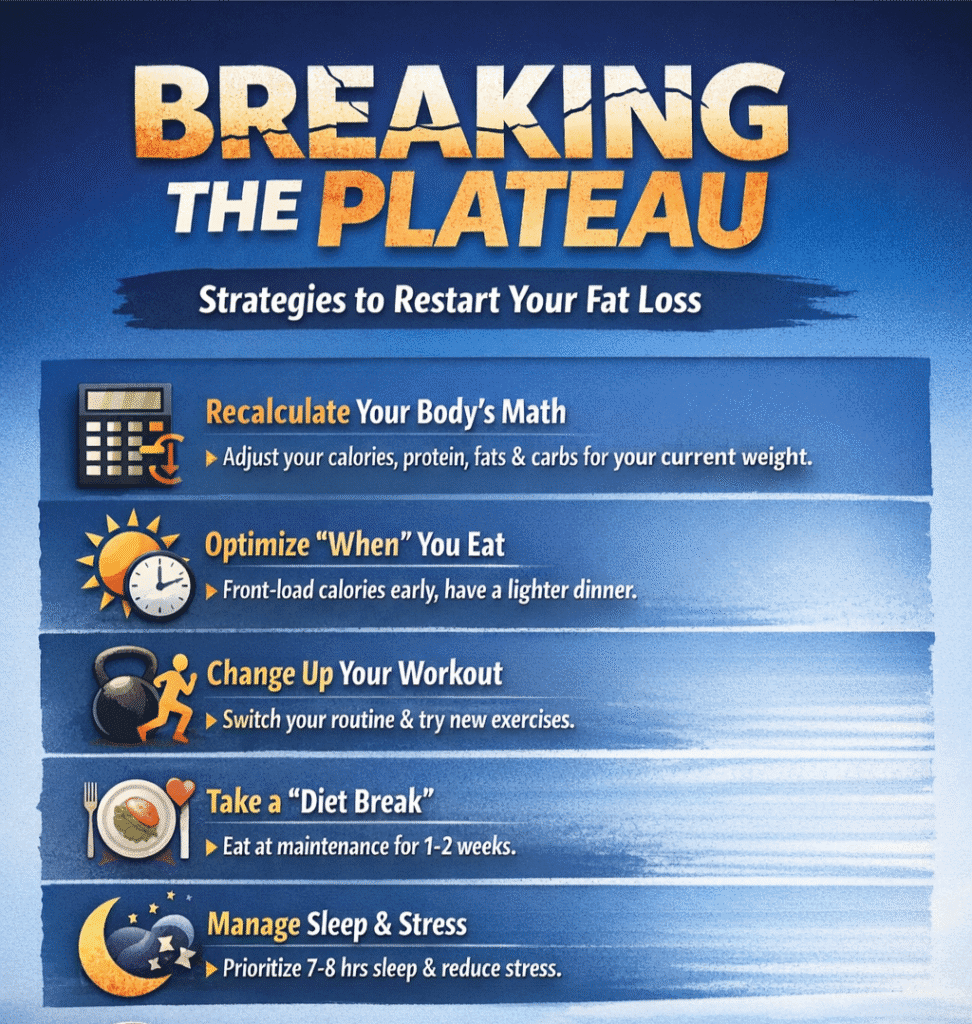
Breaking the Pleatue: Pleatue is a biological survival mechanism called metabolic adaptation. As you lose weight, your body becomes smaller and more efficient. A lighter body simply burns fewer calories to exist and move. The exact diet and workout routine that helped you lose the first 15 kilos is now only enough to maintain your current weight. Your body has adapted.
If you are someone who have hit the pleatue the following strategies may help:
1. Recalculate Your Body’s Math: As your Basal Metabolic Rate (BMR) has dropped. Without realizing it, you may be eating at maintenance calories for your new body weight. It is time to recalculate your protein, fat, and carbohydrate needs based on the body you have today.
2. Optimize “When” You Eat (Chrono-nutrition): When calories are already controlled, timing becomes your secret weapon. Instead of eating your heaviest, most protein-dense meal at night, flip your day. Front-load your protein and calories at breakfast and lunch to align with your body’s active circadian rhythm. Eat a lighter, vegetable-forward dinner, and maintain a gentle 12-to-14-hour overnight fast. This allows your insulin levels to drop completely, shifting your body out of “storage mode” and into deep fat-burning and cellular repair overnight.
3. Shift Your Workout Stimulus (Stop Doing the Same Routine): The human body is an amazing adaptation machine. If you have been doing the same 5km run or the same dumbbell routine for 6 months, your body now burns significantly less energy doing it than when you first started. To break a plateau, you must introduce a new stimulus. If you do a lot of cardio, shift your focus to strength training. If you lift weights, alter your rep ranges or add High-Intensity Interval Training (HIIT). Force your body to adapt to something new.
4. Take a Strategic “Diet Break”: If you have been in a calorie deficit for months to lose your initial 10-20kg, your metabolism may have slowed down, and hormones like leptin (which regulates fat burning) have dropped. Sometimes, to lose weight, you need to eat more. Taking a 10-to-14-day “diet break” where you intentionally eat at maintenance calories can reduce metabolic stress, replenish your glycogen stores, and reset your hormones. When you return to a slight deficit, your body will respond to fat loss again.
5. Audit Your Sleep and Stress (The Cortisol Trap): When you hit a plateau, the culprit is often hormonal, not caloric. Chronic stress and poor sleep lead to elevated cortisol. High cortisol signals the body to hold onto water weight and specifically store fat around the midsection (visceral fat). Prioritizing 7-8 hours of deep sleep and actively managing stress can result in a sudden “whoosh” of weight loss simply by lowering your inflammatory hormones.
Ready to fine-tune your routine and shed that stubborn fat for good?
You already have the foundation and discipline; let us help you with the strategy. Contact us today at Dr. Sumaiya’s NutriCare Clinic for a personalized, non-restrictive nutrition plan that fits your active lifestyle.
📝 Take the first step right now by filling out our patient history form: [www.drsumaiya.com/form](http://www.drsumaiya.com/form)
Looking for a Personalized Clinical Nutrition Protocol?
Managing your health requires addressing your unique metabolic biomarkers, digestive transit, and root causes. Dr. Sumaiya provides individualized medical nutrition therapy tailored to your lifestyle.
- Comprehensive Blood & Biomarker Audit (HbA1c, Fasting Insulin, Lipid Ratios, Thyroid/Liver)
- Root-Cause Metabolic Mapping & Dietary Assessment
- 100% Customized Indian Meal Protocol with Continuous Weekly Monitoring
In-Clinic at Frazer Town, Bengaluru & Telehealth Pan-India / Globally | Call/WhatsApp: +91 7208660987