
Five clinical words appear below, so let me define them once. The glycemic index (a score for how fast a food raises your blood sugar) separates oats from barley. Insulin resistance (when your cells stop responding properly to insulin) is the reason people with PCOS (polycystic ovary syndrome, a common hormonal condition that affects ovulation), watch their grain choices. HbA1c (your average blood sugar over roughly three months) and fasting insulin (your insulin level after an overnight fast) show how that resistance is progressing. The thyroid (the neck gland that sets your metabolism) also matters here.
🩺 Quick Clinical Answer: Are Oats Actually Better Than Barley?
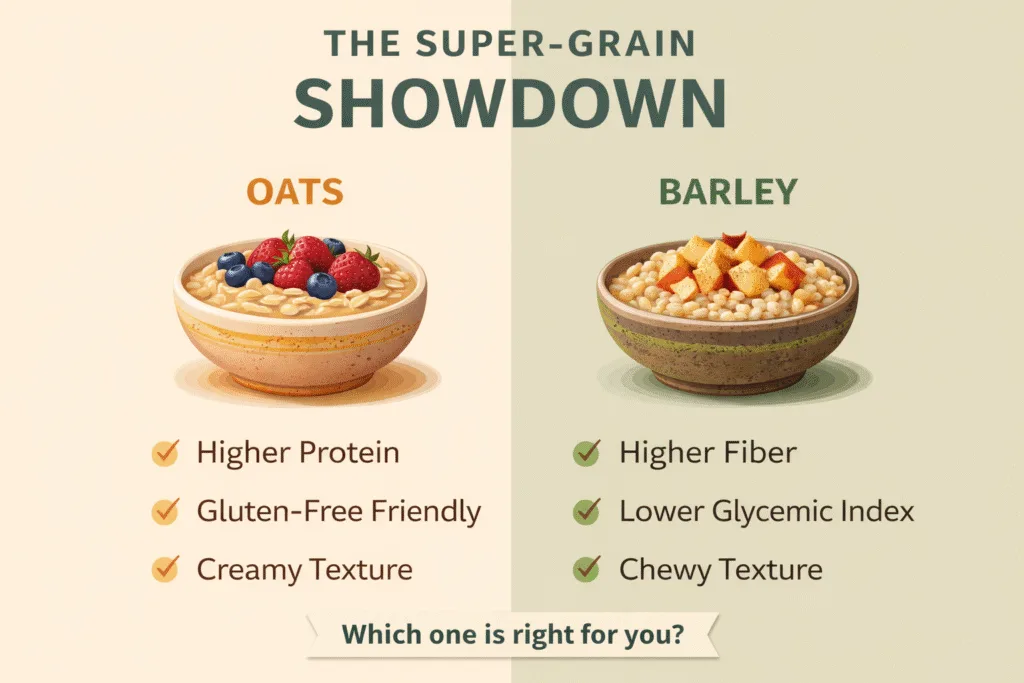
It depends on your goal. Barley has more fiber, a lower glycemic index, and extra minerals. Oats have more protein and are gluten-free by nature. Both contain beta-glucan, which lowers bad cholesterol and blunts sugar spikes. The best answer is to keep both in your kitchen.
If you are trying to eat better, there is almost certainly a packet of oats in your kitchen. For decades, oats have worn the crown as the king of healthy breakfasts. We put them in smoothies, bake them into cookies, and soak them overnight in jars. All of that is deserved. But there is an older grain sitting in the soup aisle that deserves a fairer look.
So let me settle it properly. Oats and barley are close relatives with a lot in common, and they also differ in ways that matter depending on whether your goal is cholesterol, blood sugar, or protein.
What Oats Actually Do For You
Oats earned their reputation, and it is not marketing. The useful part is a specific soluble fiber called beta-glucan. It dissolves in water and turns into a thick gel inside your gut.
That gel does three things at once. It slows how fast you digest food, so you stay full for hours. It traps cholesterol in your gut and carries it out. And it blunts the sharp rise in blood sugar after a meal.
That is the short version. Anything claiming oats do more than this is marketing.
Where Barley Wins
Barley has quietly become one of the most interesting grains in nutrition, and most people in India have never cooked it. Here is what it does that oats cannot match.
1. More Fiber, and Better Placed
Barley contains more dietary fiber than oats, but the location matters as much as the amount. In oats, most beta-glucan sits in the outer bran layer. In barley, it runs through the whole kernel.
That means even refined pearl barley keeps a solid dose of soluble fiber. Hulled barley has the most of all.
2. A Gentler Blood Sugar Response
Barley has a lower glycemic index (GI), a score for how fast a food raises your blood sugar, than standard rolled or quick oats. It breaks down more slowly, so your blood sugar rises less and flattens sooner.
If you are managing PCOS, prediabetes, or insulin resistance (when your cells stop responding properly to insulin), that difference is worth knowing about. It is one reason I suggest barley rotation in these patients.
3. More Minerals
Barley tends to carry more selenium, magnesium, and phosphorus. These support thyroid function (the neck gland that sets your metabolism), bone health, and the enzyme reactions your body runs constantly.
Oats vs Barley Side by Side
| Point of comparison | Oats | Barley |
|---|---|---|
| Beta-glucan fiber | High, concentrated in the bran | High, spread through the whole grain |
| Total fiber | Moderate | Higher |
| Blood sugar response | Moderate | Lower and gentler |
| Protein per 100 g raw | 13 to 17 g | 10 to 12 g |
| Minerals | Good | Higher in selenium, magnesium, phosphorus |
| Gluten | Naturally free, but often cross-contaminated | Contains gluten |
| Best use | Breakfast, porridge, smoothies | Khichdi, soup, salad, savoury bowls |
The Protein Question, Answered Honestly
Grains are mostly carbohydrate and fiber, so protein is where oats pull ahead. Oats carry 13 to 17 grams per 100 grams raw, against 10 to 12 for barley. Oats also have a protein profile most grains do not, since about 80 percent of it is a type called avenalin, found in no other grain.
Avenalin resembles legume protein closely, so your body digests it well. But let me be straightforward about the limit. Like almost all plant grains, neither oats nor barley is a complete protein. Both are short of an essential amino acid called lysine.
The fix is easy and tastes good. Add a spoonful of peanut butter to your oats, or roasted pumpkin seeds or chickpeas to your barley. Either addition completes the amino acid profile and turns a bowl of porridge into a real meal.
The Gluten Catch Nobody Mentions
If you have coeliac disease or non-coeliac gluten sensitivity, barley is a clear no. Oats are naturally gluten-free, but they are often grown and milled alongside wheat and barley, so cross-contamination is common. If you are sensitive, buy oats labelled certified gluten-free.
Nine Ways to Cook Both
Neither grain is fussy, and barley rewards savoury cooking. Here is what works in an Indian kitchen.
Oats
- Classic porridge. Simmer rolled oats in water or milk for 5 to 7 minutes, then add nuts, seeds, and seasonal fruit.
- Savoury vegetable oats. Cook with carrots, peas, and onion plus mild spices for a breakfast that is not sweet.
- Oat smoothie. Blend soaked oats with curd, fruit, and nuts for a fibre-rich drink.
- Oat or barley dosa. Make either from its own flour for a naturally gluten-light breakfast.
Barley
- Vegetable soup. Cook with carrot, celery, and tomato. The grain thickens it naturally and adds fiber.
- Barley khichdi. Replace rice with barley and cook with moong dal, turmeric, and vegetables.
- Barley salad. Boil, then mix with cucumber, tomato, herbs, olive oil, and lemon.
- Barley flakes. Add plain flakes to warm milk. Ready in two minutes.
- Barley porridge. Soak pearl barley overnight, then simmer in water or milk with nuts and dates.
The Verdict
It is a tie, and the tie breaks differently depending on your goal.
- Choose oats if convenience, gluten-free labelling, or a creamy breakfast texture matters most.
- Choose barley if your priority is fiber, a lower glycemic index, or a chewy grain that works in savoury dishes.
- Choose both if you want the widest range of fibers for your gut bacteria and the least chance of getting bored.
Diversity is the answer that keeps changing over time, so keep both grains in the pantry and rotate them through the week rather than committing to one.
Explore Related Clinical Guides
- The Health Benefits of a High-Fiber Diet — how much fiber you actually need and where to get it.
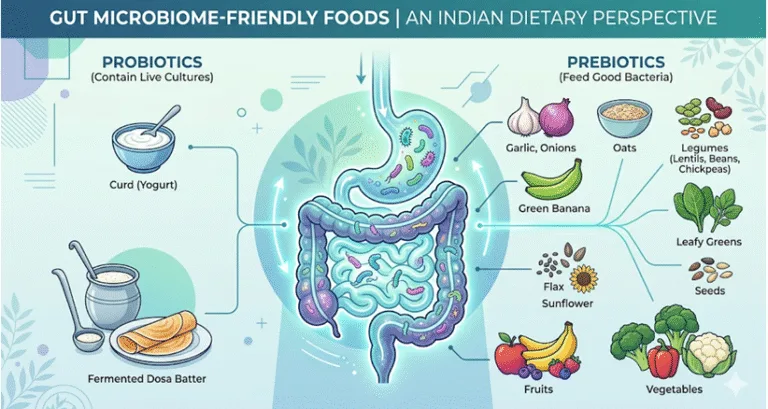
- Gut Microbiome Friendly Foods — feeding the bacteria that different fibers support.
- 5 Easy Ways to Make Your Breakfast Healthier — small changes with real results.
- Improving Digestion: A Comprehensive Guide — transit, bloating, and food tolerance.
- Unlocking Fat Loss Through Digestion — how absorption affects your results.
- Choosing the Right Wheat for Blood Sugar — comparing grains on glucose response.
Frequently Asked Questions
References
- Anderson JW, et al. Health benefits of dietary fiber. Nutrition Reviews. 2009;67(4):188-205.
- European Food Safety Authority. Scientific Opinion on the health claims for oat beta-glucan and barley beta-glucan relating to reduction of blood cholesterol concentrations. EFSA Journal. 2010;8(10):1762.
- Agarwal U, et al. Association of dietary intake of whole grains and incidence of cardiovascular disease. Nutrition, Metabolism and Cardiovascular Diseases. 2011;21(6):461-8.
- United States Department of Agriculture. FoodData Central. Nutrient values for oats and barley.
- Indian Council of Medical Research. Recommended Dietary Allowances for Indians. National Institute of Nutrition, Hyderabad.
This guide provides general health information. Your own care depends on your medical history and circumstances. Speak with your treating clinician before changing medicines or treatment.