

A few clinical words appear below, so let me define them once. Visceral fat (fat wrapped around the organs deep in your belly) is the weight that harms health most. HbA1c (your average blood sugar over three months) and fasting insulin (your insulin level after an overnight fast) show how your metabolism is coping. Cortisol (your main stress hormone) decides where some of that fat settles. Satiety (the fullness that tells you to stop eating) is what the right food buys you.
🩺 Quick Clinical Answer: Can You Really Lose 5 Kg in a Month?
Yes, some people can, but the safe clinical rate is half to one kilogram per week. The big levers for busy professionals: no sugary drinks, protein at breakfast, half-plate vegetables, a thirty-minute daily walk, seven hours of sleep, a food diary, and no eating for three hours before bed.
What This Guide Covers
- The honest math of losing 5 kg
- The eight levers that do most of the work
- All thirty tips, grouped
- A seven-day starter plan
- Frequently asked questions
- References
The Honest Math of Losing 5 Kg
Five kilograms in thirty days needs a large daily deficit, roughly a thousand calories below your burn. For some starting weights that is achievable. For many it is not, and pretending otherwise builds failure. My clinical promise is different: lose at the rate you can hold, usually two to four kilograms in the first month, and let the scale keep moving after.
Also know what the scale measures. Early losses are often water, especially when carbohydrates drop. True fat loss shows up over weeks, not days. What matters is the trend across the month and whether visceral fat is shrinking, which your waistband and your reports will both tell you. Crash approaches shed muscle along with fat, and muscle is what keeps your metabolism alive. That is why every tip below protects protein, sleep, and strength.
The Eight Levers That Do Most of the Work
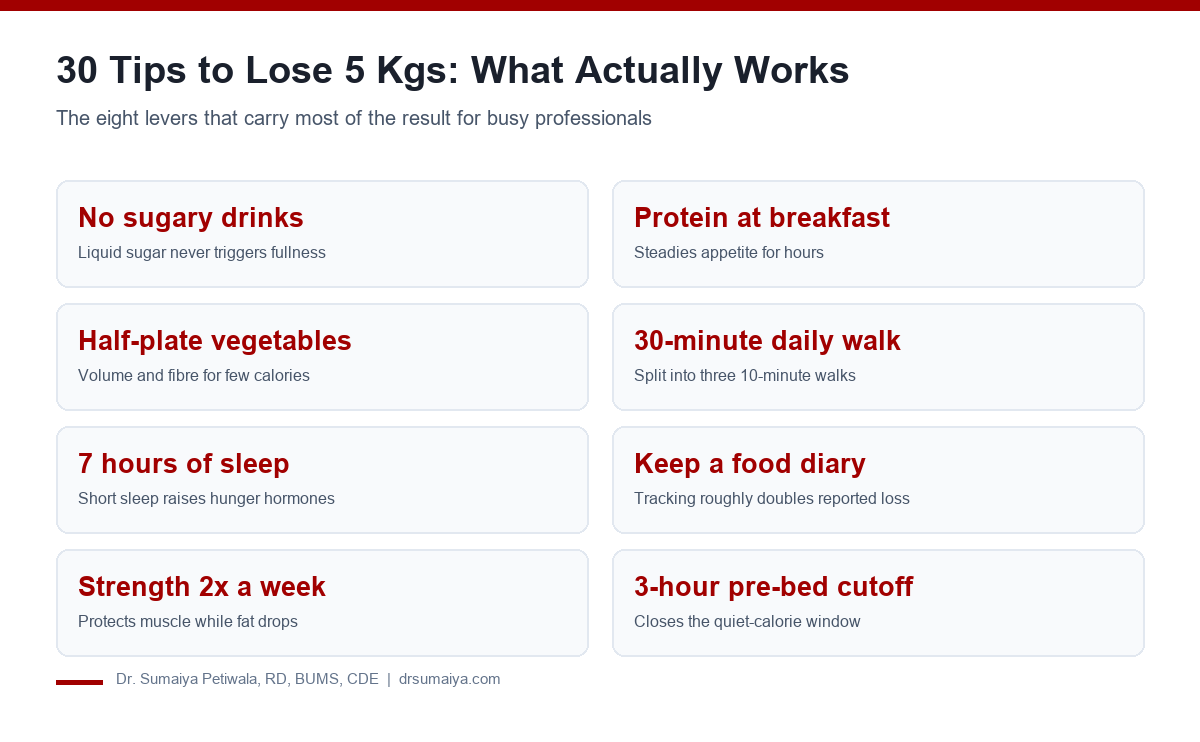
Thirty tips sound like a lot. In practice, eight of them carry most of the result. Master these first; the rest are fine-tuning.
| Lever | Why it works | Start today |
|---|---|---|
| No sugary drinks | Liquid sugar does not trigger satiety | Chai without sugar; water instead of cola |
| Protein at breakfast | Cuts mid-morning cravings | Eggs, paneer bhurji, or curd with fruit |
| Half-plate vegetables | Volume and fibre for very few calories | Salad first at lunch and dinner |
| Thirty-minute daily walk | Reliable, sustainable burn | Split into three ten-minute walks |
| Seven hours of sleep | Short sleep raises hunger hormones | Fixed bedtime, alarm on the phone |
| Food diary | Tracking roughly doubles reported loss | One app or one notebook, every meal |
| Strength twice a week | Protects muscle while fat drops | Bodyweight squats and push-ups at home |
| Three-hour pre-bed cutoff | Removes the biggest quiet-calorie window | Kitchen closes after dinner |
All Thirty Tips, Grouped
They are grouped the way a work week actually flows: movement, food, drink and sleep, eating habits, consistency, and stress.
Daily movement (tips 1 to 6)
- Stand when you can, walk when you can stand. Take calls standing. Every small upgrade adds up across a working day.
- Ten minutes before every shower. Set a timer and cycle through squats, push-ups, and planks. Short, regular, and surprisingly effective.
- One minute of walking every hour. Stand up and walk to the far end of the office. Eight minutes of movement by lunch, and your back will thank you too.
- Strength training twice a week, minimum. Muscle burns fuel even at rest and protects your metabolism while the weight drops.
- Take the stairs by rule. Two floors up, one floor down, always. Decisions made once cost no willpower later.
- Walk during calls. Headphones on, phone in pocket, pace your meeting room or corridor.
Food choices and portions (tips 7 to 14)
- Take the sugar out of chai and coffee. Three cups a day at two teaspoons each is a lot of quiet sugar. Step down gradually over one week.
- Use smaller plates at home. The same katori on a smaller plate reads as more food. It is a visual trick that works.
- Count liquid calories as eaten. Colas, packaged juices, and sweet lassis carry calories with zero satiety. This is the fastest win available.
- Fry less, tawa more. Rotate grilled, steamed, and tawa-cooked dinners. Save deep-fried food for rare occasions, not weekly defaults.
- Protein at every breakfast. Eggs, paneer bhurji, moong chilla, or curd with fruit. Protein at the first meal steadies appetite for hours.
- Fill half the plate with vegetables. Dal, sabzi, and salad first, then roti and rice. This is the meal-order habit that blunts every meal that follows.
- Put fibre on the plate deliberately. Beans, vegetables, whole grains, and fruit slow digestion and feed your gut. My guide to fibre as the hero of your health covers the targets.
- Portion the staples, do not ban them. Measure rice and roti for a week so your eyes learn true portions. Banning staples only builds rebound.
Hydration and sleep (tips 15 to 19)
- One full glass of water on waking. It wakes up digestion and prevents mistaking thirst for hunger.
- Keep a bottle within reach. Visibility drives behaviour; a bottle on the desk gets drunk.
- Drink water before meals. A glass before lunch modestly reduces intake for most people.
- Sleep seven to eight hours. Short sleep raises ghrelin (your hunger hormone) and lowers leptin (your fullness hormone), which is why tired days feel hungry. A landmark trial showed exactly this shift after a few short nights (Ann Intern Med, 2004).
- Fix a bedtime, not just a wake time. A consistent window beats an inconsistent eight hours. My guide to eating for better sleep helps here.
Mindful eating and planning (tips 20 to 25)
- Stock the right snacks where cravings strike. Roasted chana, peanuts, fruit, and curd at eye level. Biscuits at eye level lose to biscuits on the top shelf.
- Ask the question before you eat. Is it really worth it? Not as guilt, as arithmetic. Sometimes yes. Then eat it slowly and enjoy it.
- Keep a food diary for one month. In a large trial, consistent diaries roughly doubled reported weight loss (Am J Prev Med, 2008). Ten seconds per entry is the cheapest tool on this list.
- Order less when dining out. Serve yourself less than you think you want. You can always order more; you cannot un-eat it.
- Plan one flexible meal a week. A planned indulgence protects the other twenty-eight meals from the all-or-nothing spiral.
- Close the kitchen three hours before bed. Late dinners push calories into a low-activity window and disturb sleep. Finish dinner, brush, done.
Consistency and support (tips 26 to 28)
- Choose the eighty-twenty rule. Eat well eighty percent of the time and stop renegotiating the other twenty. Perfection is not required; repetition is.
- Tell one person your goal. Accountability works. A colleague, partner, or a clinician who checks in weekly changes the maths on skipped days.
- Weigh weekly, same day, same conditions. Daily weighing drives anxiety; weekly weighing shows the trend. Track the month, not the morning.
Stress (tips 29 to 30)
- Take five real minutes for breathing. Chronic stress keeps cortisol (your main stress hormone) high, and cortisol nudges fat toward the belly. A five-minute breathing break after lunch is a clinical tool, not a luxury.
- Set a screen curfew. Forty-five minutes before bed, screens go off. Better sleep is a weight-loss tool, as tip 18 explains.
A note on pace before the plan. If your starting weight is high, a supervised month can genuinely reach five kilograms safely. If your goal is the last few kilos, aim for two and keep them. The patients who win long-term are rarely the fastest starters. They are the ones whose plan survives a bad week.
A Seven-Day Starter Plan
- Day 1: set up the food diary and take a starting waist measurement along with the weigh-in.
- Day 2: remove sugar from chai and coffee. Expect three grumpy days; they pass.
- Day 3: plan protein for every breakfast this week. Shop for eggs, paneer, and curd.
- Day 4: place a bottle and a snack jar on your desk. Biscuits go to the top shelf.
- Day 5: schedule three ten-minute walks in your calendar, like meetings.
- Day 6: do one strength session at home. Squats, wall push-ups, planks. Twenty minutes.
- Day 7: review the diary, fix a 10:45 pm lights-out alarm, and plan next week’s flexible meal.
Want a Plan That Survives Your Calendar?
Busy weeks are exactly when generic diets collapse. At Dr. Sumaiya NutriCare Clinic we build around your real schedule, test the metabolic markers first, and adjust weekly so progress continues without crash dieting.
- Comprehensive Blood & Biomarker Audit (blood sugar, liver panel, iron studies)
- Root-Cause Assessment with Diet Recall and Schedule Audit
- 100% Customised Indian Meal Protocol with Continuous Weekly Monitoring
In-Clinic at Frazer Town, Bengaluru & Telehealth Pan-India / Globally | Call/WhatsApp: +91 7208660987
Frequently Asked Questions
References
- Malik VS, Schulze MB, Hu FB. Intake of sugar-sweetened beverages and weight gain: a systematic review. Am J Clin Nutr. 2006;84(2):274-288. PMID 16895873
- Leidy HJ, et al. The role of protein in weight loss and maintenance. Am J Clin Nutr. 2015;101(6):1320S-1329S. PMID 25926512
- Spiegel K, Tasali E, Penev P, Van Cauter E. Brief communication: Sleep curtailment in healthy young men is associated with decreased leptin levels, elevated ghrelin levels, and increased hunger and appetite. Ann Intern Med. 2004;141(11):846-850. PMID 15583226
- Hollis JF, et al. Weight loss during the intensive intervention phase of the weight-loss maintenance trial. Am J Prev Med. 2008;35(2):118-126. PMID 18617080
- Indian Council of Medical Research – National Institute of Nutrition. Recommended Dietary Allowances for Indians. Hyderabad: NIN.