
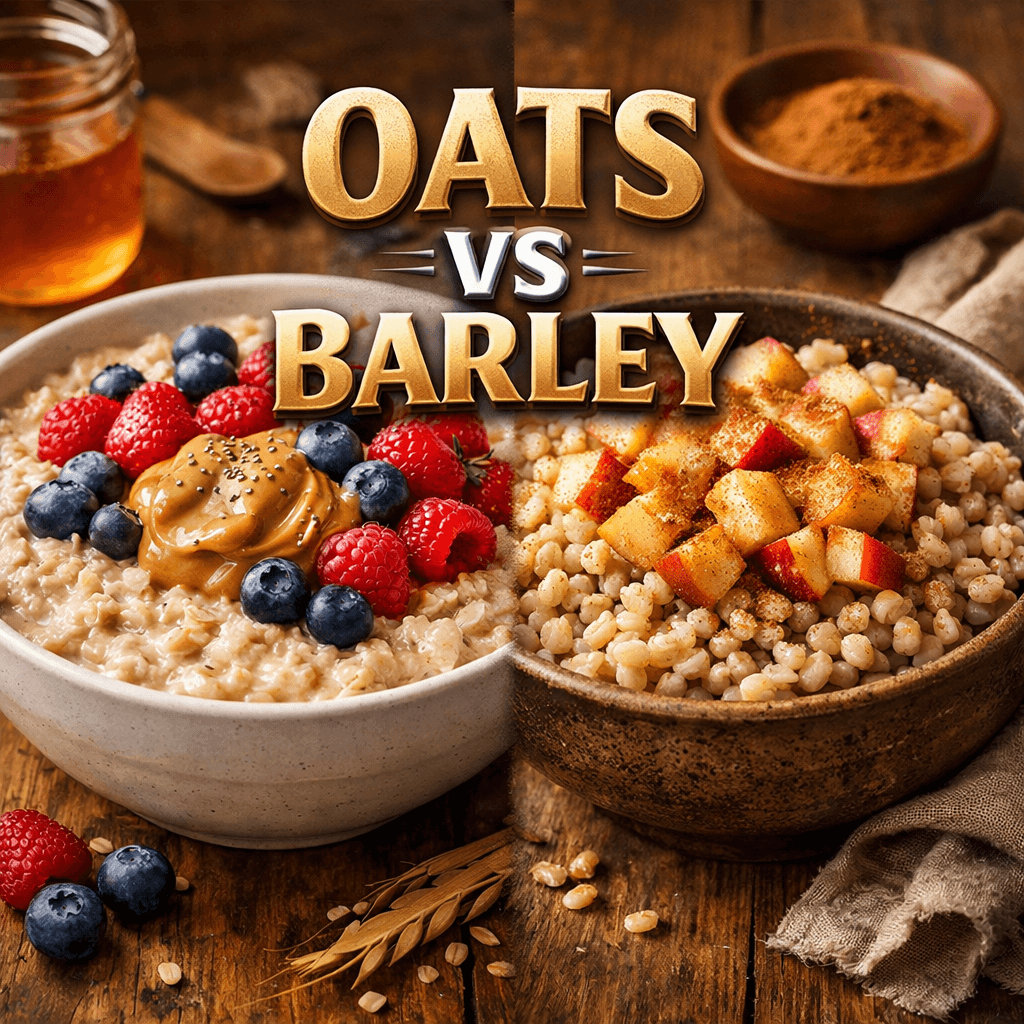

If you are on a journey to eat healthier, lose weight, or manage your blood sugar, chances are you already have a bag of oats sitting in your pantry.
For decades, oatmeal has worn the undisputed crown as the “King of Healthy Breakfasts.” We bake it into cookies, blend it into smoothies, and soak it overnight in jars. And for good reason! But what if I told you there is an ancient, unsung hero hiding in the soup aisle that might just give your beloved oats a run for their money?
Hold onto your spoons. We are about to dive into the ultimate grain showdown.
First, Let’s Talk About the Magic of Oats.
Oats have earned their stellar reputation. They are a nutritional powerhouse packed with vitamins, minerals, and antioxidants.
But the real superstar inside a bowl of oats is a specific type of soluble fiber called beta-glucan. When beta-glucan hits your digestive tract, it forms a thick, gel-like substance. This magical gel slows down your digestion (keeping you full for hours), traps bad cholesterol and sweeps it out of your body, and prevents sudden blood sugar spikes.
Oats are comforting, quick to cook, and the ultimate blank canvas for fruits, nuts, and seeds. It seems like the perfect food, right?
Enter the Challenger: The Ancient Underdog:
Just when you thought oats had a monopoly on your morning routine, a close competitor steps into the ring.
Meet Barley: Today, it’s making a massive comeback in the nutrition world.
Before we pit them against each other, it’s important to note that oats and barley are practically nutritional siblings.
The Beta-Glucan Bond: Just like oats, barley is loaded with cholesterol-lowering, gut-healing beta-glucan fiber.
Heart Health Heroes: Both grains are heavily endorsed by dietitians for their ability to lower blood pressure and protect against heart disease.
Weight Loss Wonders: Because both expand in your stomach and digest slowly, they are incredibly effective at crushing mid-morning sugar cravings and keeping you satiated.
The Plot Twist: Why Barley Might Actually Be Better Than Oats
Here is where the story gets interesting. While oats get all the PR, a side-by-side comparison reveals that barley packs a few secret punches that oats simply can’t block.
1. The Fiber Champion:
Barley actually contains more dietary fiber than oats. But it’s not just about the amount; it’s about the location. In oats, the beta-glucan fiber is mostly concentrated in the outer bran layer. In barley, the beta-glucan is distributed throughout the entire kernel. This means even if you buy refined pearl barley, you are still getting a massive dose of that magical soluble fiber. If you buy hulled barley, the fiber content absolutely crushes oats.
2. The Blood Sugar Stabilizer (Lower GI)
If you are struggling with PCOS, pre-diabetes, or insulin resistance, pay attention. Barley has a significantly lower Glycemic Index (GI) than standard rolled or quick oats. This means barley breaks down even slower, resulting in a much gentler, flatter blood sugar response.
3. Mineral Density: Barley often contains higher levels of Selenium, Magnesium and Phosphorus. These minerals contribute to antioxidant protection, bone health and enzymatic processes.
Because of these features, barley can be considered one of the most metabolically protective cereal grains.
4. The Muscle-Building Matchup: The Protein Punch-Out
When we think of grains, we usually think of carbs and fiber. But if you are trying to build muscle, stay full, or hit your daily plant-based macro goals, protein matters.
So, who wins the protein round? This time, Oats take the crown.
While both grains are fantastic sources of plant-based protein compared to things like white rice or refined wheat, oats have a slight, undeniable edge. Oats Pack roughly 13 to 17 grams of protein per 100 grams (raw). Barley comes in slightly lower, offering about 10 to 12 grams of protein per 100 grams (raw).
Oats have incredibly unique protein profile. About 80% of the protein in oats is a type called avenalin—a protein that isn’t found in any other grain but is remarkably similar to the high-quality protein found in legumes (like beans and lentils). This makes the protein in oats highly digestible and exceptionally good for a grain. Like almost all plant-based grains, neither oats nor barley are “complete” proteins. This means they are both missing sufficient amounts of an essential amino acid called *lysine*.
You can easily complete the protein profile for both grains by inviting a friend to the bowl. Adding a spoonful of peanut butter to your oatmeal, or tossing some roasted pumpkin seeds or chickpeas into your savory barley bowl, instantly transforms both into a complete, muscle-repairing meal!
5. The Texture Upgrade
Let’s be honest: oats can get mushy. Barley, on the other hand, retains a delightfully chewy, nutty, “al dente” texture even after it’s cooked. It holds its shape beautifully, making it much more versatile for savory dishes, salads, and hearty bowls.
The Crucial Disclaimer: The Gluten Factor
Before you throw out your oats and buy a truckload of barley, there is one major catch you must know about: Gluten.
Barley: Barley naturally contains gluten. If you have Celiac disease, an autoimmune condition, or non-celiac gluten sensitivity, barley is an absolute no-go.
Oats: Oats are naturally gluten-free. However, they are frequently grown in the same fields and processed on the same equipment as wheat and barley. If you are highly sensitive to gluten, you must always look for oats explicitly labeled “Certified Gluten-Free.“
Let’s Get Cooking!
Ready to invite both of these nutritional powerhouses into your kitchen? Here are few incredibly easy ways to enjoy them.
1. Classic Oat Porridge
Cook rolled oats with milk/non dairy milk or water for 5–7 minutes. Add nuts, seeds and seasonal fruit.
2. Savoury Vegetable Oats
Cook oats with vegetables such as carrots, peas and onions with mild spices for a savoury breakfast alternative.
3. Oat Smoothie
Blend soaked oats with yogurt, fruit and nuts for a fibre-rich breakfast drink.
4. Oats/barley dosa: Made from the respective flours.
5. Barley Vegetable Soup
Cook barley with vegetables such as carrots, celery and tomatoes. The grain thickens the soup naturally and increases fibre content.
6. Barley Khichdi
Replace rice with barley and cook with moong dal, turmeric and vegetables.
7. Barley Salad
Boiled barley mixed with cucumber, tomato, herbs, olive oil and lemon creates a highly nutritious whole-grain salad.
8. Barley flakes: Just add plain barley flakes in your warm milk and you are good to go.
9. Barley Porridge: Soak pearl barley overnight in water and boil it in the milk/water/non dairy milk in the morning. Add some nuts and dates for taste and crunch.
The Final Verdict (Summary)
So, who wins the ultimate super-grain showdown?
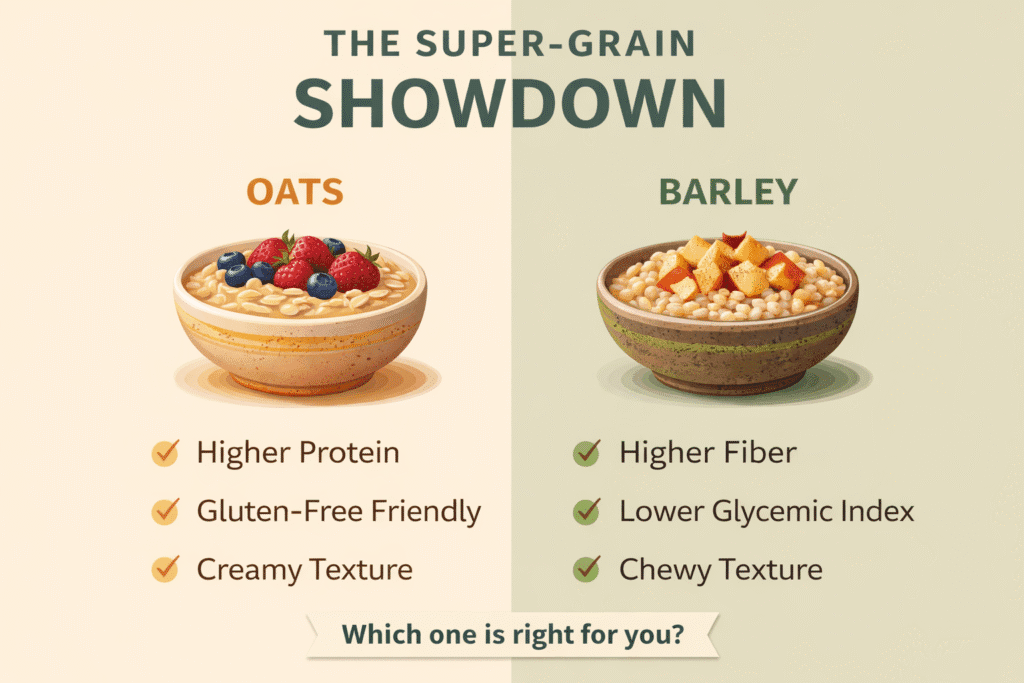
It’s a tie—but for different reasons!
Oats remain the undisputed champion of convenience, gluten-free friendliness, and creamy comfort. But Barley is the ultimate stealth-health grain, boasting a lower glycemic index, a higher fiber profile, and a wonderfully satisfying chew.
The best diet isn’t about choosing just one; it’s about diversity. By keeping both oats and barley in your pantry, you feed your gut microbiome a wider variety of fibers, keep your tastebuds entertained, and supercharge your long-term health.
Next time you are at the grocery store, grab a bag of barley. Your metabolism (and your palate) will thank you!
Looking for a Personalized Clinical Nutrition Protocol?
Managing your health requires addressing your unique metabolic biomarkers, digestive transit, and root causes. Dr. Sumaiya provides individualized medical nutrition therapy tailored to your lifestyle.
- Comprehensive Blood & Biomarker Audit (HbA1c, Fasting Insulin, Lipid Ratios, Thyroid/Liver)
- Root-Cause Metabolic Mapping & Dietary Assessment
- 100% Customized Indian Meal Protocol with Continuous Weekly Monitoring
In-Clinic at Frazer Town, Bengaluru & Telehealth Pan-India / Globally | Call/WhatsApp: +91 7208660987