Nutrition is often reduced to totals. Total calories. Total protein. Total fat. While these remain important, when you eat protein may influence how your body balances growth and repair at a cellular level.
A structured approach to protein timing can support metabolic health without extreme diets or prolonged fasting.
Understanding the Body’s Internal Switch
The body constantly shifts between two fundamental states:
Growth mode: building muscle, repairing tissues
Repair mode: clearing damaged cells and maintaining internal balance
A key regulator of this switch is a pathway called mTOR (Mechanistic Target of Rapamycin). This pathway is activated through amino acid leucine (direct activator), arginine, methionine and glutamine (indirect activators). When mTOR is active, the body focuses on growth and protein synthesis. When mTOR is suppressed, the body shifts toward repair processes like autophagy.
Health depends on balance, not constant activation or supression.
The Problem with Continuous Activation
Modern eating patterns often involve:
1. Frequent meals and snacks.
2. High protein intake spread throughout the day and night.
This leads to persistent activation of growth pathways, which may contribute to:
1. Reduced cellular repair
2. Metabolic dysfunction over time
The goal is not to suppress growth, but to allow natural cycling between growth and repair.
Leading research on the mTOR pathway shows that continuous feeding keeps the body trapped in ‘growth’ mode, effectively shutting off autophagy—the biological process responsible for clearing out damaged cells.
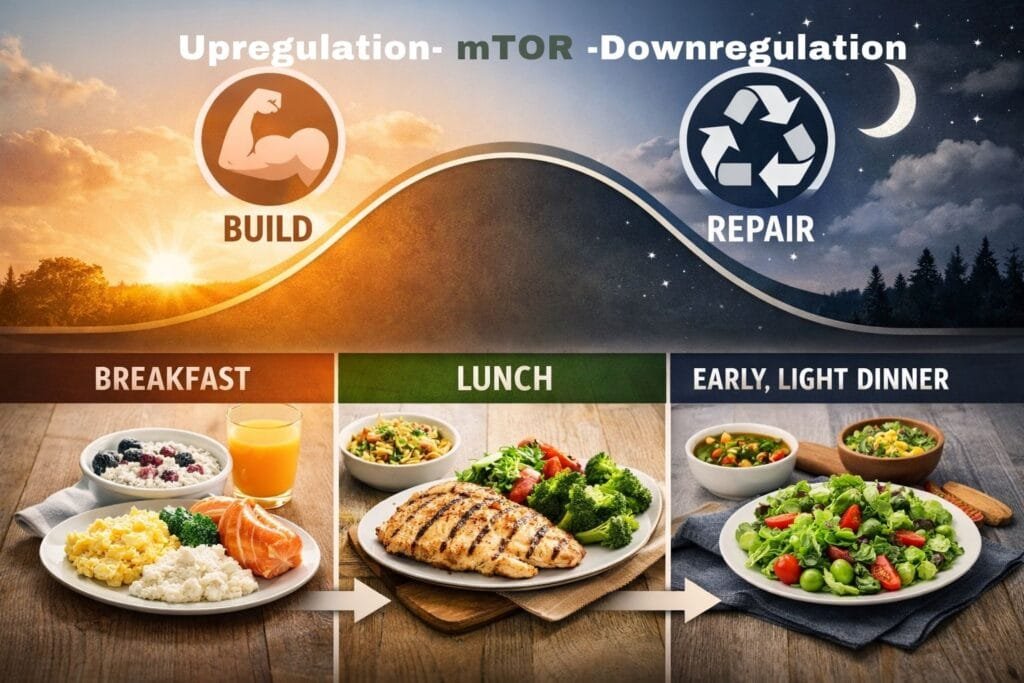
A Practical Strategy: Protein Distribution Across the Day
A simple and sustainable approach involves:
1. Prioritizing protein earlier in the day
Include adequate protein in breakfast and lunch
Each meal should be sufficient to support muscle maintenance and repair
2. Keeping dinner lighter in protein
Emphasize grains, vegetables, and lighter foods.
Avoid heavy protein sources such as large portions of meat, pulses, or dairy at night.
3. Finishing dinner early
Maintain a 12–14 hour overnight fasting window.
What Happens in the Body
During the day, Protein intake activates growth pathways, muscle repair and strength.
During the night
Lower protein intake allows gradual reduction in mTOR activity and the body shifts toward cellular repair and maintenance.
This creates a natural daily cycle:
Day: build and strengthen
Night: clean and restore
Role of Physical Activity
Strength training enhances the benefits of this approach by: Improving how efficiently the body uses protein, strengthens and preserve muscle and supports a clear separation between growth (day) and repair (night). Training earlier in the day aligns well with this pattern.
What This Approach Can and cannot Do
Likely benefits
Better metabolic regulation
Improved alignment with natural body rhythms
Support for long-term health through balanced cellular function
This approach does not :
Does not prevent cancer on its own as cancer has many other causes.
Does not guarantee increased lifespan as health outcomes depend on multiple factors, including: Overall diet quality, Body weight, Physical activity, Sleep and lifestyle etc.
This strategy is one supportive component, not a standalone solution.
Critical Conditions for Safety and Effectiveness
This approach works only when:
Total daily protein intake is adequate
Protein needs are met through earlier meals
Overall calorie intake is appropriate
Failure to meet protein requirements may lead to: Muscle loss, Reduced strength and
Slower metabolism.
Who Should Be More Careful
Older adults
Individuals with low body weight
Those with high physical demands
These groups require careful planning to ensure sufficient protein intake.
Key Takeaway
A structured pattern of:
Higher protein intake earlier in the day
Lighter, low-protein dinners
Consistent overnight fasting
can support a healthy balance between growth and repair mechanisms in the body.
This is not an extreme intervention. It is a refinement of timing, aligned with how human physiology naturally operates.
When combined with adequate nutrition and regular strength training, it offers a practical way to support long-term metabolic health.
Want to incorporate this simple but effective technique into your day-to-day routine?
Stop guessing and start optimizing your metabolism with expert guidance! Contact us now at Dr. Sumaiya’s NutriCare Clinic to craft a protein-timing strategy tailored just for you.
Call now at 7208660987 for an appointment or get started right now by filling out our patient history form here: http://www.drsumaiya.com/form
Citations:
- mTOR signaling in growth, metabolism, and disease (Laplante & Sabatini, Cell, 2012). This foundational paper explains how mTOR acts as a central switch connecting environmental cues (like protein intake) to cellular growth, and how hyperactive mTOR contributes to metabolic diseases. Read the full study here: https://pubmed.ncbi.nlm.nih.gov/22500797/https://pubmed.ncbi.nlm.nih.gov/22500797/
- mTOR: a pharmacologic target for autophagy regulation (Kim & Guan, Regulation of mTOR by Amino Acids, 2015). Proves that continuous amino acid (protein) availability continuously stimulates mTORC1, directly inhibiting autophagy. Read the full study here: https://pubmed.ncbi.nlm.nih.gov/25654547/https://pubmed.ncbi.nlm.nih.gov/25654547/
- Distribution of dietary protein intake in daily meals influences skeletal muscle hypertrophy via the muscle clock (Aoyama et al., Cell Reports, 2021). This landmark study showed that eating protein early in the active phase (morning) resulted in more muscle growth and better metabolic function than eating it late in the day, due to the circadian “muscle clock.” Read the full article here https://pubmed.ncbi.nlm.nih.gov/34233179/https://pubmed.ncbi.nlm.nih.gov/34233179/