
Quick Answer: Can You Fast Safely with Diabetes?
Many people with well-managed Type 2 Diabetes can fast safely after a pre-Ramadan medical check as per IDF-DAR guidance. Slow carbs and protein at Suhoor prevent sugar crashes, and a light Iftar prevents spikes. Dr. Sumaiya’s clinical recommendation: check your sugar at 12 noon, 4 pm and 2 hours after Iftar, and break the fast if it drops below 70 mg/dL.
Ramadan fasting is a cherished part of the year for millions of families. You may be wondering how to keep your fast while keeping your sugar steady.
A long fast of 14 to 16 hours changes your body. Sugar can fall too low in the afternoon. It can also climb too high after Iftar. Both are risky when you take diabetes medicines.
The good news is simple plan. With the right meals and the right checks, most people with Type 2 Diabetes can fast safely. Read on for the meal plan and the red-line rules.
What this guide covers
1. Who Should Not Fast
Islam gives clear medical exemption when fasting harms your health. Your doctor will place you in a risk group before Ramadan begins.
- Very high risk: You had a severe low sugar episode in the last three months, or you went into diabetic ketoacidosis (a build-up of harmful acids in your blood) recently.
- Very high risk: You are pregnant with gestational diabetes (high sugar during pregnancy), or you are on dialysis, or you have advanced heart, liver or kidney disease.
- High risk: Your sugar is far from target, or you use insulin and have frequent lows, or you take strong diabetes tablets such as sulfonylureas.
- Moderate risk: Type 2 Diabetes that is well controlled, with no insulin and no recent lows. Fasting is usually possible with a plan and monitoring.
If you fall in the very high risk group, fasting is medically discouraged. Please speak to your doctor before you decide. This is not a spiritual failure. It is medical safety, and Islam allows the exemption.
2. Suhoor and Iftar Meal Matrix
How you build your two meals decides how your day goes. Here is the clinical comparison you can keep on your fridge.
| Meal timing | Safe choices | High-risk foods | Why it matters |
|---|---|---|---|
| Suhoor (pre-dawn meal) | Khapli (emmer) wheat roti, steel-cut oats with chia, eggs, sattu, paneer, thick dal | White bread, sugary cereals, oily parathas, sweet chai | Slow carbs plus protein release sugar steadily for many hours. This prevents the afternoon crash. |
| Opening the fast | One fresh date, two glasses of water, clear vegetable soup | Fruit juices, sweet sherbet, cold drinks, four to five dried dates | Liquid sugar enters your blood fast. It spikes your sugar and pushes fat into your liver. |
| Iftar snacks | Roasted chana chaat, sprouted moong salad, grilled paneer or chicken tikka | Pakoras, samosas, jalebi, fried kebabs from reheated oil | Reheated frying oil is harmful to your blood vessels and worsens insulin resistance (when your cells stop responding well to insulin). |
| Dinner after Taraweeh | Half plate vegetables and salad, quarter plate lean protein, quarter plate jowar or millet roti | Heavy biryani, maida naan, rich cream gravies | A balanced plate keeps the night steady and helps your liver recover while you sleep. |
| Drinks through the night | Two and a half to three litres of water, lemon water without sugar, unsweetened buttermilk | Sweet milkshakes, energy drinks, packaged soups | Good hydration keeps your blood from thickening, which would push your sugar readings up. |
Notice one simple pattern. The plainer the food, the calmer your sugar. Fried and sweet food is what breaks most fasts.
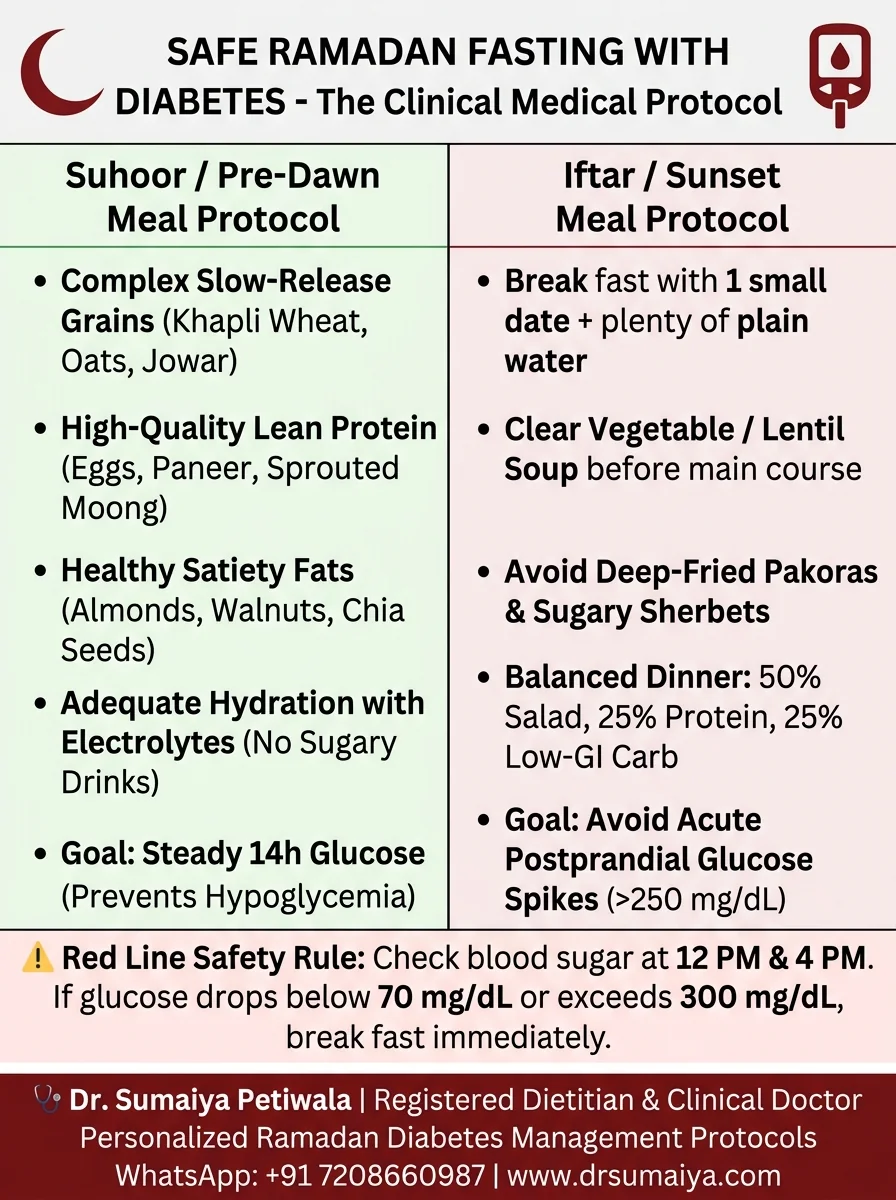
📊 Visual summary: Suhoor and Iftar protocols, plus the red-line safety rules.
3. Red-Line Safety Rules: When to Break the Fast
Follow the IDF-DAR advice on checking. Test your sugar at 12 noon, at 4 pm, and two hours after Iftar. Keep your glucometer and a sugar source next to you.
🚨 Break Your Fast Immediately If
- Sugar falls below 70 mg/dL: Treat it at once with 15 grams of fast sugar, such as half a cup of juice or three glucose tablets.
- Sugar rises above 300 mg/dL: This brings dehydration and dangerous acid build-up in the blood.
- You feel severely unwell: Strong dizziness, cold sweat, shaking hands, confusion, blurred vision or vomiting.
Breaking a fast in an emergency is allowed and wise. No prayer is worth a hospital visit.
4. Three Medical Rules for a Stable Fast
Rule 1: Push Suhoor as late as possible
Do not eat Suhoor at midnight and then sleep. Eat it 30 to 45 minutes before the Fajr prayer. A later meal means a shorter fasting window. Add protein such as eggs or sprouted moong, and a slow carb such as Khapli wheat roti.
Rule 2: Open the fast with one date, not five
Dates carry a lot of natural sugar. Four or five dates with a sweet drink is a sugar overload on an empty stomach. Take one date, two glasses of water and a warm soup. Wait 10 to 15 minutes before your main meal.
Rule 3: Change medicine timing only with your doctor
Never adjust your insulin or tablets on your own. Some tablets, such as Glimepiride, can cause dangerous low sugar if taken at Suhoor. Your doctor can move your morning dose to Iftar safely.
5. A Full Day Plan You Can Follow
Here is a simple day that keeps sugar steady and energy up.
- Suhoor: Two Khapli rotis with paneer bhurji, or a bowl of steel-cut oats with chia and curd. Add four to five soaked almonds and one glass of water.
- During the day: Rest after Zuhr, avoid heavy work in the sun, and keep testing at 12 noon and 4 pm.
- Iftar: One date, water, soup. Then grilled paneer tikka or chana chaat. Pray, then eat dinner.
- Dinner: Half plate salad and sabzi, quarter plate protein such as dal, fish or chicken, quarter plate jowar or millet roti.
- After dinner: A short walk and a glass of buttermilk. Keep sipping water until bedtime.
- Before sleep: Light snack if your doctor advises it, such as curd with roasted jeera or a small bowl of makhana.
Try the eating order that works all year. Salad and sabzi first, protein second, roti or rice last. This sequence slows the rise of sugar after meals.
6. Medicine Timing During Ramadan
Your medicine schedule needs a rewrite for Ramadan. Bring your prescription to your doctor before the month starts.
- Metformin is often moved to Iftar and Suhoor, as per your doctor’s plan.
- Sulfonylureas may be reduced or moved, because they can cause low sugar in a long fast.
- Insulin users need a full dose revision, plus more frequent testing.
- Blood pressure and heart medicines may also need new timings.
Do not skip a dose to make fasting easier. Always ask your doctor first.
If your reports show extra fat in your liver, which is called fatty liver (extra fat building up inside your liver), fasting without a plan can make it worse. Read the Grade 1 fatty liver reversal protocol before you start.
Get a Doctor-Supervised Ramadan Diabetes Plan
Do not guess your meals or your medicine timings this Ramadan. Get a plan built around your HbA1c (a blood test that shows your three-month average blood sugar), your fasting sugar and your daily routine.
- Step 1: Pre-Ramadan risk review — Your recent blood work, sugar readings and current medicines.
- Step 2: Custom Suhoor and Iftar plan — Home-cooked Indian meals that keep sugar steady through the day.
- Step 3: Weekly monitoring — Clinical check-ins during Ramadan to adjust food and doses safely.
In-Clinic at Frazer Town, Bengaluru & Telehealth Pan-India / Globally | WhatsApp: +91 7208660987
Frequently Asked Questions
Medical Disclaimer
This guide is general health information, not personal medical advice. Fasting with diabetes depends on your medicines, your reports and your doctor’s judgement. Always get a pre-Ramadan review and never change your doses on your own.
Dr. Sumaiya NutriCare Clinic
Phone: 7208660987
Email: doc@drsumaiya.com
Address: 7, Moore Rd, off Coles Road, Pulikeshi Nagar, Frazer Town, Bengaluru, Karnataka 560005.
References
- International Diabetes Federation & Diabetes and Ramadan (DAR) Alliance. IDF-DAR Practical Guidelines: Diabetes and Ramadan.
- Hassanein, M., et al. (2018). Diabetes and Ramadan: Practical guidelines. Diabetes Research and Clinical Practice, 126, 303–316.
- World Health Organization. Diabetes fact sheet.
- Traversy, G., & Chaput, J. P. (2017). Alcohol consumption and obesity: An update. Current Obesity Reports, 6(2), 237–245.
- Yeomans, M. R., et al. (2011). Alcohol and food intake. American Journal of Clinical Nutrition, 94(1), 36–47.