
Five terms come up in this guide, so let me define them before we start. Postprandial (meaning after a meal) glucose spikes are sharp rises in blood sugar. Insulin resistance (when your cells stop responding properly to insulin) makes them worse. Visceral fat (fat stored deep around your organs) grows with repeated spikes, as does a fatty liver (extra fat stored in the liver). Triglycerides (blood fats) rise, and HbA1c (your average blood sugar over roughly three months) only tells you part of the story.
🩺 Quick Clinical Verdict: Do Glucose Spikes Matter If Fasting Sugar Is Normal?
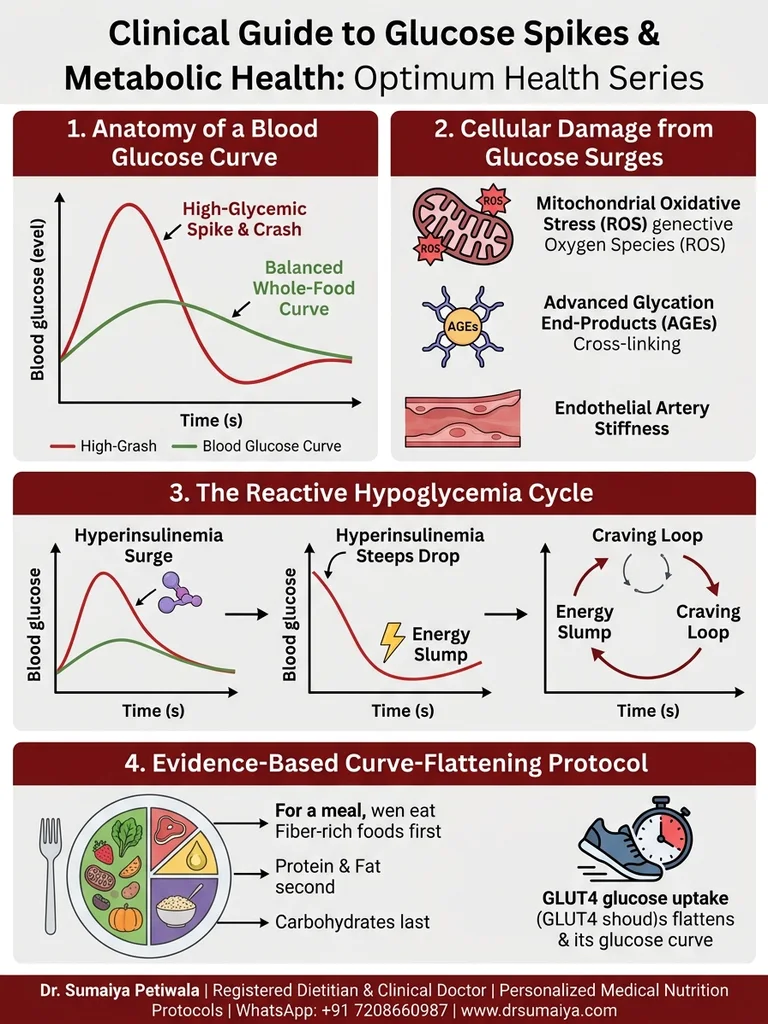
Yes. A normal morning reading of 90 mg per dL can hide daily spikes to 160 or 180 after meals. Blood sugar measured one to two hours after eating should stay under 120, and never pass 140. Flatten your curve by eating vegetables first, protein second, carbohydrates last, then walk for ten minutes.
Most people only get one blood sugar test, and it is taken in the morning before breakfast. That single number is useful, but it tells you very little about what your blood sugar does the rest of the day. Patients walk into my clinic with a fasting reading of 90 and no idea that their sugar is hitting 180 after every meal.
This is where modern preventive medicine has shifted. Attention has moved from the static morning number to what happens dynamically after eating. Let me explain what the spikes do to your body, why the 3 PM crash is a real sign rather than tiredness, and how four changes flatten your curve.
Table of Contents
- Two Blood Sugar Curves, Side by Side
- What Repeated Spikes Do Inside Your Cells
- The 3 PM Crash Explained
- 4 Strategies to Flatten Your Curve
- Frequently Asked Questions
Two Blood Sugar Curves, Side by Side
Everything you need to know about your blood sugar comes down to how high it goes, how fast it drops afterwards, and what that does to you by mid-afternoon.
| What you track | The rollercoaster pattern | The flattened pattern |
|---|---|---|
| Peak after eating | Sharp surge above 140 to 180 mg/dL | Gentle rise staying below 120 to 130 |
| How you feel by 3 PM | Crash, brain fog, irritability, strong cravings | Steady focus and calm appetite for 4 to 5 hours |
| Insulin demand | Very high, which stores fat and exhausts insulin-producing cells | Low and steady, which protects fat burning |
| Skin, vessels and liver | Extra stress from sugar sticking to proteins | Protected, HbA1c closer to 5.4 percent |
| Long-term risk | Type 2 diabetes, plaque in arteries, fatty liver | Better metabolic and heart health |
What Repeated Spikes Do Inside Your Cells
You do not need a biochemistry degree for this section. Four things happen, and all four are cumulative.
1. Free Radicals Flood Your Cells
Your cells turn glucose into energy inside structures called mitochondria. Flood them with excess glucose and they leak free radicals, which damage cell material and trigger swelling. Think of it as your cells working overtime and fraying at the edges.
2. Sugar Sticks to Your Proteins
Glucose attaches to proteins in your body, forming advanced glycation end-products, or AGEs for short. These cross-linked compounds stiffen collagen in your skin and blood vessel walls. They also build up in your lens and kidneys. That is a large part of why skin ageing and blood vessel damage track together.
3. The Rebound Crash
Your pancreas responds to a spike by releasing a large amount of insulin. That pushes sugar into cells so fast that your blood sugar falls below where it started, usually within two to three hours. This is called reactive hypoglycemia (a steep crash that triggers stress hormones, fatigue, and strong cravings). It is the single most common explanation I hear for the 3 PM biscuit run.
4. Your Blood Vessels Take Damage
A spike reduces nitric oxide, the chemical that keeps your blood vessels relaxed. They stiffen and narrow, which keeps a low level of ongoing inflammation (the body’s persistent swelling response) in the body. Over years, that is how damage to blood vessels turns into heart disease.
The 3 PM Crash Explained
If you feel reliably worse mid-afternoon, do not dismiss it. The pattern is usually textbook.
Your lunch was carbohydrate-heavy, meaning roti or rice with little salad and no protein. Your blood sugar rose fast, your pancreas over-reacted, and two hours later you were below your starting point. Your brain reads that as an emergency and demands fast energy. You reach for chai and a biscuit. You feel better for twenty minutes, then drop again.
Fasting glucose and HbA1c are single snapshots. They do not show post-meal volatility at all. That is why I use continuous glucose monitoring for selected patients, along with fasting insulin (your insulin level after an overnight fast) and HOMA-IR (a score of how resistant your cells are to insulin).
4 Strategies to Flatten Your Curve
You do not need to give up carbohydrates. You need to change the order you eat them in and what you do afterwards.
1. Eat in the Right Order
The sequence of food decides how fast your stomach empties. Start with soluble fiber such as a cucumber and tomato salad or cooked leafy vegetables. That forms a gel which slows everything behind it. Next eat protein and fat, such as dal, paneer, eggs, or chicken, which slows emptying further. Eat your roti and rice last, and the sugar trickles in instead of flooding.
This is the highest-value change on the page. It works at the same meal, requires no new food, and patients report the difference the same week.
2. Walk for Ten Minutes After Eating
When your muscles contract during a walk, they pull glucose out of your blood directly, without needing insulin. A gentle ten to fifteen minute walk after a meal clears post-meal sugar quickly and stops it being redirected into visceral fat.
3. A Spoonful of Vinegar Before Starchy Meals
One tablespoon of vinegar diluted in a glass of water, taken ten minutes before a starchy meal, slows an enzyme in your saliva that starts digesting starch. Small trials report the spike being reduced by roughly 20 to 30 percent. It tastes sharp, so start small and use it consistently.
4. Choose Intact Whole Grains
Drop maida, packaged biscuits, and refined breakfast cereals. Use grains that still have their germ and bran, such as khapli atta, bajra, and brown rice. They digest more slowly and raise blood sugar less.
Explore Related Clinical Guides
- Meal Sequencing: The Smart Clinical Eating Order — the full protocol, with the physiology behind each step.
- 15 Hidden High-Glycemic Indian Foods to Avoid — the everyday items that cause the worst spikes.
- The Best Rice for Blood Sugar Management — portion, variety, and preparation compared.
- Why You Still Crave Sweets After a Meal — the afternoon crash explained from the insulin side.
Experiencing Afternoon Brain Fog or Prediabetes?
A standard blood panel often misses post-meal volatility entirely. At Dr. Sumaiya NutriCare Clinic we map your glucose pattern, then build an Indian whole-food plan that keeps your sugar steady across the whole day.
- Continuous Glucose Biomarker Mapping (post-meal readings, fasting insulin, HOMA-IR and HbA1c)
- Meal Sequencing Prescription structured around your own test results
- Metabolic Movement Integration with a short walk after each main meal
In-Clinic at Frazer Town, Bengaluru & Telehealth Pan-India / Globally | Call/WhatsApp: +91 7208660987
Frequently Asked Questions
References
- American Diabetes Association. Standards of Care in Diabetes. Nutrition therapy and postprandial glycemic targets.
- Battelino T, et al. Clinical targets for continuous glucose monitoring data interpretation. Diabetes Care. 2019;42(8):1593-603.
- Shukla AP, et al. Effect of vinegar supplementation on glucose and insulin. Journal of the American Dietetic Association. 2009;109(10):1760-3.
- Wolever TM, et al. Methodology for measuring the glycemic response to foods. American Journal of Clinical Nutrition. 1998;68(4):709-15.
- Indian Council of Medical Research. Recommended Dietary Allowances for Indians. National Institute of Nutrition, Hyderabad.