
🩺 Medically reviewed and written by Dr. Sumaiya Petiwala, BUMS, RD
Doctor and Registered Clinical Dietitian. Clinical focus: diabetes and metabolic nutrition.
Aligned with ICMR-NIN Dietary Guidelines for Indians, ADA Standards of Care, and published clinical nutrition research. Last clinically reviewed: October 2026.
Your blood sugar does not rise only because of sweets. It rises when everyday home food reaches your bloodstream faster than your body can handle. Poha at breakfast. A full plate of rice at lunch. Naan at dinner. In my clinic in Frazer Town, Bengaluru, I have watched thousands of patients eat what looked like a healthy Indian diet. Yet their HbA1c (a blood test that shows your 3-month average blood sugar) kept climbing.
The glycemic index (a 0 to 100 score that shows how fast a food pushes your blood sugar up) explains most of these surprises. Foods that score 70 or more are called high. Several of our most loved Indian staples sit right at the top of that list. This guide shows you all 15 of them, with real numbers. It also gives you the simple swaps that flatten your sugar curve without giving up your food.
🩺 Quick Answer: Which Indian Foods Spike Blood Sugar Most?
Puffed rice, rice poha, idli, and dosa top the list of everyday Indian foods with a high glycemic index (GI 69 to 85). White rice, maida naan, sabudana, and instant oats follow. Dr. Sumaiya’s recommendation: eat salad and dal first, keep carbs to one katori, and walk for 10 minutes after every meal.
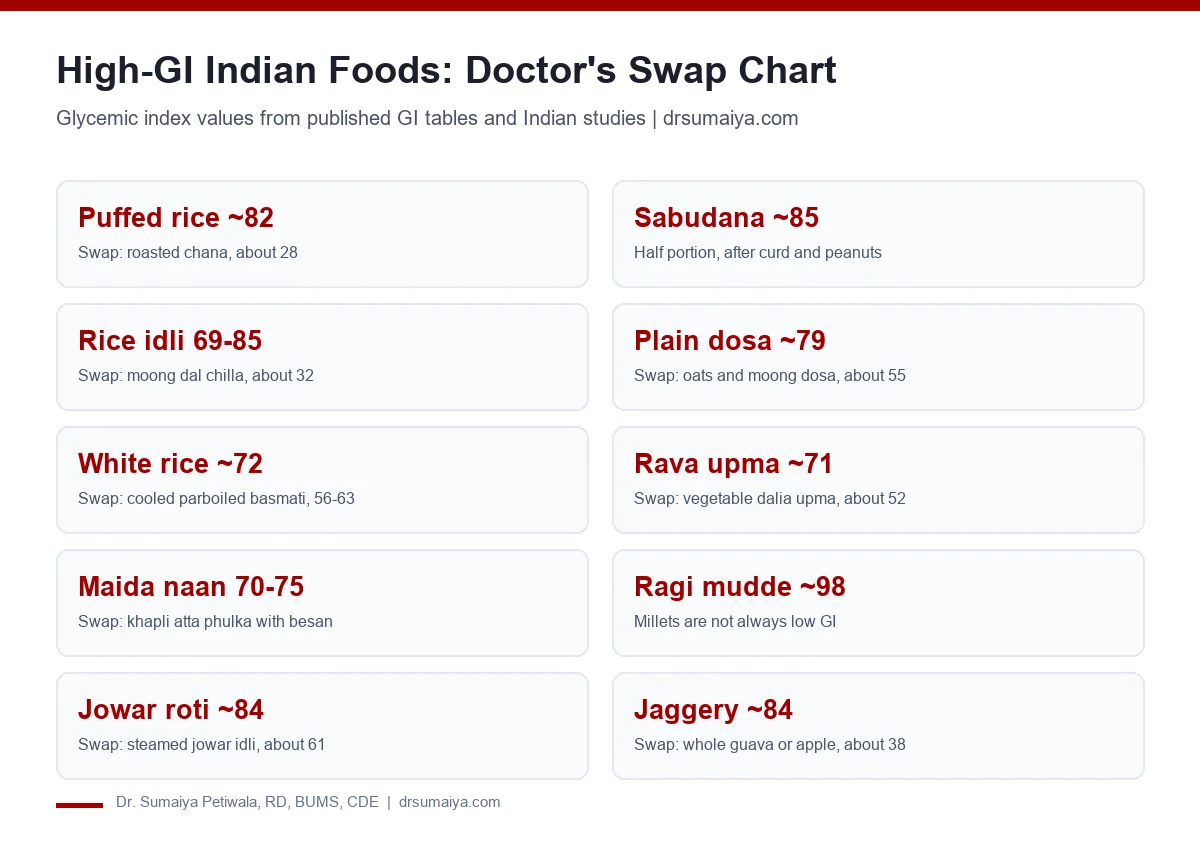
Everyday Indian carbohydrate foods, ranked by glycemic index.
How the Glycemic Index Works in Your Body
When you eat, your pancreas releases insulin. Think of insulin as a key. It opens the doors of your muscle cells so sugar can enter and be used for energy.
With insulin resistance (when those locks become rusty and jammed), sugar cannot get in easily. So it backs up in your bloodstream. Your body then makes even more insulin to force the doors open. Over years, this quiet struggle is what pushes people from normal sugar to prediabetes, and then to type 2 diabetes.
Now think about fibre as a brake pedal. A food with intact fibre digests slowly, like a car easing to a stop. A food with the fibre stripped away hits your blood like a car with no brakes.
This is why two foods with the same calories can behave completely differently. A bowl of puffed rice and a bowl of chana both contain carbohydrate. Only one of them sends your sugar soaring within 30 minutes.
How to read glycemic index numbers
- Low GI: 55 or below. Gentle rise in blood sugar.
- Medium GI: 56 to 69. Moderate rise.
- High GI: 70 and above. Sharp, fast rise.
One caution before you read the chart. A GI number is measured on a fixed portion of carbohydrate. It does not know your portion size, your cooking style, or your insulin level. So treat these numbers as a direction, not a verdict.
The 15 Hidden High-GI Indian Foods
These are the everyday foods I ask my patients to change first. None of them look like junk food. That is exactly what makes them hidden traps.
- Puffed rice (murmura) and bhel puri. Puffed rice is starch pushed full of air, with almost no fibre left. A chart value of about 82 means it hits fast. Most people eat three to four cups in one sitting without noticing.
- Rice poha (flattened rice). Poha is rice that has already been steamed and flattened. That pre-cooking speeds up digestion. Reported values sit in a wide band from 38 to 64, depending on thickness and how long you cook it. Plain, dry poha with a lot of sugar and lemon sits at the top of that band.
- Rice idli. Idli is steamed, so we assume it is safe. But the batter is usually four parts rice to one part dal. ICMR-NIN researchers measured idli with sambar at about 69. Another study listed rice idli at 85. The rice-heavy ratio is the problem, not the steaming.
- Plain rice dosa. Indian researchers measured plain dosa at about 79. Fermentation makes it airy and light, so it digests quickly. Two dosas can push sugar higher than a small bowl of rice.
- Polished white rice (Sona Masuri, Kolam). Published tables average boiled white rice at about 73. Sona Masuri has been reported around 72. Milling removes the bran, so all that is left is fast starch.
- Rava upma. Semolina is refined wheat. A published Indian entry lists upma at about 71. Rava is fine particles, so your enzymes attack it almost instantly.
- Maida naan and white bread. Refined flour has no bran and no germ. Comparable baked products score between 70 and 75. Restaurant naan is also brushed with fat and often eaten with sweet curry, which adds to the load.
- Sabudana khichdi and sabudana vada. Sabudana is nearly pure refined starch from tapioca, with very little protein. Consumer GI charts list it around 85. Fasting days often mean a full plate of it, which can undo a week of careful eating.
- Boiled and mashed potato. Boiled potato averages about 78. Mash it, and the score climbs to about 87 because the cell walls are broken. Aloo paratha and potato curry are double trouble.
- Instant oat porridge. Oats are famous as a healthy breakfast. But instant sachets are milled very fine. Published values are about 79 for instant porridge against 55 for rolled or steel-cut oats. Same grain, very different behaviour.
- Cornflakes and sweetened muesli. Extruded corn flakes average about 81. Many “diabetic friendly” muesli mixes add maltodextrin, honey, or dried fruit, which pushes the number up again.
- Ragi mudde (finger millet ball). This surprises almost every patient. Millets are whole grains, but a measured ragi stiff porridge scored about 98. When a grain is cooked into a sticky paste with very fine particles, it digests fast. Whole grain does not automatically mean low GI.
- Jowar (sorghum) roti. A measured jowar roti scored about 84. Interestingly, the same grain steamed as jowar idli scored only about 61. How you cook a grain matters as much as which grain you choose.
- Bajra (pearl millet) roti. A measured bajra roti came in at about 70. That is better than jowar roti, but still high when you eat three rotis with potato sabzi.
- Jaggery, honey, and fruit juice. Jaggery is often described as the healthy sugar. In practice, consumer charts list jaggery around 84 and honey around 61. Both are still fast sugars. Fresh juice removes the fibre that whole fruit gives you, which turns a snack into a sugar drink.
Full GI Chart: High-GI Indian Foods and Smart Low-GI Swaps
Use this table as your kitchen reference. The swap column is what I actually hand my patients.
| High-GI Indian Food | Glycemic Index | Why It Spikes Sugar | Smart Low-GI Swap | Swap GI |
|---|---|---|---|---|
| Puffed rice (murmura), bhel puri | About 82 | Air-puffed starch, almost no fibre | Roasted chana (whole chickpeas) | About 28 |
| Rice poha (flattened rice) | 38 to 64 | Pre-steamed, then flattened starch | Vegetable dalia (broken wheat) upma | About 52 |
| Rice idli with sambar | 69 to 85 | Rice-heavy 4 to 1 batter ratio | Moong dal chilla (2 parts dal, 1 rice) | About 32 |
| Plain rice dosa | About 79 | Fermented, airy, quick to digest | Oats and moong dosa | About 55 |
| Polished white rice | About 72 to 73 | Bran stripped off, only fast starch left | Cooked and cooled parboiled basmati or matta rice | About 56 to 63 |
| Rava upma (semolina) | About 71 | Refined wheat in very fine particles | Dalia upma with peas and carrots | About 52 |
| Maida naan, white bread | 70 to 75 | No bran, no germ, no fibre | Khapli atta phulka with besan | About 52 to 62 |
| Sabudana khichdi, vada | About 85 | Nearly pure tapioca starch, little protein | Half portion sabudana with curd and peanuts first | Portion and protein protected |
| Boiled and mashed potato | 78 to 87 | Cell walls broken, starch fully open | Cooled boiled sweet potato with skin | About 63 |
| Instant oat porridge | About 79 | Milled very fine, so starch opens fast | Rolled or steel-cut oats with chia and flaxseed | About 55 |
| Cornflakes, sweetened muesli | About 81 | Extruded grain plus hidden sugars | Rolled oats with curd and roasted seeds | About 55 |
| Ragi mudde (finger millet ball) | About 98 | Sticky fine paste digests very quickly | Whole ragi with generous dal and vegetables | Small portion, protein buffered |
| Jowar (sorghum) roti | About 84 | Fine flour, dry high-heat cooking | Steamed jowar idli | About 61 |
| Bajra (pearl millet) roti | About 70 | Fine-milled flour, eaten in threes | One bajra roti with equal dal and curd | About 30 with dal |
| Jaggery, honey, fruit juice | About 84 and 61 | Liquid or syrup sugar, no fibre to slow it | Whole guava or apple with the peel | About 38 |
Numbers are drawn from published international glycemic index tables and Indian studies (see References at the end). Values vary by variety, recipe, and cooking time. Treat them as a ranking, not a fixed promise.
Frustrated by Unpredictable Blood Sugar Spikes?
Managing diabetes is not about starving yourself. It is about smart food pairing for your own body. Dr. Sumaiya reviews your blood work and builds a meal plan around the food your family already cooks.
- Biomarker review: HbA1c, blood insulin levels, insulin resistance score, lipids and liver panel.
- Root-cause mapping: where your sugar curve actually breaks.
- Kitchen prescription: your regional recipes, rebuilt for stable sugar.
In-clinic at Frazer Town, Bengaluru. Telehealth for patients across India and for NRIs worldwide. Call or WhatsApp: +91 7208660987
Glycemic Index vs Glycemic Load: Which One Really Matters?
This is the question most patients ask me after reading a chart like the one above. The glycemic index alone can mislead you. That is why we also use glycemic load (the glycemic index multiplied by the actual carbohydrate in your serving).
Here is the practical difference. Watermelon has a high glycemic index of about 76. But one ordinary slice has very little carbohydrate, so its glycemic load is low. Watermelon is not the enemy. A large bowl of white rice has a moderate index and a huge load. The bowl is the enemy.
| Measure | What It Tells You | Real Example | How to Use It |
|---|---|---|---|
| Glycemic Index | How fast one fixed portion pushes sugar up | Watermelon scores about 76, which looks alarming | Use it to choose between two similar foods |
| Glycemic Load | How much sugar that real serving actually delivers | One slice of watermelon has a low load | Use it to decide how much you eat |
| Your portion | The single biggest lever you control at every meal | One katori of rice behaves very differently from three | Measure for two weeks, then trust your eye |
So the honest answer is this. High-GI foods are not banned. They are portioned, paired, and eaten last.
Dr. Sumaiya’s Meal Sequencing Protocol
You can lower the same meal’s sugar spike without changing a single ingredient. You only change the order. I call this the Indian Meal Sequencing Protocol, and patients find it the easiest habit to keep.
- Step 1: Fibre first. Start with salad, cucumber, or a bowl of sabzi. Fibre forms a soft gel in your stomach and slows everything behind it.
- Step 2: Protein second. Thick dal, chana, sprouts, paneer, eggs, fish, or chicken. Protein and fat slow the emptying of your stomach.
- Step 3: Carbohydrate last. One to two phulkas or one measured katori of rice, eaten at the end of the meal.
- Step 4: Walk for 10 minutes. Light walking after meals helps your muscles pull sugar out of the blood without extra insulin.
Three more kitchen rules help a lot. Add one teaspoon of pure cow ghee or cold-pressed oil to your dal. Add a fibre-rich vegetable to every carb meal. And never drink your carbohydrates, because liquid sugar arrives far too fast.
Your Indian Kitchen Plan: The 50/25/25 Plate
You do not need a printed diet chart from the internet. You need a way of building any plate in your own kitchen.
- Half the plate: cooked vegetables and sabzi, plus a raw salad. Bhindi, palak, methi, lauki, beans, cucumber, tomato, carrot.
- One quarter: protein. Thick dal with jeera or hing, boiled chana, sprouted moong, paneer, curd, eggs, fish, or chicken.
- One quarter: smart carbohydrate. One to two phulkas of whole wheat or khapli atta, or one measured katori of rice.
Smart swaps that cost nothing extra:
- Swap rava upma for vegetable dalia or rolled oats.
- Swap bhel puri for roasted chana or roasted makhana.
- Serve rice with an equal portion of thick dal and raw cucumber, always after the salad.
- Swap packaged juice and soft drinks for roasted jeera chaas or plain buttermilk.
- Cook rice or potato ahead, cool it in the fridge, and reheat it. Cooling changes part of the starch into a form your body absorbs more slowly.
Lab Tests to Monitor if You Have Sugar Spikes
Ask your doctor for these markers and keep a record. They tell the real story, not a single finger-prick reading.
- HbA1c (a blood test that shows your 3-month average blood sugar).
- Fasting insulin (a blood test that shows how much insulin is circulating before you eat anything).
- HOMA-IR (a calculated score that shows how resistant your cells are to insulin).
- Triglycerides (the main type of fat travelling in your blood after excess calories).
- Liver function and ultrasound to check for fatty liver (extra fat stored inside the liver).
- Vitamin B12 and vitamin D, especially on a vegetarian diet or long-term metformin.
If you are a woman with irregular cycles, ask about PCOS (a hormonal condition that makes insulin resistance worse). The same food rules help here, and they help early.
When sugar spikes need medical attention
Some symptoms should never wait for a diet change. See a doctor urgently if you have very high sugar readings with vomiting, deep rapid breathing, fruity-smelling breath, confusion, or extreme drowsiness. Also seek care for repeated low sugar episodes, blurred vision, or a foot wound that is not healing. Book a consultation for persistent readings above your agreed target, or if you feel unwell after meals on a regular basis.
Still Guessing Which Food Is Safe for You?
A generic internet chart cannot see your fasting insulin, your liver report, or your family’s cooking style. Your plan has to be built around your own reports and your own kitchen.
In-clinic at Frazer Town, Bengaluru. Telehealth pan-India and worldwide. Call or WhatsApp: +91 7208660987 | Email: doc@drsumaiya.com
Patient Questions About Blood Sugar Spikes
References
- Indian Council of Medical Research and National Institute of Nutrition. Dietary Guidelines for Indians: A Manual. ICMR-NIN, Hyderabad, India. nin.res.in
- American Diabetes Association. Standards of Medical Care in Diabetes: Facilitating Positive Health Behaviors and Well-being to Improve Health Outcomes. Diabetes Care. diabetesjournals.org
- Atkinson, F. S., Foster-Powell, K., and Brand-Miller, J. C. International Tables of Glycemic Index and Glycemic Load Values. Diabetes Care. PMC2584181
- Gayathri, R. and Mohan, V. Glycemic index of South Indian breakfast foods. Published Indian glycemic index research. PMC9304465
- A glycaemic index compendium of non-western foods. Nutrition and Diabetes. PMC7791047
- Glycemic index of traditional Indian foods and the effect of food form and processing. PMC9552392