The Biological Symphony of Fasting: How Your Hormones Adapt During Ramadan
Every year, millions of Muslims around the world observe Ramadan, a month characterized by strict fasting from dawn until sunset. For 29 to 30 days, absolutely nothing passes the lips during daylight hours—no food, and notably, no water.
To the conscious mind, Ramadan is a time of spiritual reflection, self-discipline, and community. But beneath the surface, inside your bloodstream and organs, your body is executing a brilliant, highly coordinated biological symphony.
The human body is the ultimate survival machine. When deprived of food and water for 12 to 18 hours a day, it doesn’t shut down; it recalibrates. This recalibration is driven by your endocrine system—the network of glands that produce hormones.
Here is an in-depth, accessible look at the fascinating hormonal shifts that happen inside your body during the month of Ramadan, and why what feels like a hardship is actually a profound biological reset.
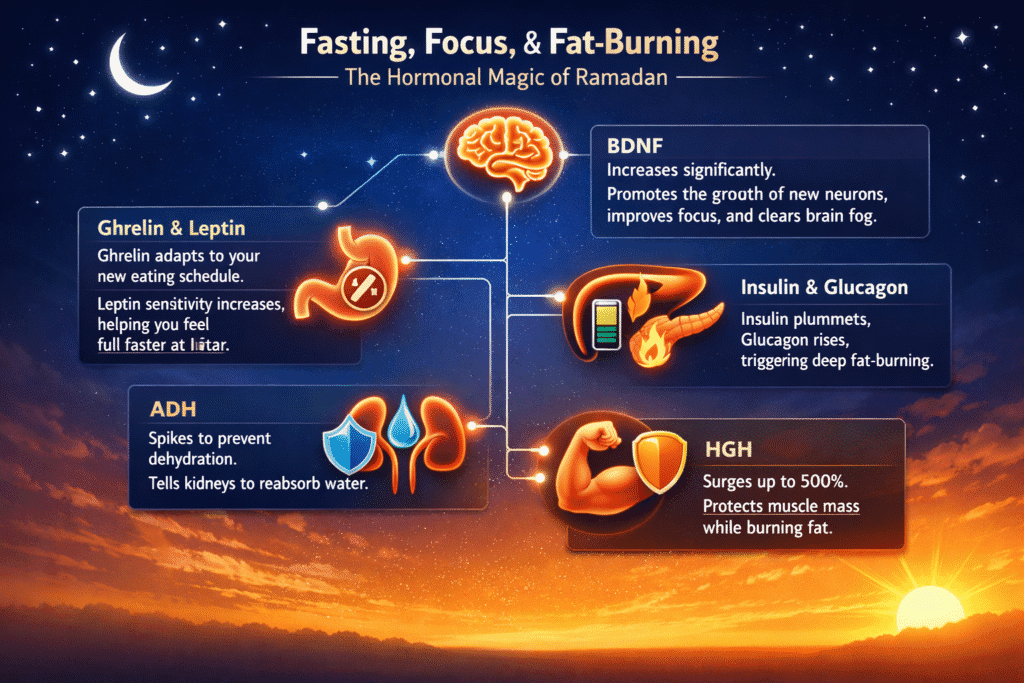
1. The Energy Shift: Insulin and Glucagon
To understand fasting, you must first understand the body’s “energy bank.”
When you eat, your pancreas releases insulin. You can think of insulin as a storage manager; its job is to escort glucose (sugar) from your blood into your cells for immediate energy, and pack the leftovers into your liver and fat cells for later.
During the fasting hours of Ramadan, insulin levels plummet. When insulin drops, your body realizes the incoming energy has stopped. It then releases insulin’s opposite hormone: glucagon.
Glucagon is the “withdrawal” hormone. It goes to your liver and says, “We need energy now!” The liver responds by releasing stored sugar (glycogen) into the blood. Once those sugar stores run low (usually around 8 to 12 hours into the fast), the body makes a profound metabolic shift: it starts breaking down stored body fat for energy.
The Result: This daily drop in insulin gives your pancreas a much-needed rest. Over the month, your body becomes incredibly efficient at managing blood sugar (improving “insulin sensitivity”), which drastically reduces the risk of type 2 diabetes and metabolic syndrome.
2. The Hunger Games: Ghrelin and Leptin
Anyone who has observed Ramadan knows that the first three to five days are the hardest. By day seven, the intense daytime hunger pangs mysteriously fade. You can thank two hormones for this: Ghrelin and Leptin.
- Ghrelin is known as the “hunger hormone.” (A good way to remember it: Ghrelin makes your stomach growl). Normally, ghrelin spikes at your usual meal times. On day one of Ramadan, your body expects lunch at noon, so it pumps out ghrelin. You feel starving. However, ghrelin operates on a circadian rhythm (a 24-hour internal clock). It is highly adaptable. After a few days of fasting, ghrelin “learns” your new schedule. It stops spiking during the day and shifts to peak right before Iftar (the evening meal).
- Leptin, on the other hand, is the “satiety hormone.” It tells your brain, “We have enough energy, you can stop eating.” Because your insulin levels are so low and stable during the day, your brain becomes highly sensitive to leptin. This is why, despite fasting all day, you often feel full after eating just a small amount of food at Iftar.
3. The Hydration Guardian: Anti-Diuretic Hormone (ADH)
Most popular intermittent fasting diets allow water. Ramadan fasting does not. Surviving a “dry fast” requires a specific hormonal response to prevent dangerous dehydration.
Enter Anti-Diuretic Hormone (ADH), also known as vasopressin.
As the day progresses and you lose water through breathing and slight sweating, your blood becomes slightly more concentrated. The brain senses this instantly and releases ADH. This hormone travels straight to your kidneys and gives a strict order: “Stop releasing water!”
The kidneys respond by reabsorbing water back into the bloodstream instead of turning it into urine. This is why you rarely need to use the restroom in the late afternoon of a fast, and why your urine is much darker. Your body is masterfully hoarding every drop of water it has to keep your vital organs functioning perfectly.
4. The Muscle Protector: Human Growth Hormone (HGH)
A common fear during Ramadan—especially among athletes—is the loss of muscle mass. However, human evolution has provided a hormonal defense mechanism: Human Growth Hormone (HGH).
If early humans lost all their muscle every time they couldn’t find food, our species would have gone extinct. Instead, fasting triggers a massive spike in HGH. Some studies show that fasting can increase HGH levels by up to 500%.
HGH serves a dual purpose during a fast: it instructs the body to burn fat for fuel, while simultaneously locking down and protecting muscle tissue. As long as you eat adequate protein during your feeding window (between sunset and dawn), your hormones will fight to keep your muscles intact.
5. The Stress and Wakefulness Managers: Cortisol and Adrenaline
Cortisol is famously known as the “stress hormone,” but it is also the “wake-up” hormone. Normally, cortisol peaks early in the morning to get you out of bed, and slowly drops throughout the day.
During Ramadan, your sleep and eating cycles are disrupted by waking up for Suhoor (the pre-dawn meal) and staying up late for prayers. Consequently, your cortisol rhythm shifts. Your body experiences a mild, biological stress from fasting. But this is a good kind of stress—known as hormesis. Just like lifting weights stresses muscles to make them stronger, the mild stress of fasting makes your cells more resilient.
Furthermore, as blood sugar drops, the body releases a slight amount of adrenaline. From an evolutionary standpoint, this was meant to give hunter-gatherers the energy and alertness required to hunt for food on an empty stomach. During Ramadan, this adrenaline often translates to a feeling of light, energetic alertness in the hours just before sunset.
6. The Brain Booster: BDNF
Have you ever noticed that after the first week of Ramadan, the mental fog lifts and is replaced by a deep sense of clarity and focus? This isn’t just a spiritual phenomenon; it’s a hormonal one.
Fasting stimulates the production of a protein hormone called Brain-Derived Neurotrophic Factor (BDNF). Neurologists often refer to BDNF as “Miracle-Gro for the brain.” It encourages the growth of new brain cells (neurons) and strengthens the connections (synapses) between them. High levels of BDNF are linked to improved memory, faster learning, and a lower risk of neurodegenerative diseases like Alzheimer’s.
Coupled with a slight increase in endorphins (the body’s natural painkillers and mood elevators), this biological cocktail is responsible for the “fasting high” many people experience during the holy month.
The Takeaway
Ramadan is undeniably a test of willpower, faith, and patience. But from a biological perspective, it is essentially a month-long workout for your hormones.
By repeatedly flipping the switch between feasting and fasting, you train your insulin to be more responsive, your hunger hormones to be more disciplined, your brain to be sharper, and your body to become a highly efficient, fat-burning, muscle-protecting machine. The human body is designed to endure and thrive in these conditions, turning a month of deprivation into a month of profound biological healing.
References:
1. Lessan, N., & Ali, T. (2019). “Energy Metabolism and Intermittent Fasting: The Ramadan Perspective.” Nutrients, 11(5), 1192. This is a highly comprehensive review that specifically looks at the Ramadan fasting model. It confirms the depletion of glycogen, the shift to fat oxidation (burning fat for fuel), and the overall improvement in insulin sensitivity.
2. Kul, S., et al. (2014). “Does Ramadan Fasting Alter Body Weight and Blood Lipids and Fasting Blood Glucose in a Healthy Population? A Meta-analysis.” Journal of Religion and Health, 53(3), 929-942. A large-scale analysis showing how the month-long daily drop in insulin positively impacts fasting blood glucose and overall lipid profiles.
3. Bogdan, A., et al. (2001). “Altered circadian rhythms of leptin, insulin, and cortisol in healthy men during Ramadan fasting.” The American Journal of Clinical Nutrition, 74(6), 746-749. A classic study demonstrating how the body’s circadian rhythm (internal clock) adjusts during Ramadan. It proves that the “peak” times for leptin and insulin shift to accommodate the new eating schedule, explaining why daytime hunger subsides.
4. Ajabnoor, G. M., et al. (2014). “Ramadan fasting in Saudi Arabia is associated with altered expression of CLOCK, DUSP and IL-1beta genes, as well as changes in melatonin and steroid hormones.” PLOS One. This study looks at the genetic and hormonal adaptations to the Ramadan eating schedule, highlighting how hunger and sleep hormones adapt to the disruption.
5. Leiper, J. B., et al. (2003). “Effects of fasting during Ramadan on water turnover in men living in the tropics.” Journal of Sports Sciences, 21(9), 738-744. This study examines how the body survives the “dry” aspect of Ramadan fasting. It discusses the bodily mechanisms, including urine concentration and water conservation, used to defend against severe dehydration.
6. Roky, R., et al. (2004). “Physiological and chronobiological changes during Ramadan intermittent fasting.” Annals of Nutrition and Metabolism, 48(4), 296-303.
7. Ho, K. Y., et al. (1988). “Fasting enhances growth hormone secretion and amplifies the complex rhythms of growth hormone secretion in man.” The Journal of Clinical Investigation, 81(4), 968-975. While not specific to Ramadan, this is the foundational medical study proving that fasting triggers massive spikes in Human Growth Hormone (HGH) to protect muscle mass and promote the breakdown of fat.
8. Salgin, B., et al. (2012). “The effect of prolonged fasting on levels of growth hormone-binding protein and free growth hormone.” Growth Hormone & IGF Research, 22(2), 76-81.
9. Faris, M. A. E., et al. (2019). “Impact of Ramadan Diurnal Intermittent Fasting on the Metabolic Syndrome Components in Healthy, Non-Athletic Muslim Men.” Physiology & Behavior, 209, 112640.
This study contains recent data specifically linking Ramadan Intermittent Fasting (RIF) to changes in neurotrophic factors and metabolic health.
10. Mattson, M. P. (2005). “Energy intake, meal frequency, and health: a neurobiological perspective.” Annual Review of Nutrition, 25, 237-260.
Note: The scientific community studies Ramadan under the term Ramadan Intermittent Fasting (RIF). The hormonal adaptations described in this article are supported by peer-reviewed studies on RIF and general intermittent fasting protocols.
For personalized Ramadan diet plan contact us at 7208660987 or fill our form www.drsumaiya.com/ramadan