

Have you ever wondered why your physical stamina dips, muscle recovery slows down, or your heart feels fatigued as the years advance? Deep within every cell of your body sits microscopic power generators called mitochondria. And driving their non-stop energy production is a compound called an antioxidant (a substance that protects your cells from daily wear and tear): Coenzyme Q10 (CoQ10).
While your heart, liver, kidneys, and pancreas naturally synthesize CoQ10 endogenously, tissue concentrations begin a steady decline after your third decade. Compounding this natural depletion, widely prescribed cardiovascular medications—particularly statin cholesterol therapies—inhibit the biochemical pathway responsible for producing CoQ10. This creates a state of cellular fatigue, increased oxidative stress, and muscular discomfort for millions of patients.
🩺 Quick Clinical Verdict: CoQ10 Forms, Dosing & Efficacy
Coenzyme Q10 is a critical mitochondrial antioxidant that supports cellular ATP energy production and cardiovascular pumping efficiency. While diet supplies only 3–5 mg daily, therapeutic clinical protocols require 100–300 mg daily. For individuals over 60 or those on statin therapy, active ubiquinol offers superior absorption over standard ubiquinone.
What Is Coenzyme Q10 (CoQ10) and How Does It Work?
Coenzyme Q10 is a fat-soluble, vitamin-like quinone concentrated in the inner mitochondrial membrane of metabolically demanding organs—most notably the heart muscle (myocardium), which beats over 100,000 times each day without pause.
At the biochemical level, CoQ10 serves two non-negotiable physiological functions:
- Cellular Energy Transduction: CoQ10 acts as a vital mobile electron carrier in the Mitochondrial Electron Transport Chain (the series of cellular protein complexes that convert oxygen and food into energy). Without adequate CoQ10, your cells cannot synthesize sufficient ATP or Adenosine Triphosphate (the biochemical energy currency that powers all muscular contractions, organ functions, and cellular repair).
- Potent Lipid-Soluble Antioxidant Defense: In its reduced form, CoQ10 directly scavenges reactive oxygen species (ROS) and lipid peroxyl radicals. It actively protects mitochondrial DNA and cell membranes from oxidative damage while regenerating other essential antioxidants, including vitamin E and vitamin C.
CoQ10 exists in your body in a continuous oxidation-reduction equilibrium between two distinct chemical states:
- Ubiquinone: The oxidized, conventional form of CoQ10. Once ingested, healthy young bodies convert ubiquinone into ubiquinol across the intestinal enterocytes.
- Ubiquinol: The reduced, active antioxidant form of CoQ10. Over 90% to 95% of the total circulating CoQ10 in human plasma naturally circulates as ubiquinol.
| Clinical Feature | Ubiquinone (Oxidized Form) | Ubiquinol (Reduced Form) | Dietary Food Sources |
|---|---|---|---|
| Chemical & Biological State | Fully oxidized coenzyme form; must be enzymatically reduced after ingestion. | Active, reduced electron-rich antioxidant form ready for immediate cellular action. | Mixed forms present in trace quantities within animal and plant tissues. |
| Bioavailability & Absorption | Moderate bioavailability (~2–4%); requires bile salts and dietary lipids for uptake. | Significantly higher bioavailability (up to 2–4x plasma absorption in older adults). | Extremely low absolute yield (average diet provides merely 3–5 mg total daily). |
| Ideal Patient Demographics | Healthy adults under age 40–50 with intact endogenous enzymatic conversion. | Adults aged 55+, individuals on statins, heart failure, high oxidative stress. | General baseline nutritional support; insufficient for therapeutic repletion. |
| Evidence-Based Daily Dose | 100–200 mg / day (divided into 2 servings taken with fat-containing meals). | 100–300 mg / day (clinically monitored for cardiac or metabolic protocols). | 3–5 mg / day (typical intake from organ meats, mackerel, sardines, sesame). |
| Cost & Stability | More affordable; chemically stable against light and ambient oxidation. | Higher manufacturing cost; requires specialized encapsulation to prevent oxidation. | Standard grocery cost; negligible therapeutic impact on clinical serum titers. |
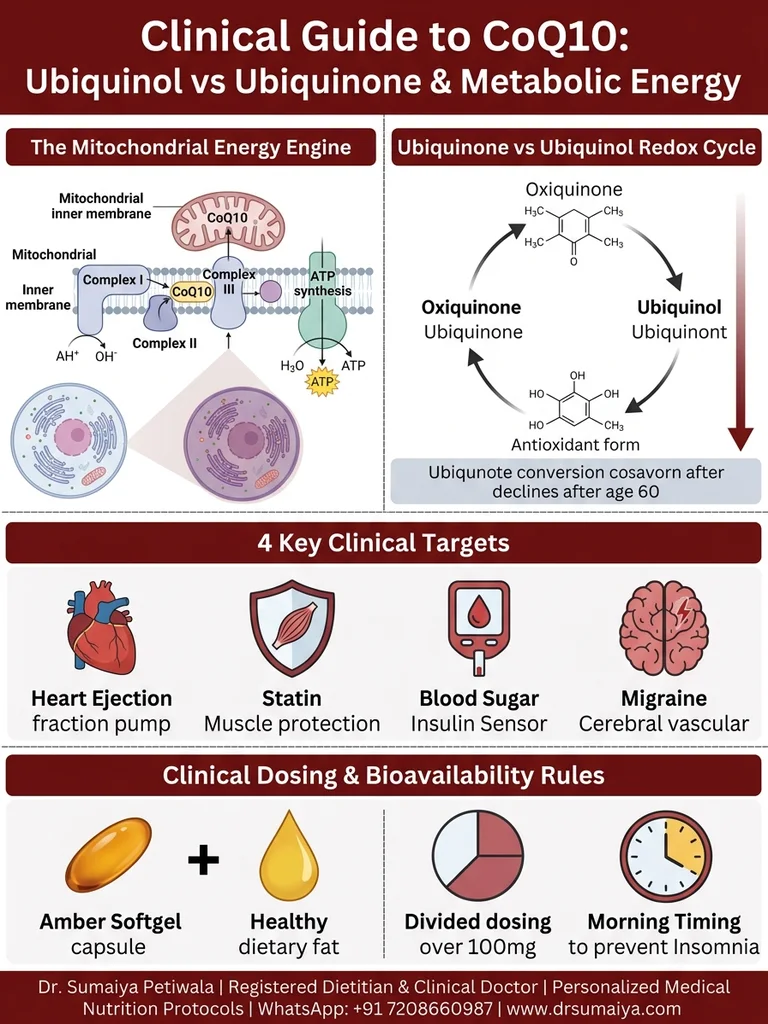
📊 Visual Summary: CoQ10 Mechanism of Action, Ubiquinol vs. Ubiquinone Absorption, Clinical Indications, and Dr. Sumaiya’s Evidence-Based Dosing Protocol.
The Age-Related Drop: Why Tissue CoQ10 Levels Plummet
Human plasma and myocardial concentrations of CoQ10 reach their peak during early adulthood (around age 20 to 25) and gradually wane over successive decades. By the time an individual reaches age 60 to 65, myocardial CoQ10 concentrations are approximately 50% lower than those of a healthy 20-year-old.
Equally critical is the decline in conversion efficiency. Aging decreases the activity of cellular reductase enzymes responsible for transforming dietary or supplement ubiquinone into active ubiquinol. Consequently, the plasma ubiquinol-to-total-CoQ10 ratio declines substantially in older adults, serving as a reliable clinical biomarker of systemic oxidative stress and reduced mitochondrial capacity.
Clinical Evidence: Top Health Benefits Backed by Medical Trials
1. Cardiovascular Support and Congestive Heart Failure
The human myocardium possesses the highest concentration of mitochondria of any tissue in the body. Because the heart never rests, it is exceptionally vulnerable to cellular energy deficits.
In a landmark randomized, double-blind multicenter trial published in JACC: Heart Failure (the Q-SYMBIO Trial), 420 patients with moderate-to-severe chronic heart failure were randomized to receive 100 mg of CoQ10 three times daily (300 mg total) or a matching placebo alongside standard medical therapy for two years. The results were profound:
- Patients in the CoQ10 group experienced a 43% relative reduction in major adverse cardiovascular events (MACE), including hospitalizations and cardiovascular mortality.
- Cardiovascular mortality was cut by nearly half (9% in the CoQ10 cohort versus 16% in the placebo group).
- Symptoms and NYHA functional class improved significantly, with benefits becoming pronounced after long-term, sustained repletion rather than short-term usage.
Furthermore, a comprehensive meta-analysis of 13 randomized clinical trials indexed in the American Journal of Clinical Nutrition demonstrated that CoQ10 supplementation yielded a statistically significant 3.67% improvement in left ventricular Ejection Fraction (the percentage of blood your heart pumps out with each contraction) in patients with congestive heart failure.
2. Statin-Associated Muscle Symptoms (SAMS) and Myalgia
Statin medications (such as atorvastatin, rosuvastatin, and simvastatin) are first-line therapies for hypercholesterolemia. They function by inhibiting the hepatic enzyme HMG-CoA Reductase (the primary control enzyme in the liver that synthesizes cholesterol).
However, the biochemical pathway that produces cholesterol—the mevalonate pathway—is the exact same pathway responsible for the endogenous biosynthesis of CoQ10. By blocking this cascade, statins routinely reduce circulating plasma CoQ10 levels by 30% to 50%. This depletion is thought to impair muscle mitochondrial respiration, contributing to Statin-Associated Muscle Symptoms (myalgia, cramping, muscle weakness, and fatigue experienced by up to 10–20% of patients on statin therapy).
While large guideline meta-analyses show heterogeneous responses, multiple targeted randomized trials demonstrate that supplementing with 100–200 mg/day of CoQ10—particularly when formulated as high-bioavailability phytosomes or taken with fat—significantly alleviates muscle soreness, improves handgrip strength, and enhances statin tolerance in symptomatic individuals.
3. Glycemic Regulation, Fasting Glucose & Insulin Sensitivity
Oxidative stress inside pancreatic beta-cells and peripheral muscle tissue impairs insulin signaling and reduces glucose uptake. In a systematic review and meta-analysis of 40 randomized controlled trials published in eClinicalMedicine (The Lancet Discovery Science), researchers investigated the impact of CoQ10 on glycemic profiles:
- Supplementation with 100–200 mg/day of CoQ10 generated statistically significant reductions in Fasting Blood Glucose (average drop of ~5.2 mg/dL) and HbA1c (a 3-month average measure of your blood sugar control, with a mean reduction of 0.12%).
- Circulating serum fasting insulin (a blood test that shows how hard your body is working to control blood sugar) levels dropped by approximately 1.3 µIU/mL, accompanied by measurable improvements in HOMA-IR (a calculated score measuring how resistant your body’s cells are to insulin).
- Clinical Nuance: The meta-analysis revealed a clear non-linear dose-response curve. Doses between 100 mg and 200 mg provided optimal glycemic modulation, whereas excessive mega-dosing (≥300 mg/day) offered no added metabolic benefit.
4. Migraine Prophylaxis & Neurovascular Energy
Mitochondrial dysfunction and impaired cerebral oxidative metabolism are established pathophysiological hallmarks of migraine headaches. Clinical trials published in Neurology demonstrated that 300 mg of CoQ10 daily reduced migraine frequency by approximately 50% after three months of consistent use compared to placebo, with noticeable reductions in nausea and episode duration.
5. Skin Elasticity and Photoprotection
Human skin is constantly subjected to extrinsic photo-damage from ultraviolet (UV) radiation and intrinsic biological aging. Placebo-controlled dermatological trials evaluating 100–150 mg of daily water-soluble CoQ10 documented significant reductions in fine peri-orbital and perioral wrinkle depth, improved viscoelastic properties, and enhanced dermal collagen resilience after 12 weeks.
Bioavailability Science: Ubiquinol vs. Ubiquinone
A frequent question asked in clinical consultations is: “Doctor, should I buy standard CoQ10 (ubiquinone) or active ubiquinol?”
The answer depends entirely on your age, digestive physiology, and medication profile:
- Oral Absorption Kinetics: Standard crystalline ubiquinone powder has notoriously poor Bioavailability (the proportion of an ingested nutrient that successfully crosses the gut wall and enters systemic circulation), with less than 2% to 4% absorbed due to its large molecular weight and extreme lipophilicity. Formulations dissolved in medium-chain triglycerides (MCTs), olive oil, or phytosomal lipid carriers dramatically enhance micellar absorption.
- Conversion Efficiency After Age 50: If you are under 40, your small intestine and liver readily convert absorbed ubiquinone into ubiquinol. However, after age 50 to 55—or if you have long-term inflammatory conditions, non-alcoholic fatty liver (extra fat stored inside your liver), or diabetes—your reductase enzymes lose efficiency. For this cohort, direct Ubiquinol supplementation provides 2x to 4x higher steady-state plasma concentrations for an identical oral dose.
Evidence-Based Dosage Guidelines
Because CoQ10 is Lipophilic (fat-soluble, meaning it requires dietary fats and bile salts to dissolve and enter intestinal lymph vessels), it must always be consumed alongside meals containing healthy dietary lipids (such as eggs, nuts, seeds, avocado, or pure desi cow ghee).
📋 Clinical Dosage Protocol by Indication:
- General Cellular & Mitochondrial Maintenance (Ages 35–50): 100 mg daily of ubiquinone or 50–100 mg ubiquinol with breakfast.
- Statin Therapy Support (Statin-Associated Myalgia): 100–200 mg daily in divided doses (e.g., 100 mg with breakfast, 100 mg with lunch).
- Cardiovascular Health & Heart Failure Adjunct: 100–300 mg daily under medical supervision, split into 2 to 3 doses. Clinical note: In heart failure patients, therapeutic benefits require at least 3 to 6 months of steady repletion; never discontinue abruptly.
- Metabolic syndrome (a cluster of problems such as high blood sugar, high blood pressure and extra belly fat) and insulin resistance (when your cells stop responding well to insulin): 100–200 mg daily of ubiquinol alongside personalized medical nutrition therapy.
- Migraine Prophylaxis: 300–400 mg daily in divided doses for a minimum 3-month therapeutic trial.
Timing Tip: CoQ10 stimulates cellular ATP production and may increase alertness in sensitive individuals. Doses exceeding 100 mg should be taken in the morning and afternoon. Avoid consuming high-dose CoQ10 late in the evening to prevent potential sleep disruption.
Safety Profile, Side Effects & Crucial Drug Interactions
Coenzyme Q10 exhibits an exemplary clinical safety record. Placebo-controlled clinical trials spanning over 16 months have evaluated doses as high as 1,200 mg per day without significant toxicity. Mild adverse events occur in fewer than 1% to 2% of users, primarily limited to mild nausea, upper abdominal fullness, or loose stools at high doses.
However, CoQ10 is a biochemically active molecule and interacts with specific pharmaceuticals:
- Warfarin & Blood Thinners: CoQ10 shares structural homology with Vitamin K2 (menaquinone). In high supplemental doses, CoQ10 can exhibit slight pro-coagulant activity, potentially blunting the anticoagulant efficacy of Warfarin and lowering your International Normalized Ratio (INR). Patients on Warfarin must never start CoQ10 without close INR monitoring by their treating physician.
- Antidiabetic Medications: Because CoQ10 improves peripheral insulin sensitivity and reduces fasting blood glucose, combining it with insulin, sulfonylureas, or metformin may exert additive glucose-lowering effects. Regular self-monitoring of blood glucose (SMBG) is recommended during the first 4 to 8 weeks of initiation.
- Antihypertensive Therapies: By promoting endothelial nitric oxide synthesis and arterial elasticity, CoQ10 can modestly lower systolic blood pressure (by 3–6 mmHg). If you take blood pressure medications, monitor your blood pressure to prevent asymptomatic hypotension.
- Chemotherapy Agents: While CoQ10 has been studied to protect cardiac tissue from anthracycline toxicity (e.g., doxorubicin), high-dose antioxidants may theoretically attenuate the therapeutic mechanisms of certain radiation and cytotoxic regimens. Oncologist clearance is mandatory before use during active cancer therapy.
Why Generic Supplement Prescriptions Fail
Many patients walk into clinics holding multiple bottles of over-the-counter supplements, wondering why their fatigue, muscle pain, or metabolic markers haven’t improved. The reality of nutritional biochemistry is clear: no single supplement operates in a vacuum.
CoQ10 synthesis and cellular mitochondrial function rely on an intricate web of nutritional cofactors, including Vitamin B6, B12, folate, magnesium, selenium, and iron. If your diet is deficient in basic micronutrients, or if your gut microbiome cannot properly emulsify and absorb fats due to subclinical bile acid insufficiency or dysbiosis, oral capsules will simply pass unabsorbed.
This is why indiscriminate self-prescribing rarely delivers clinical results. Sustainable vitality requires a structured, biomarker-led investigation that diagnoses your unique metabolic bottlenecks before crafting a precision dietary and repletion protocol.
CoQ10 in Your Indian Kitchen
CoQ10 is fat-soluble. That means your body absorbs it best with a little healthy fat in the same meal. You do not need exotic food to support your levels.
Where CoQ10 sits on an Indian plate
- Eggs, sardines and mackerel, and chicken or mutton liver are the richest everyday sources.
- Vegetarian sources include soybean, peanuts, roasted chana, whole wheat, spinach, cauliflower and broccoli.
- Serve these with a little fat, such as a teaspoon of ghee on your roti or a katori of curd, so the nutrient is absorbed.
Three swaps for your daily meal
- Swap a plain white-bread breakfast for two eggs with one phulka and a bowl of vegetable sabzi.
- Swap a fried evening snack for a small katori of masala peanuts or roasted chana with buttermilk.
- Swap a dessert for a bowl of curd with fruit, so your protein and fat intake stay steady.
Follow the 50/25/25 plate at lunch and dinner: half plate vegetables and salad, quarter plate protein such as dal, chana, paneer, eggs, fish or chicken, and quarter plate whole carbs such as phulka or millet roti. Eat salad and sabzi first and roti last. This simple order keeps your meals steady.
Frequently Asked Questions (FAQs)
Can I obtain enough CoQ10 from my daily diet alone?
No. The typical diet provides merely 3 to 5 mg of CoQ10 per day, predominantly from organ meats (beef heart, liver), fatty cold-water fish, and small amounts in sesame seeds and peanuts. Because clinical therapeutic benefits—such as myocardial support, statin myalgia relief, or migraine prophylaxis—require between 100 mg and 300 mg daily, achieving these levels through food alone is physiologically impossible without targeted supplementation.
Which form of CoQ10 is better: Ubiquinol or Ubiquinone?
Both forms raise blood levels, but ubiquinol is the active, reduced antioxidant form. In healthy adults under 40 years old, standard ubiquinone is cost-effective and readily converted by the body. However, for individuals over age 50, those taking statin medications, or patients managing cardiovascular conditions, endogenous conversion enzymes decline significantly. In these cases, ubiquinol provides superior cellular bioavailability and 2 to 4 times higher plasma absorption.
What is the best time of day to take CoQ10?
CoQ10 should always be taken in the morning or early afternoon alongside a meal containing healthy dietary fats (such as eggs, nuts, avocado, or desi cow ghee) to maximize intestinal absorption. Because CoQ10 directly stimulates cellular ATP mitochondrial energy production, taking doses greater than 100 mg late in the evening or before bed may cause mild insomnia or sleep disturbances in sensitive individuals.
Does CoQ10 interact with blood thinning or diabetes medications?
Yes. CoQ10 shares chemical structural similarities with Vitamin K2 and may reduce the blood-thinning effectiveness of Warfarin, requiring close medical INR monitoring. Additionally, because CoQ10 enhances cellular insulin sensitivity and lowers fasting blood sugar, it may have an additive effect when combined with diabetes drugs like insulin or metformin. Always consult your prescribing doctor or clinical dietitian before starting CoQ10.
About this guide
This guide provides general health information. Your own care depends on your medical history and circumstances. Speak with your treating clinician before changing medicines or treatment.