

Dr. Sumaiya Petiwala, RD, BUMS, CDE · Registered Clinical Dietitian & Medical Doctor · Evidence-Based Clinical Nutrition Guide · November 2026
Every week at my clinic in Frazer Town, Bengaluru and during online consultations with patients across India, I hear the same story. Patients say: “Doctor, my TSH (the brain signal that checks body metabolism) is normal at 3.8. I take my thyroid (the master metabolism gland in your neck) tablet every morning. But my weight keeps rising, my face looks puffy, and I feel worn out by afternoon.”
If this sounds like you, you are not alone. When you live with hypothyroidism (an underactive thyroid (the master metabolism gland in your neck) that makes too little hormone), a normal test on paper does not always mean your cells are burning fat. True recovery means looking deeper than one test. It means giving your body the right home meals to turn thyroid hormone into active energy.
Why am I gaining weight if my TSH is normal with hypothyroidism?
Hypothyroidism slows down your metabolic rate, causing stubborn weight gain, fatigue, and water retention even when TSH blood tests appear normal. Converting inactive T4 into active T3 requires selenium, zinc, and iron. Dr. Sumaiya’s clinical recommendation: protect muscle with 50/25/25 Indian meals and keep a strict 60-minute thyroid medication window.
The Thyroid Thermostat: Why “Normal” Tests Can Still Leave You Tired
Think of your thyroid (the metabolism control gland in your neck) as your master thermostat. When it runs warm, your cells burn food for fuel, your bowels move daily, and your energy stays strong. When it runs cold, every organ slows down.
Most routine clinics only test TSH. But testing TSH alone has two major blind spots:
- The Normal Range Is Too Broad: Standard labs mark any score between 0.45 and 4.5 mIU/L as normal. While 4.0 looks fine on paper, many Indian adults feel sluggish unless their personal level sits between 1.0 and 2.0 mIU/L.
- The Storage Hormone Trap: Your daily pill provides Free T4 (the storage form of thyroid hormone). Think of T4 as paper money in your pocket. Your body cannot spend it yet. Your liver and gut must turn it into Free T3 (the active hormone that burns calories). If that step stalls, your cells stay starved of energy even when your TSH looks fine.
In addition, up to 90% of low thyroid cases in adults stem from Hashimoto’s thyroiditis (an autoimmune condition where your immune system attacks your thyroid). Checking Anti-TPO antibodies (proteins that attack thyroid cells in autoimmune disease) tells us if silent inflammation (ongoing immune tissue irritation) is slowing down your thyroid.
Clinical Evidence: Thyroid Slowdown & Metabolic Rate
Research shows an underactive thyroid can drop your basal metabolic rate / BMR (the daily calories your body burns at rest just to stay alive) by 15% to 35%. Extreme crash diets make this worse. Starving yourself signals your liver to make reverse T3, which locks up your metabolism.
Low thyroid also often brings on insulin resistance (when your body cells stop responding well to insulin). This diverts extra carbs into visceral fat (deep belly fat packed tightly around internal organs). Healing your metabolism requires steady protein and minerals—not starvation.
| Metabolic Check | Standard Lab Range (“Normal”) | Optimal Functional Target | Why It Stalls Weight Loss | Practical Indian Kitchen Solution |
|---|---|---|---|---|
| TSH (Thyroid Signal) | 0.45 to 4.5 mIU/L | 1.0 to 2.0 mIU/L | High-normal score points to a sluggish thyroid gland | Keep a strict 60-minute gap before morning tea or food |
| Free T3 (Active Hormone) | 2.0 to 4.4 pg/mL | Upper half of normal range (>3.2 pg/mL) | Low active T3 drops resting calorie burn by up to 30% | Eat 1 spoon of pumpkin and sunflower seeds daily for selenium (a mineral that helps turn T4 into active T3) |
| Anti-TPO Antibodies | <35 IU/mL (Negative) | Zero or undetectable antibodies | High antibodies signal ongoing immune stress on thyroid tissue | Build an anti-inflammatory plate; cut refined oils and excess bakery foods |
| Insulin & Blood Sugar | Fasting insulin (the insulin level in your blood after an overnight fast) <25 µIU/mL | Fasting insulin <6 µIU/mL; HOMA-IR (a score calculating cellular insulin resistance) <1.5 | High insulin locks your fat stores and halts fat burning | Use the 50/25/25 Indian plate rule and eat vegetable fiber first |
| Serum Ferritin (Iron Reserve) | 15 to 150 ng/mL | >50 to 70 ng/mL | Low ferritin (your body’s stored iron reserve needed to build thyroid hormone) blocks hormone-making enzymes | Pair cooked palak or methi greens with fresh lemon juice and soaked kala chana |
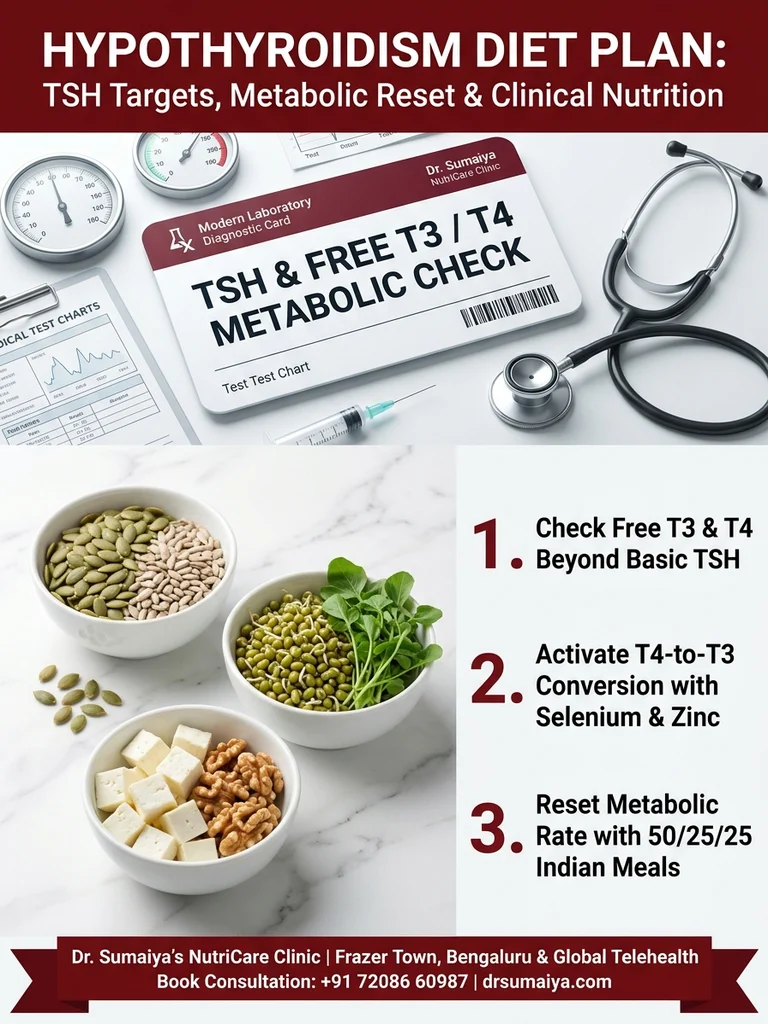
📊 Visual Clinical Summary: Hypothyroidism Diet Plan India: TSH Targets & Metabolic Reset — Dr. Sumaiya NutriCare Clinic.
Common Indian Kitchen Mistakes That Block Thyroid Healing
Many patients make small daily mistakes that block their medicine or slow down hormone conversion. Here are three major missteps to fix right away:
1. Taking Your Thyroid Pill with Morning Chai, Coffee, or Milk
Thyroid tablets need an empty, acidic stomach to break down. Milk proteins, coffee oils, and tea tannins bind tightly to the pill. This flushes up to 40% of the medicine out of your body unabsorbed. Always swallow your tablet with plain water upon waking. Then wait a full 60 minutes before having your morning tea, coffee, or breakfast.
2. Fearing Cabbage, Cauliflower, and Greens
Many people believe they must avoid cabbage (patta gobi), cauliflower (phool gobi), and mustard greens (sarson). Raw cruciferous vegetables do carry goitrogens (natural plant compounds that can slow iodine uptake if eaten raw in large amounts). But heating them in daily Indian sabzis or dal completely deactivates these compounds. Cooked gobi, cabbage, and spinach are safe, gut-healing, and full of fiber.
3. Starving on “Fruit and Cucumber Only” Diets
When weight refuses to move, many people skip lunch or eat only raw fruit. This backfires on thyroid health. Without enough protein, your body breaks down muscle mass. That lowers your daily calorie burn even further, making rebound weight gain almost certain.
The 4 Pillars of the Dr. Sumaiya Indian Thyroid Meal Plan
Reviving an underactive thyroid means feeding your cells with everyday foods from your local market:
Pillar 1: Key Minerals for T4-to-T3 Hormone Activation
- Selenium & Zinc: Your liver needs these two minerals to turn storage T4 into active T3. Eat 1 tablespoon of raw pumpkin and sunflower seeds daily, along with soaked walnuts and roasted chana.
- Iron & Ferritin Support: The enzyme that builds thyroid hormones depends on iron. Eat soaked kala chana, sprouted green moong, and cooked methi greens. Squeeze fresh lemon juice on top to boost iron uptake.
- Iodine Balance: Cook with standard iodized salt in normal home amounts. Avoid exotic pink salts that lack reliable iodine.
Pillar 2: The 50/25/25 Indian Plate Architecture
Structure your lunch and dinner with this steady metabolic balance:
- 50% Cooked Vegetables & Fresh Salad: Bhindi, lauki, tori, French beans, cooked cabbage, or palak, plus a small katori of cucumber and tomato salad.
- 25% High-Quality Clean Protein: Thick dal (toor, moong, or masoor with a jeera-hing tadka), boiled rajma, paneer, curd, whole eggs, or grilled fish or chicken.
- 25% Complex Smart Grains: One or two phulkas made from traditional khapli wheat (emmer) or unpolished foxtail millet.
Pillar 3: The Golden Eating Sequence (The Fiber Brake Pedal)
Eat your salad and cooked sabzi first. The vegetable fiber forms a gentle gel that acts like a Fiber Brake Pedal in your gut. Eat your dal or protein second, and eat your roti or rice last. This sequence flattens after-meal sugar spikes and keeps insulin low.
Pillar 4: Heal Your Gut Garden
About 20% of your body’s T4-to-T3 hormone conversion takes place inside your gut with help from healthy bacteria. Drink a glass of fresh spiced chaas (buttermilk) with roasted jeera and ginger after lunch. It eases bloating and aids smooth bowel habits.
Simple Tips for Busy Professionals & NRIs
If you live outside India or travel often, follow these easy rules: keep a strict 60-minute window between your pill and your morning espresso; start restaurant meals with vegetable soup or a salad; choose grilled fish, paneer tikka, dal, or chicken as your main protein; and snack on roasted makhana or pumpkin seeds instead of bakery cookies.
The Testing Gap: 5 Checks to Request Beyond TSH
Do not settle for a basic TSH check if you still feel tired or notice stubborn weight gain. Ask your doctor for this full panel:
🩺 Dr. Sumaiya’s Full Thyroid & Metabolic Lab Audit
- Complete Thyroid Profile: TSH, Free T3, and Free T4 to see real circulating active hormone levels.
- Autoimmune Markers: Anti-TPO and Anti-Thyroglobulin antibodies to check for Hashimoto’s thyroiditis.
- Insulin & Blood Sugar: Fasting blood sugar, fasting insulin, and HOMA-IR to catch hidden insulin resistance early.
- Iron Storage: Serum Ferritin (aim for over 50 ng/mL for good thyroid enzyme function).
- Vitamin Baseline: Vitamin D3 and Vitamin B12 to support energy, nerves, and immune balance.
How Dr. Sumaiya NutriCare Clinic Helps You Reset Your Thyroid & Metabolism
Overcoming hypothyroidism is not about starving yourself or taking unverified herbal teas or juices. It is about understanding your unique body chemistry and giving your liver, gut, and thyroid the exact nutrients they need to make active hormone.
At Dr. Sumaiya NutriCare Clinic, Dr. Sumaiya Petiwala (Medical Doctor and Registered Clinical Dietitian) provides doctor-guided Medical Nutrition Therapy tailored to your blood reports, work life, and home kitchen.
Frequently Asked Questions
1. Why am I still gaining weight even though my TSH blood test is normal?
A normal TSH (often between 0.45 and 4.5 mIU/L) only reflects the brain signal to your thyroid gland. It does not measure whether your liver and gut are converting storage T4 into active, fat-burning Free T3. Poor hormone conversion, insulin resistance, and low muscle mass keep your metabolism slow despite normal TSH reports.
2. Can I safely eat cabbage, cauliflower, and spinach if I have hypothyroidism?
Yes, as long as they are thoroughly cooked. Raw cruciferous vegetables contain goitrogens that can compete with iodine uptake. Thorough boiling, pressure cooking, or sautéing in traditional Indian sabzis completely deactivates these compounds, making cooked gobi, patta gobi, and palak safe and nutrient-rich.
3. How long should I wait after taking my thyroid tablet before having morning chai or breakfast?
You must wait a strict 45 to 60 minutes before drinking tea, coffee, milk, or eating breakfast. Milk proteins, caffeine, and tannins bind tightly to thyroid hormone tablets in your stomach, blocking absorption and reducing your effective dose by up to 40%.
4. What is the difference between simple hypothyroidism and Hashimoto’s thyroiditis?
Hypothyroidism is the general medical diagnosis of an underactive thyroid. Hashimoto’s thyroiditis is the underlying autoimmune condition responsible for up to 90% of cases, where your immune system creates Anti-TPO antibodies that attack thyroid cells. Hashimoto’s requires an anti-inflammatory nutrition approach to calm immune activity.
5. How does Dr. Sumaiya customize a thyroid diet plan for Indian kitchens?
Dr. Sumaiya audits your full biomarker panel—including Free T3, Free T4, Anti-TPO antibodies, ferritin, and fasting insulin—rather than relying on TSH alone. She then prescribes a personalized Indian home meal plan balancing the 50/25/25 plate rule, mineral cofactors like selenium and zinc, and realistic grocery staples without crash dieting.
Clinical Evidence Sources: American Thyroid Association & American Association of Clinical Endocrinologists Guidelines for Hypothyroidism. Endocrine Society Guidelines on Thyroid Dysfunction. ICMR-NIN Dietary Guidelines for Indians (2024). Rayman MP. Multiple nutritional factors in thyroid disease. Lancet Diabetes Endocrinol. 2021.
🌟 Transform Your Health Today
Takes only 60 seconds to send a booking enquiry.
"Lost 4kgs in one month... plans are simple and effective! She
responds to queries promptly."
– Payal J.
About this guide
This guide provides general health information. Your own care depends on your medical history and circumstances. Speak with your treating clinician before changing medicines or treatment.