
By Dr. Sumaiya Petiwala, RD, BUMS, CDE (Registered Clinical Dietitian & Medical Doctor)
For decades, patients in India have been reassured by routine health checkups that as long as their Body Mass Index (BMI) sits near the “normal” cutoff, their metabolic health is safe. Yet in clinical practice, I routinely see men and women with a seemingly normal body weight who carry a firm, protruding midsection alongside borderline blood sugar and elevated liver enzymes. A pivotal study published on November 3, 2026 in the journal Livers (MDPI Livers Study) using FibroScan transient elastography confirms why BMI fails to detect central organ fat—and why the Body Roundness Index (BRI) paired with the liver enzyme GGT is the superior clinical detector of steatotic liver injury.
The Body Roundness Index (BRI) is a geometric visceral fat metric combining waist circumference and height that outperforms Body Mass Index (BMI). A November 2026 FibroScan study demonstrated that high BRI quartiles increase severe fatty liver risk from 1.8% to 33.3%, particularly when paired with elevated GGT liver enzymes.
The Science & Myth-Busting: Why BMI Is Blind to the “Portal Vein Fat Spillover”
Body Mass Index simply divides your total weight by your height squared—meaning it cannot distinguish between protective leg muscle and inflammatory deep belly fat. In contrast, the Body Roundness Index (BRI) models the human torso as an ellipse, comparing your waist circumference against your height to quantify visceral adipose tissue [metabolically active fat packed tightly around your liver, pancreas, and intestines] (Understanding Fat Loss & Digestion).
Think of visceral belly fat as an Overflowing Fuel Tank connected directly to your liver via a private highway called the portal vein [the main blood vessel draining blood from the digestive tract and visceral fat directly into the liver]. Unlike harmless subcutaneous fat under the skin of your hips or thighs, visceral fat cells constantly leak non-esterified fatty acids [free fat molecules released into the blood that jam insulin receptors] and inflammatory signals straight into the liver. This blocks your Insulin Key and triggers oxidative stress, causing liver cells to leak an enzyme called gamma-glutamyl transferase (GGT) [a sensitive liver enzyme that rises early when the liver faces oxidative stress and glutathione depletion].
In the November 3, 2026 study of 2,645 adults evaluated by FibroScan (Livers 2026), researchers uncovered three critical clinical facts:
- Severe Steatosis Surged 18-Fold Across BRI Tiers: Severe liver fat (Grade S3 steatosis) jumped from just 1.8% in the lowest BRI quartile (Q1, mean BRI ~3.0) to 33.3% in the highest BRI quartile (Q4, mean BRI ~8.6), while advanced fibrosis climbed from 0% to 6.7%.
- Asian Ethnicity Carried a 3x Higher Risk: Asian participants had an independent 3.07-fold higher odds of metabolic-associated steatotic liver disease even after adjusting for BMI and age.
- Waist Circumference + GGT Beat Every Other Test: Among all blood markers, GGT (at a cutoff of just 27.5 U/L—well below many standard lab upper limits of 50 U/L!) outperformed ALT and AST, and combining Waist Circumference with GGT achieved the highest diagnostic accuracy (AUC = 0.817).
| Diagnostic Metric | What Routine Checkups Tell You | What November 2026 Clinical Data Reveal |
|---|---|---|
| Body Mass Index (BMI) | “Normal” if under 25 kg/m²; misses central abdominal fat | Fails to predict steatotic liver severity once BRI is accounted for |
| Body Roundness Index (BRI) | Rarely calculated in standard outpatient clinics | BRI > 4.6 signals high visceral fat; Q4 carries 12.8x higher liver risk |
| GGT Liver Enzyme | Often ignored unless above 50-60 U/L or only blamed on alcohol | GGT > 27.5 U/L is the #1 blood predictor of metabolic hepatic oxidative injury |
| Waist-to-Height & Waist Cutoff | Uses generic Western cutoffs (102 cm men / 88 cm women) | Asian metabolic risk rises above 90 cm (men), 80 cm (women), or BRI > 4.6 |
3 Practical Indian Food Upgrades to Shrink Your BRI & Lower GGT Naturally
Because visceral fat is highly sensitive to post-meal insulin spikes and hepatic oxidative stress, pressing the Fiber Brake Pedal and replenishing liver antioxidants can shrink waist circumference faster than subcutaneous fat (Foods That Spike Blood Glucose).
1. Replace Refined Evening Starches With Foxtail Millet, Khapli Wheat & Flaxseed Podi
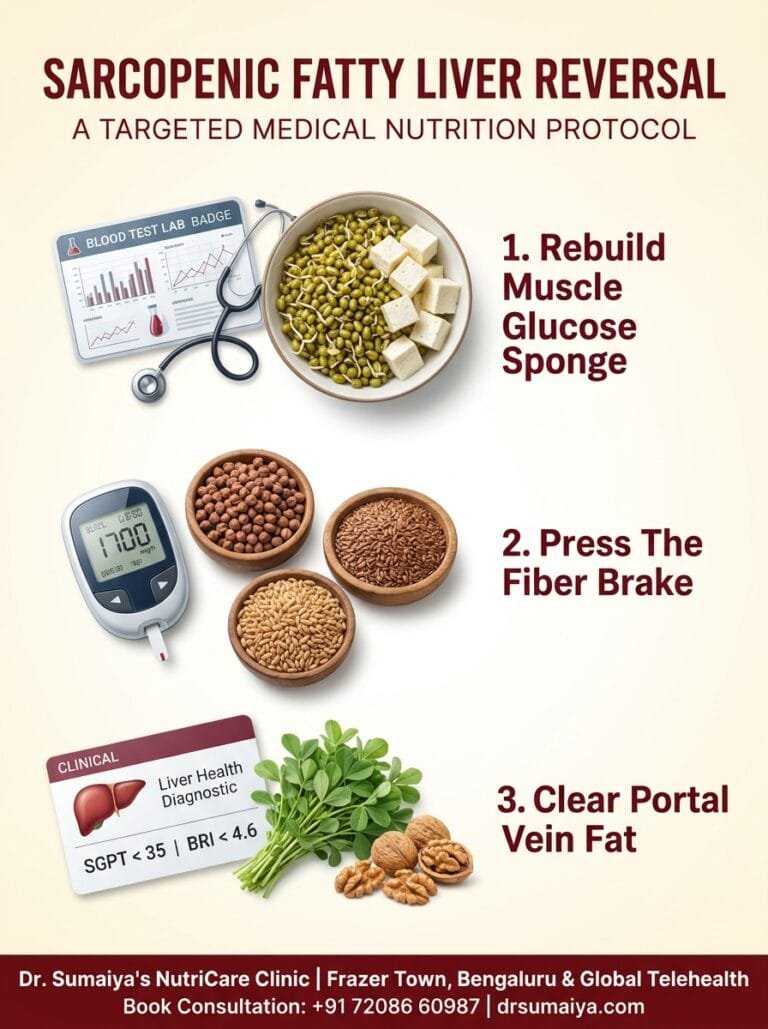
Visceral fat accumulates fastest when high-glycaemic carbs are eaten at night when peripheral insulin sensitivity drops. Swap white rice or refined wheat rotis at dinner for unpolished foxtail millet or khapli wheat chapati paired with 1 tablespoon of freshly roasted flaxseed podi. The lignans and alpha-linolenic acid in flaxseed reduce portal-vein fatty acid flux into the liver.
2. Replenish Hepatic Glutathione (To Lower GGT) With Methi Greens, Whole Moong & Paneer
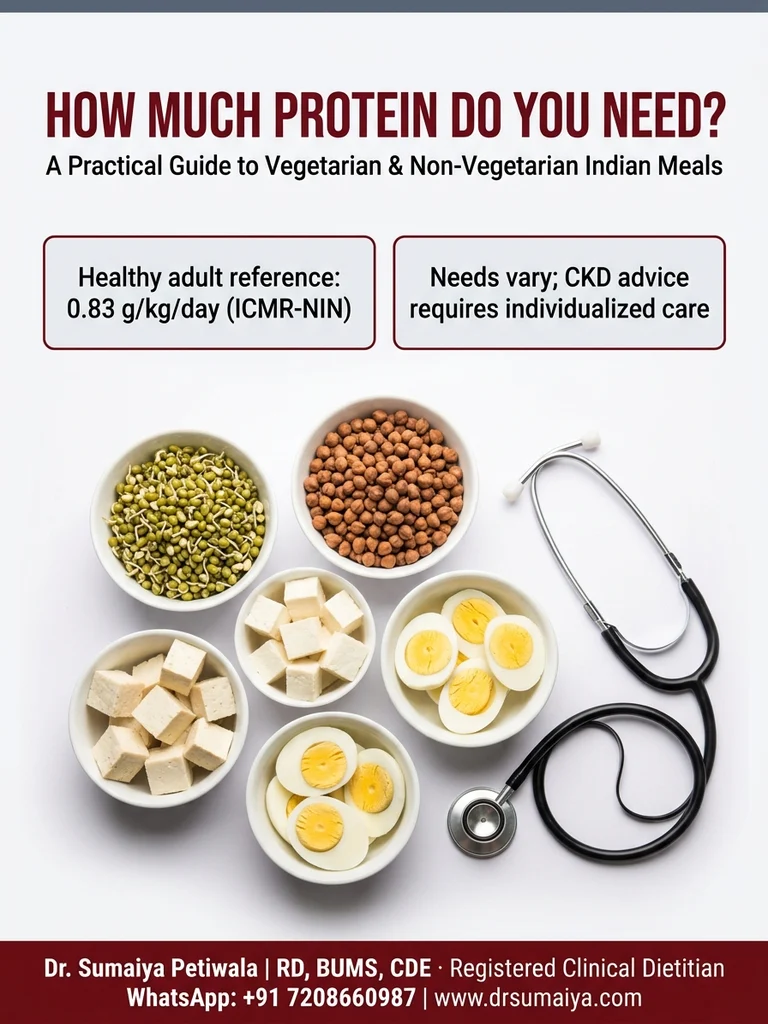
Elevated GGT is a direct distress signal that your liver is running low on glutathione [the liver’s master intracellular antioxidant that neutralizes free radicals]. Rebuild glutathione precursors (cysteine, glycine, and glutamate) by pairing sulfur-rich methi greens, garlic-tempered spinach, and cruciferous sabzis with bioavailable proteins like homemade paneer and sprouted whole moong at lunch.
3. Eliminate Liquid Fructose & Anchor Midday Meals With Kala Chana and Rajma
Packaged juices, sweetened beverages, and weekend alcohol act synergistically with visceral fat to spike GGT and accelerate liver fibrosis. Replace liquid sugars with infused jeera-coriander water, and anchor your afternoon meals with intact-cell legumes—specifically kala chana or rajma—whose slow colonic fermentation boosts butyrate and improves waist-to-height ratios.
The Diagnostic Gap: Get Your Clinical BRI, GGT & Visceral Metabolic Audit
Don’t wait for your BMI or routine ALT/AST to cross into the “red zone” when a rising waist line and a GGT above 27.5 U/L are already signaling silent visceral and hepatic strain. At Dr. Sumaiya’s NutriCare Clinic, we calculate your exact Body Roundness Index (BRI), Waist-to-Height Ratio, GGT-to-Platelet fibrosis risk, and HOMA-IR to design a physician-supervised Medical Nutrition Therapy protocol that targets deep abdominal fat first.
🌟 Transform Your Health Today
Takes only 60 seconds to send a booking enquiry.
"Lost 4kgs in one month... plans are simple and effective! She
responds to queries promptly."
– Payal J.
Frequently Asked Questions (Clinical FAQs)
1. What is a healthy Body Roundness Index (BRI) score to prevent fatty liver?
In the November 2026 FibroScan study, the lowest risk quartile had a mean BRI of 3.01, whereas a BRI cutoff above 4.6 was identified as the threshold where steatotic liver disease risk and visceral adiposity rose sharply.
2. Why is my GGT liver enzyme elevated even if I rarely or never drink alcohol?
While GGT is traditionally associated with alcohol intake, modern research shows that visceral belly fat, insulin resistance, and high dietary fructose cause hepatic oxidative stress and glutathione depletion, driving GGT above 27.5 U/L even in non-drinkers or light social drinkers.
3. Why are Indians and South Asians at higher risk for fatty liver at a lower BMI?
South Asians have a lower subcutaneous fat storage threshold, meaning excess energy spills over into visceral abdominal depots and liver cells much earlier (often at a BMI of 22 to 24 kg/m²), making BRI and waist circumference far more accurate than BMI.
4. Which Indian foods reduce visceral waist circumference fastest?
Replacing refined grains and liquid sugars with intact high-fiber staples (foxtail millet, khapli wheat, kala chana, whole moong, rajma, methi greens, and flaxseed podi) anchored by 25 to 30g of protein per meal (such as paneer) lowers post-meal insulin and mobilizes visceral fat stores first.
About this guide
This guide provides general health information. Your own care depends on your medical history and circumstances. Speak with your treating clinician before changing medicines or treatment.