

Dr. Sumaiya Petiwala, RD, BUMS, CDE · Registered Clinical Dietitian · Evidence-Based Clinical Nutrition Guide · November 2026
Few nutritional topics generate more widespread anxiety and contradictory advice in India than dietary protein. Urban professionals and fitness enthusiasts are often exposed to aggressive marketing promoting ultra-processed protein powders and imported supplements, alongside claims that an Indian home diet cannot provide adequate nutrition.
At the same time, many traditional households assume that a small katori of watery dal at lunch fully meets daily protein needs. Between supplement marketing and traditional habits lies a practical clinical reality: meeting biological protein requirements does not demand commercial powders or extreme regimens, but it does require understanding food composition, protein density, and individual health context.
How much protein do you need per day on an Indian diet?
Under ICMR-NIN guidelines, healthy sedentary Indian adults require 0.83 grams of protein per kilogram of body weight daily—approximately 54 grams for a 65 kg man and 46 grams for a 55 kg woman. Requirements vary by activity and clinical status; KDIGO 2024 advises CKD patients target 0.8 g/kg and avoid exceeding 1.3 g/kg.
Understanding Official Protein Guidelines: ICMR-NIN Standards Explained
To establish baseline requirements, Indian nutritionists reference the Indian Council of Medical Research – National Institute of Nutrition (ICMR-NIN) Nutrient Requirements and Dietary Guidelines for Indians (2024). The expert panel defined two key benchmarks for healthy adults:
- Estimated Average Requirement (EAR): Established at 0.66 g/kg of body weight per day. This represents the median intake estimated to meet nitrogen balance requirements in 50% of healthy adults.
- Recommended Dietary Allowance (RDA): Established at 0.83 g/kg of body weight per day. Calculated by adding two standard deviations to the EAR, this level covers the physiological maintenance needs of roughly 97.5% of healthy sedentary Indian adults.
Under these official parameters, a reference Indian male weighing 65 kg requires approximately 54 grams of protein daily, while a reference Indian female weighing 55 kg requires roughly 46 grams of protein daily. These reference values assume adequate total energy intake from food; if overall caloric intake is inadequate, dietary protein is diverted to meet basic energy demands rather than tissue maintenance.
| Clinical Category / Life Stage | Reference Intake / Clinical Recommendation | Physiological Context & Clinical Evidence | Practical Indian Kitchen Anchors |
|---|---|---|---|
| Sedentary Healthy Adults | 0.83 g/kg/day (ICMR-NIN RDA) | Covers physiological nitrogen balance and protein turnover for 97.5% of healthy adults with adequate caloric intake. | Moong dal, whole masoor, curd (dahi), seasonal vegetables, whole-wheat phulkas. |
| Older Adults (Ages 65+) | Individualized (often 1.0–1.2 g/kg/day considered) | Clinical literature (PROT-AGE / ESPEN) notes higher intake may help counter age-related anabolic resistance, evaluated against baseline renal function (eGFR). | Soft paneer, boiled whole eggs, hung curd, soft-cooked khichdi with sprouted legumes. |
| Type 2 Diabetes & Prediabetes | Individualized (ADA 2026: No universal target) | The American Diabetes Association (ADA 2026) reports no single optimal macronutrient ratio; protein is tailored to metabolic targets, satiety, and renal screening. | Sprouted legumes, edamame, tofu, low-fat paneer, eggs, fish, cooked greens. |
| Chronic Kidney Disease (Stages G3–G5 Non-Dialysis) | Target ~0.8 g/kg/day; avoid >1.3 g/kg/day (KDIGO 2024) | KDIGO 2024 clinical guidelines advise ~0.8 g/kg/day for metabolically stable adults with CKD G3–G5 to prevent progression while avoiding protein-energy wasting. High intake (>1.3 g/kg) is discouraged. | Portion-controlled, high-biological-value protein prescribed and monitored by a renal dietitian. |
| Active Resistance Training / Athletes | 1.2–1.8 g/kg/day depending on training load | Supports myofibrillar protein synthesis and muscle remodeling during consistent exercise (ISSN consensus); higher intakes show diminishing returns for non-athletes. | Chicken breast, fish, soy chunks, paneer, eggs, mixed lentil-seed preparations. |
| Pregnancy & Lactation | RDA + trimester-specific additions (ICMR-NIN) | ICMR-NIN recommends additional protein (+9.5g in second trimester, +22g in third trimester) to support maternal and fetal tissue expansion. | Milk, curd, paneer, eggs, diverse pulses, roasted chana, nuts, and home-cooked meals. |
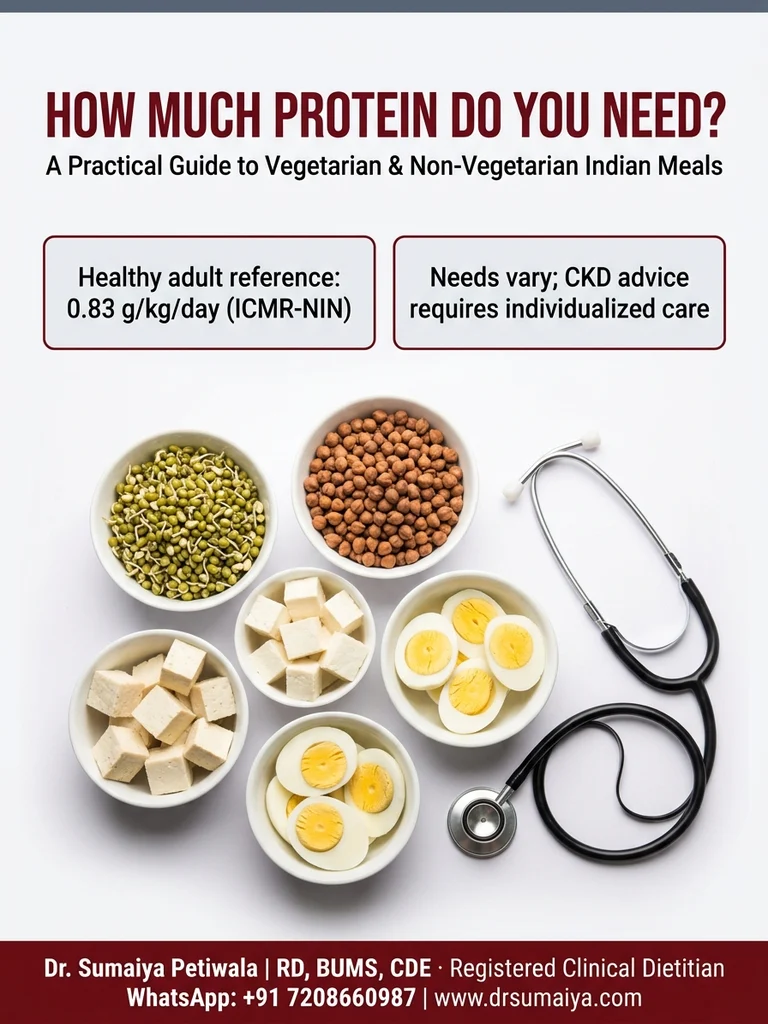
Daily protein reference targets (ICMR-NIN) and practical food anchors for Indian vegetarian and non-vegetarian meals: Dr. Sumaiya NutriCare Clinic.
The Dal Dilemma: Understanding Protein Density vs. Carbohydrate Content
In Indian cuisine, lentils and legumes (dals) are staple foods rich in dietary fiber, potassium, folate, and slowly digestible starches. However, confusion often arises when home cooks view cooked dal purely as a concentrated protein source comparable to poultry or eggs.
Whole dry pulses contain about 20% to 24% protein by weight, alongside roughly 55% to 60% complex carbohydrates. When cooked into a typical home-style katori (approximately 150 ml of liquid dal with common dilution), that serving delivers roughly 4 to 5 grams of protein and 15 to 18 grams of carbohydrates.
Because of this natural macronutrient ratio, relying solely on thin dal to reach a 60-gram daily protein target would require consuming 12 to 14 katoris daily. This would introduce roughly 180 to 200 grams of carbohydrates and substantial fluid volume, which can make overall energy and carbohydrate budgeting challenging. Legumes remain healthy and low in glycemic index, but balancing them with more protein-dense foods ensures nutritional goals are met without disproportionate portion sizes.
Amino Acid Quality: Mutual Complementation and the 3:1 Principle
Proteins consist of amino acids, nine of which are essential and must be obtained from food. Plant proteins are often described as incomplete because specific botanical sources have lower amounts of certain essential amino acids:
- Cereals (Rice, Wheat, Millets): Provide sulfur-containing amino acids (methionine and cysteine), but are naturally lower in lysine.
- Pulses and Legumes (Dals, Chana, Rajma): Contain ample lysine, but are lower in methionine.
Traditional Indian meals resolve this through mutual amino acid complementation. When cereals and pulses are combined—such as in khichdi (rice and moong dal), rajma-chawal, or idli and dosa (rice and urad dal)—the amino acid profile of the cereal complements that of the pulse.
The 2024 ICMR-NIN Dietary Guidelines emphasize that consuming cereals and pulses in an optimal 3:1 to 4:1 ratio by weight improves the overall biological quality of the meal. In a balanced, calorically adequate vegetarian diet with diverse ingredients, all essential amino acids can be obtained across the day.
Protein-Dense Indian Food Choices: Vegetarian vs. Non-Vegetarian
Understanding the protein yield of common Indian kitchen staples helps you design balanced, satisfying meals:
Vegetarian and Dairy Protein Options
- Paneer (Cottage Cheese): 100 grams provides approximately 18 grams of protein. For individuals managing saturated fat or cardiovascular markers, low-fat paneer made from toned milk provides dense protein with lower saturated fat.
- Curd / Dahi & Hung Curd: Standard dahi provides roughly 3 to 3.5 grams of protein per 100g, while strained hung curd or unsweetened Greek-style yogurt provides about 8 to 10 grams per 100g.
- Tofu & Edamame: 100 grams of firm tofu yields 12 to 14 grams of complete plant protein with low saturated fat and minimal carbohydrate content.
- Sprouted Legumes (Moong, Kala Chana): Sprouting reduces phytic acid and enhances micronutrient availability. One cup of cooked sprouted moong yields about 7 to 8 grams of protein.
- Soy Chunks (Textured Soy Protein): 30 grams of dry soy chunks boiled and rinsed provides roughly 15 grams of protein. They can be used as a protein booster in curries.
- Seeds (Pumpkin, Hemp, Chia): Two tablespoons (approx. 20g) of pumpkin or hemp seeds provide 5 to 7 grams of protein along with dietary minerals.
Eggetarian and Non-Vegetarian Options
- Whole Eggs: One large egg provides approximately 6 grams of complete protein containing all essential amino acids, choline, and vitamin B12. Combining one whole egg with two egg whites provides roughly 13 grams of protein with minimal fat.
- Skinless Chicken Breast: 100 grams of cooked lean chicken breast provides approximately 27 to 30 grams of protein with virtually no carbohydrates.
- Fresh Fish: 100 grams of cooked fish provides 20 to 24 grams of protein, and fatty varieties provide preformed marine omega-3 fatty acids (EPA and DHA).
- Lean Mutton: Provides approximately 22 grams of protein per 100g cooked, but should be consumed in moderation due to higher saturated fat content.
Practical Indian Meal Blueprints: Meeting 65–70g Daily Protein
Meeting a realistic protein target does not require extreme dieting. Below are two sample meal architectures illustrating how to achieve roughly 65 to 75 grams of protein from accessible Indian foods:
Blueprint A: 100% Vegetarian (Target: ~66g Protein)
- Breakfast (~14g): Two medium sprouted moong chillas with vegetables (~10g protein) paired with 100g fresh plain dahi (~3.5g protein).
- Lunch (~25g): One katori thick rajma curry (~7g protein), 80g low-fat paneer or firm tofu bhurji (~14g protein), one whole-wheat phulka (~3g protein), and a cucumber-tomato salad (~1g protein).
- Evening Snack (~9g): One glass of roasted chana sattu chaas (20g sattu flour whisked into spiced buttermilk, ~6g protein) plus 15g roasted almonds (~3g protein).
- Dinner (~18g): One katori thick yellow moong dal (~5g protein), 50g paneer or steamed edamame tossed with vegetables (~9g protein), one whole-wheat phulka (~3g protein), and mixed green sabzi (~1g protein).
Blueprint B: Eggetarian / Non-Vegetarian (Target: ~74g Protein)
- Breakfast (~16g): Two whole eggs scrambled with spinach and tomatoes (~12g protein), served with one small whole-wheat phulka (~3g protein) and salad (~1g protein).
- Lunch (~32g): 90 grams of cooked chicken curry or grilled fish fillet (~24g protein), one small katori dal (~4g protein), one whole-wheat phulka (~3g protein), and cooked sabzi (~1g protein).
- Evening Snack (~11g): 100g plain hung curd mixed with 1 tablespoon roasted pumpkin seeds (~11g protein).
- Dinner (~15g): Egg bhurji made from two egg whites and one whole egg (~11g protein), paired with one whole-wheat phulka (~3g protein) and clear vegetable soup (~1g protein).
Free “Indian Kitchen Protein & Satiety Guide”
Looking to balance daily protein with realistic Indian meals? Access Dr. Sumaiya’s practical food matrix designed specifically for South Asian kitchens.
- The Dal-to-Paneer Satiety Matrix: Understand portioning and food combinations for steady energy.
- South Asian Protein Ladder: Practical comparisons of vegetarian and non-vegetarian food staples.
- Renal & Metabolic Safety Checklist: Key baseline blood markers (eGFR, BUN, urine albumin) to discuss with your doctor.
- Balanced Distribution: Practical tips for including protein across breakfast, lunch, and dinner.
Clinic Consultation Options
For individuals seeking structured dietary guidance, Dr. Sumaiya NutriCare Clinic offers individualized consultation programs:
- Know Your Body (KYB) Screening — ₹800: One-time in-clinic body composition screening and report explanation, valid for 7 days.
- Single Consultation — ₹2,599: Includes comprehensive review of medical reports, lifestyle evaluation, customized Indian food plan, and seven days of direct clinical WhatsApp follow-up.
- Be Healthy Program — ₹3,999/month: Continuous clinical nutrition management, three consultations monthly, metabolic pace tracking, and active dietary adjustments for weight management, fatty liver, and prediabetes.
- Special Diets Program — ₹4,999/month: Intensive medical nutrition therapy for complex clinical conditions, including type 2 diabetes management, renal dietary modifications, PCOS hormonal support, and postpartum care.
Review full plan specifications and inclusions on our official Plans & Pricing Page.
Frequently asked questions
Can an Indian vegetarian get enough protein without commercial protein powders?
Yes. By combining traditional cereals and pulses in a 3:1 ratio and incorporating protein-dense foods like paneer, curd (dahi), tofu, edamame, and sprouted legumes, vegetarians can readily achieve 55 to 70 grams of quality protein daily from whole foods without commercial powders.
Why is relying solely on dal for daily protein challenging in an Indian diet?
Cooked dal has a natural carbohydrate-to-protein ratio of roughly 3:1 to 4:1 by weight. A standard 150 ml katori provides about 4 to 5 grams of protein alongside 15 to 18 grams of carbohydrates. While legumes are nutrient-dense and low-GI, relying on dal alone requires unmanageable meal volume and carbohydrate totals to hit daily targets.
Does a higher protein intake harm kidney function in healthy adults?
In adults with normal kidney filtration (eGFR above 90 mL/min), evidence shows protein intakes up to 1.6 to 1.8 g/kg do not cause renal disease. However, for adults with chronic kidney disease (CKD stages G3 to G5, non-dialysis), the KDIGO 2024 guidelines recommend targeting roughly 0.8 g/kg/day and specifically advise avoiding high protein intakes above 1.3 g/kg/day.
How do the ICMR-NIN 2024 guidelines differ from popular fitness advice?
Popular fitness media often recommends an arbitrary 1 gram per pound (2.2 g/kg) and routine supplement powders. In contrast, ICMR-NIN establishes a baseline Recommended Dietary Allowance of 0.83 g/kg for healthy adults and explicitly advises against routine commercial protein powders for the general population.
What is the metabolic benefit of including protein across each main meal?
Distributing protein across meals slows gastric emptying, blunts rapid absorption of co-ingested carbohydrates, and promotes satiety through the release of gut peptides like GLP-1 and peptide YY. This supports steady postprandial glucose control and sustained daytime fullness.
Clinical Evidence Sources: Indian Council of Medical Research & National Institute of Nutrition (ICMR-NIN): Nutrient Requirements for Indians (RDA & EAR) and Dietary Guidelines for Indians (2024). American Diabetes Association (ADA 2026) Standards of Care in Diabetes: Facilitating Positive Health Behaviors and Well-being to Improve Health Outcomes. Kidney Disease: Improving Global Outcomes (KDIGO 2024) Clinical Practice Guideline for the Evaluation and Management of Chronic Kidney Disease. International Society of Sports Nutrition (ISSN) Position Stand: Protein and Exercise. Indian Food Composition Tables (IFCT 2017), ICMR-NIN.
🌟 Transform Your Health Today
Takes only 60 seconds to send a booking enquiry.
"Lost 4kgs in one month... plans are simple and effective! She
responds to queries promptly."
– Payal J.
About this guide
This guide provides general health information. Your own care depends on your medical history and circumstances. Speak with your treating clinician before changing medicines or treatment.