

Dr. Sumaiya Petiwala, RD, BUMS, CDE · Medical Doctor & Registered Clinical Dietitian · Updated 20 October 2026
You wake up with a relatively flat stomach, swallow your prescribed levothyroxine tablet with plain water, and wait your required time before breakfast. Yet by 4:00 PM, your abdomen swells outward so severely that your waistband digs painfully into your skin. By evening, you look five months pregnant, burdened by agonizing trapped gas, sluggish digestion, persistent constipation, and profound brain fog.
When you visit your physician to report these debilitating symptoms, your routine thyroid stimulating hormone [TSH (the pituitary signaling hormone that instructs your thyroid to produce metabolic hormones)] comes back perfectly “normal” at 2.1 mIU/L. You are told your thyroid is fully managed, and your severe abdominal distension is casually dismissed as “everyday irritable bowel syndrome (IBS)” or stress. But landmark 2026 clinical research reveals that your chronic bloating is neither in your head nor unrelated to your thyroid: a slow thyroid directly sabotages small intestinal motility to cause bacterial overgrowth.
Why does hypothyroidism cause chronic bloating and SIBO?
Hypothyroidism slows gastrointestinal transit by suppressing the Migrating Motor Complex (MMC), the small intestine’s cleansing motility wave. Inadequate clearing allows bacteria like Klebsiella to migrate from the colon into the small bowel, triggering Small Intestinal Bacterial Overgrowth (SIBO). These bacteria ferment undigested carbohydrates, producing painful bloating, constipation, and impaired levothyroxine absorption.
The 2026 Cedars-Sinai Breakthrough: SIBO Identified in Up to 40% of Thyroid Patients
For decades, endocrinologists and gastroenterologists treated thyroid disorders and gastrointestinal complaints in complete isolation. However, a groundbreaking multicenter clinical study conducted by the renowned REIMAGINE team at Cedars-Sinai Medical Center, published in the Journal of Clinical Endocrinology & Metabolism (JCEM, 2026), has definitively proven the biological connection between hypothyroidism and small bowel disease.
Unlike historical studies that relied on indirect breath tests, the Cedars-Sinai researchers performed direct duodenal endoscopic aspirates followed by next-generation microbial sequencing. Their findings established an undeniable clinical reality:
- Double the Rate of Overgrowth: 32.65% of patients with hypothyroidism were clinically diagnosed with Small Intestinal Bacterial Overgrowth [SIBO (an abnormal proliferation of colonic-type bacteria inside the small intestine)], compared to only 15.38% in non-hypothyroid controls.
- The Autoimmune Hashimoto’s Risk: In patients diagnosed with autoimmune Hashimoto’s thyroiditis [an autoimmune condition where immune antibodies attack thyroid tissue], the SIBO prevalence climbed to nearly 40%, demonstrating that systemic autoimmunity and mucosal inflammation compound digestive motility failure.
- Pathogenic Bacterial Profiles: As analyzed in Healthpath’s late-September 2026 clinical review, the small intestines of hypothyroid patients were heavily colonized by hydrogen- and methane-producing bacterial phyla, predominantly Klebsiella and Enterobacteriaceae species, which thrive in stagnant luminal environments.
| Clinical Parameter | Euthyroid (Healthy Thyroid Axis) | Overt Hypothyroidism (Slow Motility) | Hashimoto’s Autoimmune Phenotype |
|---|---|---|---|
| Migrating Motor Complex (MMC) Activity | Vigorous phase III cleansing contractions occur rhythmically every 90–120 minutes during fasting states. | Significantly suppressed amplitude and frequency; electrical pacemaker activity in intestinal smooth muscle stalls. | Compounded impairment: autoimmune inflammation and mucosal swelling severely disrupt enteric nerve signaling. |
| Small Intestinal Bacterial Density | Low microbial population (<1,000 CFU/mL) confined predominantly to the large intestine. | Bacterial migration from the colon into the duodenum and jejunum (>100,000 CFU/mL), primarily Klebsiella. | Marked microbial overgrowth with high rates of Intestinal Methanogen Overgrowth (IMO) and gut barrier permeability. |
| Levothyroxine Bioavailability | Optimal absorption (70%–80%) across an intact, acidic proximal small intestinal brush border. | Impaired and fluctuating; bacterial deconjugation of bile and luminal mucus reduces drug bioavailability. | Unpredictable TSH swings; systemic malabsorption forces escalating medication dosages without clinical relief. |
| Predominant Digestive Symptoms | Daily effortless bowel movements, minimal postprandial gas, flat abdomen through the evening. | Severe abdominal distension by late afternoon, trapped belching, flatulence, and stubborn constipation. | Severe painful bloating, alternating bowel habits, brain fog, fatigue, joint ache, and histamine intolerance. |
| Response to Generic Probiotics & Fiber | Improves stool bulk and supports beneficial short-chain fatty acid production in the colon. | Often triggers explosive bloating and painful gas as live bacteria ferment food prematurely in the small bowel. | Triggers autoimmune flare-ups, histamine reactions, and severe abdominal cramping within 30 minutes. |
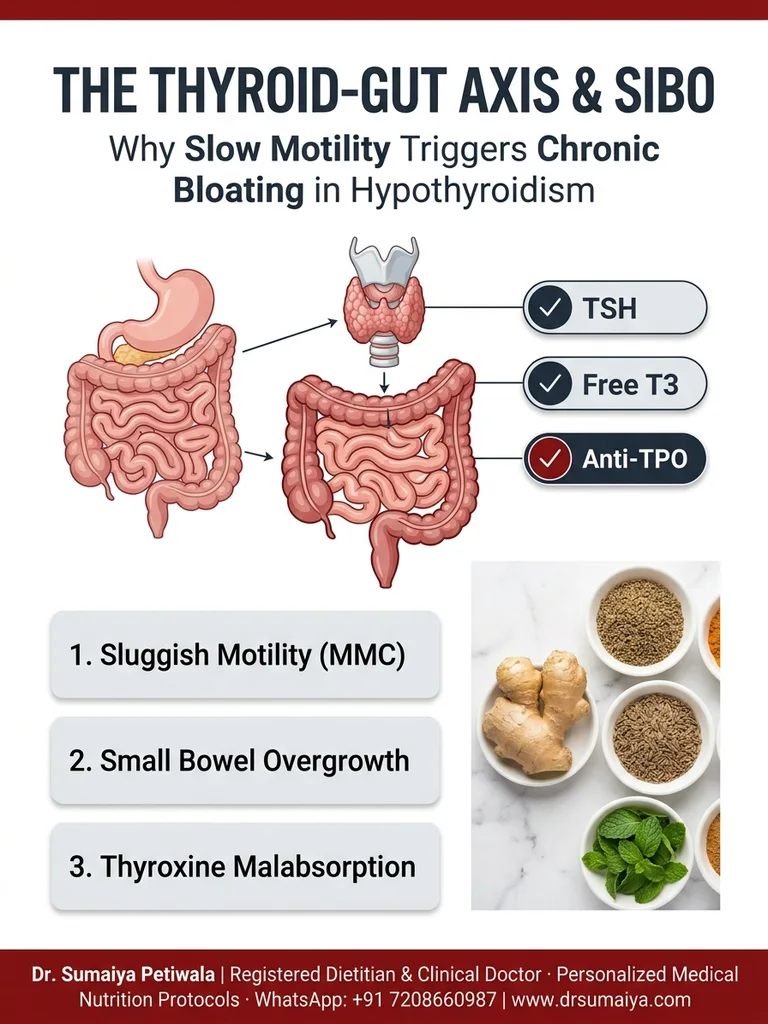
The Thyroid-Gut Axis: How thyroid hormone deficiency suppresses the Migrating Motor Complex, allowing small bowel bacterial overgrowth and blocking levothyroxine absorption.
Clinical references: Cedars-Sinai Medical Center REIMAGINE Study (JCEM, 2026); Healthpath Clinical Review: Hypothyroidism & SIBO (September 2026); ICMR-NIN Dietary Guidelines for Indians (2024).
The Science of Motility: How Low Cellular Thyroid Hormone Stalls the ‘Housekeeping Wave’
To understand why your thyroid medication has not resolved your evening distension, we must look at how thyroid hormones control gastrointestinal physiology. Every single smooth muscle cell and enteric neuron in your digestive tract possesses thyroid hormone receptors.
When you are between meals, your digestive system initiates a vital neurological mechanism known as the Migrating Motor Complex [MMC (a cyclical, sweeping wave of mechanical contractions that clears residual food particles, cellular debris, and bacteria from the small intestine into the colon every 90 to 120 minutes during fasting states)]. The MMC acts as your digestive tract’s internal housekeeping crew.
Thyroid hormone—specifically Free Triiodothyronine (Free T3) [the biologically active thyroid hormone that binds to cellular nuclear receptors]—is the primary chemical fuel required by the Interstitial Cells of Cajal [the electrical pacemaker cells of the gut that initiate intestinal peristalsis].
In women with overt hypothyroidism or Hashimoto’s thyroiditis, several pathological breakdowns occur simultaneously:
- Loss of Phase III Sweeping Waves: Without adequate cellular T3, the intestinal pacemaker cells fail to fire. Phase III—the most powerful muscular contraction wave of the MMC—becomes sluggish, infrequent, or disappears entirely.
- Retrograde Bacterial Migration: When the small intestine fails to sweep itself clean, the ileocecal valve [the muscular sphincter separating the small bowel from the colon] loses tone. Bacteria from the colon (including Klebsiella pneumoniae and Escherichia coli) migrate backwards into the sterile small intestine, setting up permanent colonies.
- Premature Carbohydrate Fermentation: When you consume complex carbohydrates or sugars, these misplaced small bowel bacteria consume the food hours before your body can absorb it. In doing so, they produce massive volumes of hydrogen and methane gas, stretching the abdominal wall like an inflated balloon.
- The Methane-Constipation Loop (IMO): If methanogenic archaea [primitive microbes such as Methanobrevibacter smithii that consume hydrogen to produce methane gas] proliferate, methane acts as a localized neurotoxin that paralyzes intestinal peristalsis. This produces stubborn, rock-hard constipation that resists standard fiber supplements.
- The Levothyroxine Malabsorption Cycle: High bacterial concentrations in the small bowel deconjugate bile acids and degrade the intestinal mucosal barrier. This directly interferes with the absorption of your morning levothyroxine tablet, requiring higher medication doses that still fail to resolve chronic cellular hypothyroidism.
Three Targeted Gut-Motility Adjustments for the Indian Kitchen
Overcoming thyroid-induced SIBO and evening distension requires addressing the neuromuscular motility defect while starving small bowel bacterial colonies. In an Indian household, generic Western low-FODMAP advice often fails because it demands abandoning staple spices and traditional foods. Instead, apply these three evidence-based clinical adjustments:
1. Enforce a Strict 4-Hour Meal Spacing Window (Stop Continuous Chai & Biscuit Grazing)
The Migrating Motor Complex operates exclusively during the fasting, interdigestive state. The moment you ingest even a single caloric item—whether it is a sip of sweetened masala chai, a Marie biscuit, a handful of roasted makhana, or a cup of milk—your stomach immediately terminates the MMC and reverts to the fed digestive state.
In many Indian families, women engage in frequent grazing: a morning chai, breakfast, mid-morning tea with snacks, lunch, evening chai with namkeen, and late dinner. This continuous grazing pattern leaves the small intestine in a perpetual fed state, completely abolishing the housekeeping wave. Leave a strict 4 to 5-hour fasting window between main meals. Between meals, consume only plain warm water or motility-stimulating herbal infusions brewed with crushed ajwain (carom seeds) and jeera (cumin), which stimulate natural digestive enzyme secretion without resetting the MMC.
2. Audit High-FODMAP Fermenters in Traditional Indian Gravies and Staples
FODMAPs [fermentable oligosaccharides, disaccharides, monosaccharides, and polyols] are short-chain carbohydrates that draw water into the bowel and are rapidly fermented by SIBO bacteria. Standard Indian cooking relies heavily on four major high-FODMAP triggers that cause severe distress in a hypothyroid gut:
- Onion & Garlic Pastes: The foundational paste of almost every Indian curry is packed with fructans [highly fermentable fructose polymer chains]. Swap heavy onion-garlic gravies for fragrant tempering using pure asafoetida [hing (which provides an allium aroma while exerting carminative anti-spasmodic effects)] combined with grated fresh ginger, turmeric, and cumin.
- Dense Whole Wheat Rotis: Commercial whole wheat flour contains high concentrations of fructo-oligosaccharides. Temporarily transition to naturally lower-fermentable ancient grains such as sourdough-fermented khapli wheat [emmer wheat] or steamed foxtail millet (kangni) rotis.
- Unsoaked Whole Legumes (Rajma & Chole): Large pulses contain dense galacto-oligosaccharides (GOS) that fuel bacterial gas. Replace heavy legumes with tender, soaked, and sprouted green moong dal, which undergoes enzymatic pre-digestion during sprouting.
- Raw Cruciferous Salads: Raw cabbage (patta gobi), cauliflower (phool gobi), and broccoli contain both fermentable raffinose and dietary goitrogens that stress the thyroid. Always cook these vegetables thoroughly with digestive spices (mustard seeds, ginger) rather than eating them raw in salads.
3. Protect the 60-Minute Levothyroxine Absorption Window
Levothyroxine sodium is an exceptionally finicky medication with narrow therapeutic bioavailability. It requires an acidic gastric environment and an unobstructed small intestinal mucosal wall for proper cellular uptake. Many patients inadvertently destroy their medication’s absorption through common morning Indian routines:
Never take your thyroid tablet with morning masala chai or coffee. The tannins, polyphenols, and calcium from milk bind chemically to levothyroxine molecules in the stomach, slashing absorption by 30% to 50%. Furthermore, if you take iron supplements, calcium carbonate, or antacids [PPIs like pantoprazole, which neutralize stomach acid and directly worsen SIBO], you must separate them from your thyroid tablet by at least 4 hours. Take your tablet upon waking with a full glass of plain lukewarm water, and wait at least 60 minutes before consuming breakfast or morning tea.
The Diagnostic Gap: Why Random Probiotics and Blind Elimination Often Backfire
When thyroid patients experience persistent abdominal bloating, the most common self-treatment is to purchase over-the-counter probiotic capsules or consume large bowls of homemade curd. While probiotics are beneficial for colon health in euthyroid individuals, taking probiotics in the presence of SIBO is akin to pouring gasoline onto an open fire.
Commercial probiotics introduce billions of live bacterial colonies into an already overcrowded small bowel. Because intestinal transit is stalled, these supplemental microbes settle in the duodenum and jejunum, fermenting carbohydrates and generating acute, painful bloating within minutes. Similarly, blindly eliminating entire food groups (such as cutting out all dairy and gluten without medical supervision) fails to resolve the underlying neuromuscular motility deficit.
True resolution of the Thyroid-Gut Axis requires precision medical diagnostics and a structured, physician-supervised protocol:
- Lactulose Breath Testing: The clinical gold standard for measuring hydrogen and methane gas curves to confirm bacterial overgrowth and identify Intestinal Methanogen Overgrowth (IMO).
- Comprehensive Thyroid & Antibody Biomarkers: Going beyond basic TSH to measure Free T3, Free T4, Anti-Thyroid Peroxidase (Anti-TPO), and Anti-Thyroglobulin (Anti-Tg) antibodies to evaluate active autoimmune inflammation.
- Critical Nutrient Cofactors: Evaluating Serum Ferritin [iron stores required for the thyroid peroxidase enzyme to synthesize hormones], Selenium [essential for the 5′-deiodinase enzyme that converts inactive T4 to active T3 in peripheral tissues], Vitamin D3, and Serum Zinc.
- Structured 3-Phase FODMAP Protocol: A clinician-guided 4-week elimination phase, followed by systematic single-ingredient reintroductions to restore long-term microbiome diversity without symptom recurrence.
If you are struggling with persistent distension and fatigue, take our 2-Minute Thyroid-Gut & SIBO Symptom Audit during your initial clinical consultation to evaluate your motility risk and map out an individualized recovery strategy.
Choose the Right Level of NutriCare Clinical Support
Whether you require an immediate targeted protocol to halt daily abdominal distension or comprehensive, ongoing medical supervision to balance Hashimoto’s autoimmunity and gut motility, Dr. Sumaiya NutriCare provides structured clinical programs:
- Single Clinical Consultation — ₹2,599: A comprehensive 1-on-1 medical review of your blood biomarkers, dietary motility evaluation, personalized low-FODMAP Indian meal strategy, and 7 days of clinical WhatsApp guidance.
- Be Healthy Program — ₹3,999/month: Continuous medical nutrition therapy featuring three consultations per month, weekly gastrointestinal motility monitoring, meal plan adjustments, and direct practitioner support for thyroid-gut dysbiosis.
- Special Diets Program — ₹4,999/month: Intensive therapeutic care for patients navigating multi-organ autoimmune conditions, Hashimoto’s thyroiditis, chronic SIBO/IMO, inflammatory bowel disorders, or co-existing metabolic syndrome.
Consultation fees reflect standard clinic pricing as of October 2026. Review our complete clinical plans and pricing to begin your recovery.
Frequently Asked Questions
Why am I always bloated and constipated with hypothyroidism even when my TSH is normal?
Thyroid hormone regulates the gastrointestinal tract’s enteric nervous system. Even when your serum TSH reads within normal reference ranges, low cellular thyroid activity slows the Migrating Motor Complex (MMC), which is the sweeping contraction wave that clears food debris. This motility stagnation allows colonic bacteria to migrate into the small intestine, triggering Small Intestinal Bacterial Overgrowth (SIBO). These bacteria prematurely ferment dietary starches, producing persistent hydrogen and methane gas that causes abdominal distension, severe bloating, and chronic constipation.
Can SIBO and gut issues block thyroxine medication absorption?
Yes. Levothyroxine sodium is absorbed primarily in the jejunum and ileum of the small intestine. When bacterial overgrowth colonizes this region, bacteria physically damage the mucosal brush border, deconjugate protective bile acids, and trigger localized intestinal inflammation. This malabsorption cascade prevents consistent medication uptake into the bloodstream, creating erratic thyroid hormone levels where patients continue experiencing severe hypothyroid fatigue, hair thinning, and brain fog despite faithful daily medication use.
Does taking over-the-counter probiotics make thyroid bloating worse?
In patients with underlying SIBO, taking conventional probiotics often worsens bloating significantly. Commercial probiotic supplements deliver billions of live bacteria (such as Lactobacillus and Bifidobacterium species) directly into the gut. If your small intestinal motility is already stalled, introducing more bacterial colonies fuels rapid fermentation of dietary carbohydrates in the small bowel rather than the colon, triggering painful abdominal tightness, trapped gas, and explosive distension within 30 minutes of consumption.
How does a low-FODMAP diet work in an Indian vegetarian kitchen for Hashimoto’s?
A clinical low-FODMAP Indian protocol eliminates rapidly fermentable oligosaccharides, disaccharides, monosaccharides, and polyols without causing nutritional deficiencies. In an Indian kitchen, this means temporarily replacing high-fructan onion and garlic gravies with digestive hing (asafoetida) and ginger, swapping whole wheat rotis for gluten-buffered ancient khapli wheat or sourdough, replacing heavy whole legumes (rajma, chole) with gentle sprouted moong, and prioritizing soothing low-FODMAP vegetables such as bottle gourd (lauki), ridge gourd (turai), and pumpkin.
How long should I leave between taking my levothyroxine and drinking morning Indian chai?
You must wait at least 60 minutes after swallowing your levothyroxine tablet with plain water before consuming morning masala chai, coffee, or food. The polyphenols, tannins, and dairy calcium in traditional Indian milk tea bind chemically to levothyroxine in the stomach, slashing medication bioavailability by up to 40%. For optimal gastrointestinal motility and absorption, drink only warm water during the first hour after your morning dose.
Enquire About Precision Clinical Care
Stop accepting painful evening bloating, trapped gas, and unyielding fatigue as your permanent reality. Send your latest thyroid reports and a brief digestive history to our clinical team to begin your personalized gut-thyroid recovery protocol.
🌟 Transform Your Health Today
Takes only 60 seconds to send a booking enquiry.
"Lost 4kgs in one month... plans are simple and effective! She
responds to queries promptly."
– Payal J.
About this guide
This guide provides general health information. Your own care depends on your medical history and circumstances. Speak with your treating clinician before changing medicines or treatment.