

Dr. Sumaiya Petiwala, RD, BUMS, CDE · Medical Doctor & Registered Clinical Dietitian · Updated 20 October 2026
You avoid fried street food, cook every meal at home in minimal cold-pressed oil, and follow a strictly vegetarian diet of dal, roti, sabzi, and rice. Yet your latest health check-up reveals a disheartening surprise: your low-density lipoprotein [LDL (the primary cholesterol-carrying particle that deposits plaque into arterial walls)] has crossed 140 mg/dL, your triglycerides are elevated, and your fasting blood sugar or HbA1c is quietly edging into the prediabetes range.
For millions of urban South Asian adults, this scenario brings immense frustration and anxiety. The common medical assumption has long been that high blood cholesterol is caused by dietary saturated fat, fried foods, or excessive cooking oil. But a landmark clinical genetic study published in PLOS ONE on 14 October 2026 reveals why standard low-oil advice frequently fails the Indian phenotype: your daily refined carbohydrates are directly interacting with diabetes-risk genes to drive silent cholesterol surges.
Why does home-cooked white rice increase cholesterol and insulin resistance in Indians?
Polished white rice and refined wheat digest rapidly, triggering acute postprandial insulin surges. In South Asians carrying diabetes-linked genetic variants, surplus carbohydrates activate hepatic de novo lipogenesis, transforming excess glucose into triglycerides and small dense LDL particles. Replacing refined starches with whole pulses and viscous fiber blunts this genetic risk.
The Chennai CURES-165 Study: How the Modern Indian Diet Shift Exposes Genetic Cholesterol Risk
The groundbreaking research, conducted collaboratively by the University of Reading and the Madras Diabetes Research Foundation (MDRF) and published in PLOS ONE (CURES-165, October 2026), analyzed 1,020 adults from the Chennai Urban Rural Epidemiology Study. Researchers investigated how overall dietary quality interacts with a genetic risk score [GRS (a calculated aggregate of diabetes-associated genetic variations)] to influence circulating blood lipids.
Over the last four decades, the traditional Indian plate has undergone a profound dietary transition. Whole unpolished grains, millets, diverse seasonal legumes, and forage vegetables have been largely supplanted by heavily polished white rice (such as sona masoori and polished basmati) and refined wheat flour [maida (wheat flour stripped of all fibrous bran and germ)].
The findings of the study were striking:
- Gene-Diet Amplification: Individuals carrying diabetes-predisposing genetic variants who consumed a low-quality diet—characterized by heavy refined cereals and inadequate dietary fiber—exhibited significantly elevated total cholesterol and LDL cholesterol levels.
- The Protective Threshold: In individuals carrying identical high-risk genetic variants who maintained high dietary quality—consuming substantial portions of whole pulses, legumes, and vegetables—the genetic risk of elevated cholesterol was effectively suppressed and unexpressed.
- Dietary Quality Trumps Fat Alone: The primary metabolic trigger for dyslipidemia [an abnormal lipid profile marked by elevated triglycerides, low HDL, and high small dense LDL] in this cohort was not cooking oil volume, but refined carbohydrate overload coupled with a chronic fiber deficit.
| Indian Dietary Staple | Glycemic Load & Fiber Density | Hepatic & Lipid Impact | Genetic Risk Interaction |
|---|---|---|---|
| Polished White Rice (Sona Masoori, Ponni, Basmati) | High glycemic load; stripped of bran layer; contains under 1g of dietary fiber per 100g cooked serving. | Rapid postprandial glucose surges force heavy insulin secretion, driving hepatic de novo lipogenesis and triglyceride production. | Significantly amplifies circulating total cholesterol and LDL in individuals carrying diabetes-linked genetic risk alleles. |
| Refined Wheat Flour & Maida (Naan, Parottas, White Bread) | High glycemic load; devoid of viscous soluble fiber and micronutrients; rapid digestive absorption. | Surges circulating insulin, slows fat oxidation, and accelerates visceral adiposity [deep abdominal fat surrounding organs]. | Promotes atherogenic dyslipidemia and increases ApoB [apolipoprotein B, the count of plaque-causing arterial particles]. |
| Intact Whole Pulses (Rajma, Kala Chana, Whole Green Moong) | Low glycemic index; packed with resistant starch and viscous soluble fiber (7–9g per 100g cooked serving). | Ferments into short-chain fatty acids in the gut, blunts post-meal insulin spikes, and inhibits hepatic lipid creation. | Suppresses genetic predisposition to elevated cholesterol by binding intestinal bile acids to force LDL clearance. |
| Unpolished Grains & Millets (Khapli Wheat, Foxtail Millet) | Moderate-to-low glycemic load; rich in magnesium, trace minerals, and intact cellular fiber matrices. | Provides sustained glucose release, prevents acute insulin surges, and supports pancreatic beta-cell longevity. | Protects against atherogenic dyslipidemia when prepared without excess refined starches or added sugars. |
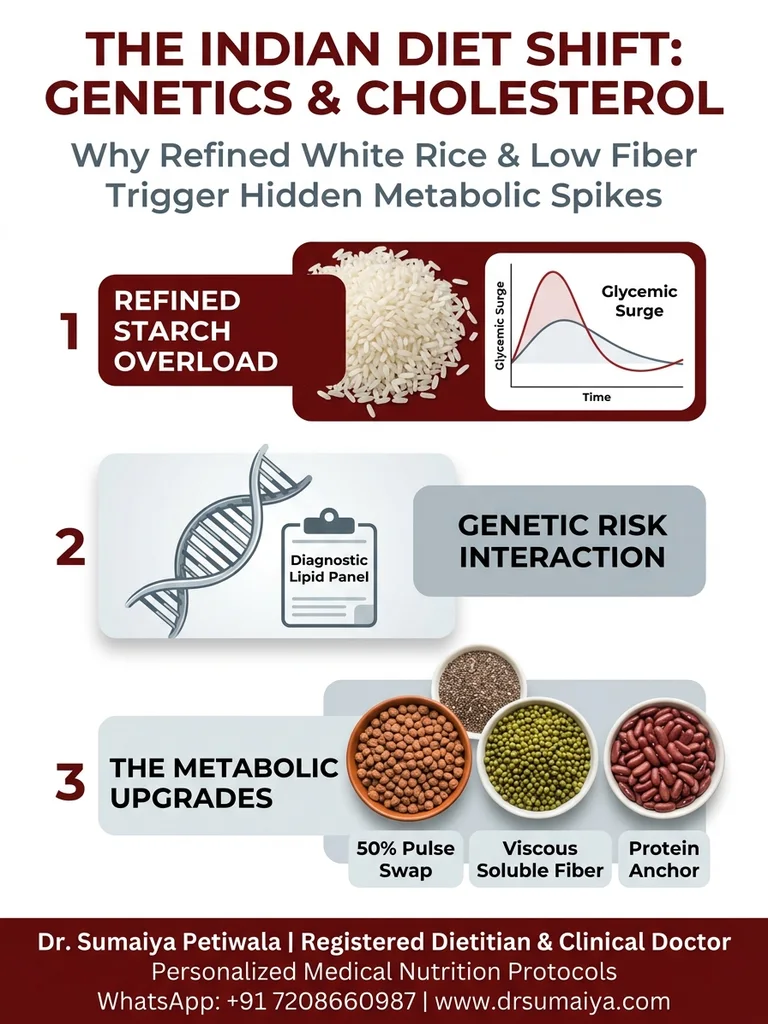
The Indian diet shift: why refined white rice triggers genetic cholesterol spikes and how whole pulses and viscous fiber buffer metabolic risk.
Clinical references: University of Reading & MDRF CURES-165 Study (PLOS ONE, 2026); ICMR-NIN Dietary Guidelines for Indians (2024); ADA Standards of Medical Care in Diabetes (2026).
The Science of Gene-Diet Interaction: Why Refined Carbs Drive Cholesterol in South Asians
To understand why a plate of plain white rice and sabzi can elevate your lipid panel, we must examine the unique physiology of the Asian Indian Phenotype. South Asians inherently exhibit higher visceral fat percentages, lower lean skeletal muscle mass, and greater baseline insulin resistance [a state where muscle and liver cells fail to respond efficiently to insulin, leaving glucose elevated in the blood] even at a normal body mass index (BMI).
When you consume a substantial serving of polished white rice or refined rotis, digestive enzymes hydrolyze the starch almost instantaneously into pure glucose. This prompts the pancreas to release massive amounts of insulin to clear the bloodstream.
In the liver, persistent hyperinsulinemia activates a master metabolic transcription factor called SREBP-1c [sterol regulatory element-binding protein 1c (the primary cellular switch that turns on fat production in liver cells)]. Through a pathway known as hepatic de novo lipogenesis [DNL (the liver’s biochemical conversion of surplus dietary glucose into saturated fatty acids)], the liver synthesizes large quantities of palmitic acid and triglycerides.
These triglycerides are immediately packaged into very low-density lipoproteins [VLDL (large lipid-transporting particles manufactured by the liver)]. In the circulation, an enzyme called CETP [cholesteryl ester transfer protein] swaps triglycerides from VLDL into low-density lipoproteins (LDL) and high-density lipoproteins (HDL). The result is the classic atherogenic triad:
- Elevated Serum Triglycerides: Directly synthesized from rapid carbohydrate overload.
- Low High-Density Lipoprotein [HDL (the protective cholesterol particle responsible for reverse cholesterol transport)]: HDL particles become triglyceride-enriched and are rapidly cleared and degraded by the kidneys.
- High Small Dense LDL (sdLDL): Rather than large, buoyant LDL particles, your bloodstream fills with small, dense LDL particles that readily penetrate the endothelia of coronary arteries, oxidize, and form atherosclerotic plaques.
When you carry diabetes-risk genetic variants, this hepatic lipogenic pathway is hypersensitive. Cutting your cooking oil from two spoons to half a spoon does almost nothing to stop this process because the substrate fueling the fire is not dietary oil—it is the unchecked surge of glucose from refined grains.
Three Precision Dietary Upgrades for the South Asian Metabolic Phenotype
Reversing atherogenic dyslipidemia and improving glycemic variability does not require extreme starvation, liquid cleanses, or abandoning Indian cuisine. The clinical objective is to reconstruct the architectural composition of your meals to blunt insulin spikes and bind cholesterol in the gut.
1. Replace 50% of Polished White Rice or Wheat with Intact Whole Pulses and Ancient Grains
In most Indian households, rice or roti occupies 70% of the dinner plate, with a watery dal and small vegetable serving functioning merely as side accompaniments. You must flip this ratio. Intact whole pulses—such as rajma (kidney beans), kala chana (brown chickpeas), whole green moong, and lobia (cowpeas)—possess an intact seed coat rich in resistant starch and prebiotic oligosaccharides.
Unlike polished grains, whole legumes release glucose slowly over several hours, preventing postprandial hyperinsulinemia and shutting down hepatic de novo lipogenesis. Furthermore, introducing ancient whole grains such as khapli wheat [emmer wheat (a primitive, low-gluten whole grain rich in polyphenols)] or unpolished foxtail millet (kangni) provides a dense fibrous matrix that prevents rapid starch breakdown.
2. Hit the Viscous Soluble-Fiber Threshold at Every Main Meal
Dietary fiber is not a single uniform nutrient. While insoluble fiber (wheat bran) adds stool bulk, viscous soluble fiber [gel-forming fibers that swell in water to form a thick mucosal barrier in the small intestine] is the true therapeutic agent for cholesterol clearance. Viscous fiber physically binds bile acids [digestive fluids synthesized in the liver from circulating LDL cholesterol] in the intestinal lumen, carrying them out of the body through bowel movements.
Deprived of recycled bile acids, the liver is forced to upregulate LDL receptors, pulling atherogenic LDL particles directly out of your bloodstream to manufacture fresh bile. Prioritize rich Indian sources of viscous fiber daily:
- Bhindi (Ladyfinger / Okra): Contains rich mucilage polysaccharides that trap intestinal lipid micelles.
- Methi Leaves & Seeds (Fenugreek): Loaded with galactomannan fiber, proven in clinical trials to lower postprandial glucose and serum cholesterol.
- Roasted Flaxseed Chutney (Alsi Podi): Provides viscous soluble lignan fiber alongside alpha-linolenic acid [ALA (a plant-based omega-3 fatty acid)].
- Isabgol (Psyllium Husk): A clinically verified soluble fiber supplement that can be added to water or dal under dietitian supervision.
3. Anchor Every Starch Serving with a Bioavailable Protein Foundation
Consuming carbohydrates in isolation produces a steep glycemic excursion. When starches are paired with bioavailable protein and healthy fats, gastric emptying slows down, and the gut releases satiety hormones (such as GLP-1 and PYY) that buffer the post-meal insulin spike.
Ensure that every meal contains a dedicated protein anchor before you touch the grain portion. Excellent Indian clinical options include low-fat fresh paneer, plain thick curd or Greek yogurt, organic non-GMO tofu, boiled egg whites, or grilled fresh fish. For strict vegetarians, pairing whole pulses with seeds and curd ensures a complete essential amino acid profile without unnecessary carbohydrate overload.
The Diagnostic Gap: Why Generic “Low-Oil” Advice Misses the Mark
If you visit a clinic and receive a generic pre-printed photocopy that simply says “avoid ghee, butter, and fried snacks,” you are experiencing the diagnostic gap of modern cardiology and nutrition. A routine lipid panel measures total cholesterol, triglycerides, HDL, and calculated LDL. However, it fails to evaluate the actual driving forces of cardiovascular and metabolic damage:
- ApoB (Apolipoprotein B): The gold-standard clinical marker that directly counts the total number of atherogenic particles (including LDL, VLDL, and IDL). A patient can have a “normal” calculated LDL of 100 mg/dL while having an dangerously elevated ApoB of 120 mg/dL due to hundreds of small dense LDL particles generated by refined carbohydrate consumption.
- Fasting Insulin & HOMA-IR: Standard annual checkups measure fasting blood glucose, which often remains deceptively normal for a decade while fasting insulin silently climbs to compensate. HOMA-IR [homeostatic model assessment of insulin resistance] detects metabolic dysfunction years before diabetes is officially diagnosed.
- Lipoprotein(a) [Lp(a)]: An independent, genetically determined lipid particle that is highly prevalent in South Asians and accelerates arterial calcification regardless of diet.
- Nutrigenomic Variability: Individual genetic polymorphisms dictate how efficiently your body clears dietary fats, metabolizes complex starches, and responds to caloric density.
To evaluate your own day-to-day risk, take our 2-Minute Indian Genetic & Metabolic Risk Scorecard during your initial evaluation to assess your refined carbohydrate-to-fiber ratio, family history, and routine biomarkers.
Choose the Right Level of NutriCare Clinical Support
Whether you require an immediate precision protocol to correct a deteriorating annual lipid profile or comprehensive medical nutrition supervision for long-term reversal, Dr. Sumaiya NutriCare provides structured clinical care:
- Single Clinical Consultation — ₹2,599: A comprehensive 1-on-1 medical review of your blood biomarkers, dietary assessment, personalized Indian meal strategy, and 7 days of clinical WhatsApp guidance.
- Be Healthy Program — ₹3,999/month: Continuous medical nutrition therapy featuring three consultations per month, metabolic monitoring, weekly food-plan adjustments, and direct practitioner support for dyslipidemia, prediabetes, and weight management.
- Special Diets Program — ₹4,999/month: Intensive therapeutic nutrition care for patients with multi-organ metabolic conditions, Grade 2–3 non-alcoholic fatty liver disease (NAFLD/MASLD), chronic kidney dysfunction, or severe metabolic syndrome.
Fees reflect standard clinic pricing as of October 2026. Review our complete clinical plans and pricing to begin your journey.
Frequently Asked Questions
Why is my cholesterol high even if I eat a home-cooked vegetarian Indian diet?
Elevated cholesterol on a vegetarian diet often stems from high glycemic carbohydrate intake rather than cooking oil. Polished white rice, maida, and refined wheat digest rapidly into glucose, elevating insulin. Excess insulin drives hepatic de novo lipogenesis, prompting your liver to manufacture triglycerides and small dense LDL particles, especially in individuals with diabetes-linked genetic variants.
Does white rice increase cholesterol as well as blood sugar?
Yes. While white rice contains no dietary cholesterol, its high glycemic load causes rapid postprandial glucose and insulin surges. In South Asians, excess circulating insulin activates hepatic lipogenic enzymes, converting surplus carbohydrates into triglycerides. These triglycerides are packaged into VLDL and converted into atherogenic small dense LDL particles in the bloodstream.
Can whole pulses like rajma and kala chana lower LDL cholesterol?
Yes. Intact whole pulses provide viscous soluble fiber and resistant starch. In the digestive tract, soluble fiber forms a gel that binds bile acids (which are made from cholesterol) and excretes them in stool. To replenish lost bile acids, your liver pulls circulating LDL cholesterol from your bloodstream, lowering total and LDL levels.
What is nutrigenomics testing, and is it necessary for managing cholesterol in India?
Nutrigenomics examines how your specific genetic variants interact with the foods you consume. While formal genetic testing can pinpoint diabetes risk alleles, a thorough clinical evaluation of your lipid panel (including ApoB), fasting insulin, and daily carbohydrate-to-fiber ratio is usually sufficient to design an effective, personalized precision nutrition protocol.
Should I completely stop eating white rice and rotis to control my lipids?
No. Eliminating traditional grains entirely is unnecessary and unsustainable. The clinical solution is to rebalance your plate: replace 50% of your refined starch serving with whole legumes (kala chana, rajma, whole moong), add viscous vegetables (bhindi, methi), and anchor meals with bioavailable protein to buffer glycemic and insulin responses.
Enquire About Precision Clinical Care
Stop guessing why generic low-oil diets have failed to normalize your lipid panel or borderline blood sugar. Send your latest blood reports and brief dietary history to our clinical team to begin your personalized metabolic journey.
🌟 Transform Your Health Today
Takes only 60 seconds to send a booking enquiry.
"Lost 4kgs in one month... plans are simple and effective! She
responds to queries promptly."
– Payal J.
About this guide
This guide provides general health information. Your own care depends on your medical history and circumstances. Speak with your treating clinician before changing medicines or treatment.