

A few clinical words appear throughout, so let me define them once. PCOS (polycystic ovary syndrome) affects ovulation. Insulin resistance (when your cells stop responding properly to insulin) drives most blood sugar problems. A fatty liver (extra fat stored in the liver) can reverse with the right changes. Thyroid (the neck gland that sets your metabolism) problems change how you tolerate a fast. Fasting insulin (your insulin level after an overnight fast) shows how well your body handles sugar.
🩺 Quick Clinical Verdict: Which Intermittent Fasting Method Is Best for You?
Start at 14:10 if you have PCOS, thyroid problems, or high stress. Move to 16:8 for type 2 diabetes, prediabetes, or a fatty liver. Break your fast with protein and fiber, never juice or biscuits. Anyone on insulin or diabetes tablets must have their doses adjusted by a doctor first.
Fasting has moved from spiritual practice to one of the most studied tools in modern nutrition. That is good news, because the evidence is finally clear enough to be practical. But the wrong window, started without guidance, can cost you muscle, disrupt your cycle, and leave you exhausted.
So let me be clear about the goal. Fasting is a tool for metabolic health. It is not starvation, and it is not a licence to skip protein. Here is what the research shows, which protocol suits which person, and how to do it without harm.
Table of Contents
- How Fasting Actually Works
- The Fasting Matrix: Protocols Compared
- Dr. Sumaiya’s 4 Rules for Safe Fasting
- Modifying Fasting for Women’s Cycles
- Who Should Not Fast
- Frequently Asked Questions
How Fasting Actually Works
When you stop eating, your body uses up the sugar circulating in your blood. Then it empties the stored sugar in your liver, called glycogen. Only after that does it turn to burning fat for fuel.
The other three terms are HbA1c (your average blood sugar over roughly three months), visceral fat (fat stored around your organs), and triglycerides (blood fats that rise with poor metabolic health and fall once insulin comes down).
This switch is why fasting can be genuinely powerful. Lower insulin, better fat access, cleaner blood markers. But the timing and the person matter enormously, which is what the next table is about.
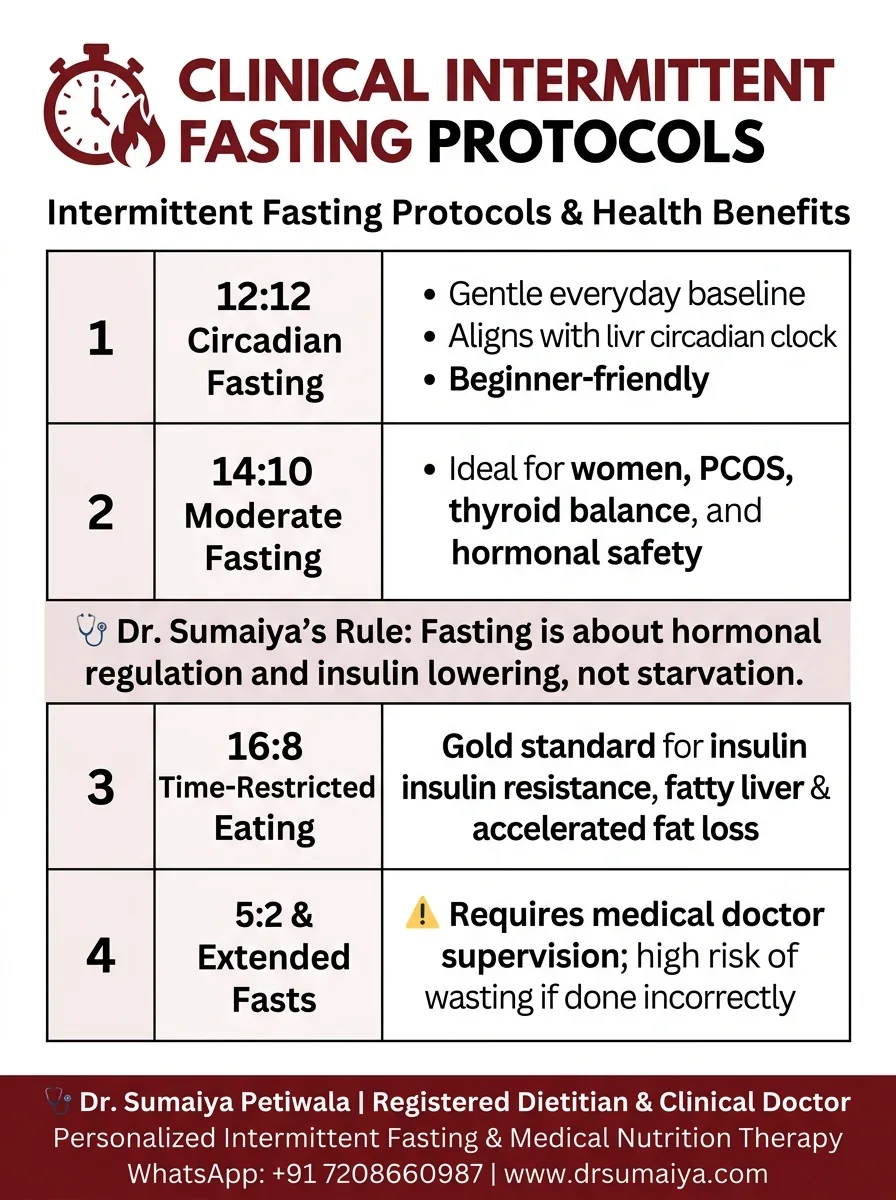
The Fasting Matrix: Protocols Compared
| Protocol | Window | What it does | Best suited to |
|---|---|---|---|
| 12:12 Circadian | 12 hrs fast, 12 hrs eat (8 AM to 8 PM) | Aligns meal times with your body clock. Gentle, with no hormonal stress. | Beginners, seniors, teenagers, and everyday maintenance. |
| 14:10 Hormone-Safe | 14 hrs fast, 10 hrs eat (9 AM to 7 PM) | Modest glycogen use with no stress on reproductive hormones. | Women with PCOS, hypothyroidism, high stress, or adrenal fatigue. |
| 16:8 Time-Restricted | 16 hrs fast, 8 hrs eat (11 AM to 7 PM) | Full glycogen depletion and deep cellular recycling. | Type 2 diabetes, prediabetes, fatty liver, stubborn visceral fat. |
| 5:2 | 5 normal days, 2 non-consecutive 500 kcal days | Weekly calorie cycling without daily time limits. | Irregular work shifts or frequent social dining. |
| Extended 24 to 48 hrs | Water only | Deep cellular recycling, but with real risk of muscle loss and electrolyte problems. | Medical supervision only. Not advised for routine weight loss. |
Dr. Sumaiya’s 4 Rules for Safe Fasting
1. Break Your Fast With Protein and Fiber, Never Simple Carbs
After 14 to 16 hours without food, your gut and pancreas are unusually sensitive. Breaking the fast with juice, biscuits, or white bread sends your blood sugar straight up and triggers an oversized insulin rebound.
Break it with protein and healthy fat instead. Two boiled eggs. A bowl of sprouted moong salad. A cup of fresh curd with soaked chia seeds. This is the single most important rule on the page.
2. Maintain Hydration and Electrolytes
As insulin falls during a fast, your kidneys pass out more salt and water. That quick shift causes headaches, dizziness, and fatigue. Drink 2.5 to 3 litres of clean water across the day, with a pinch of pink salt or a squeeze of lemon during your fasting hours.
3. Hit Your Protein Target Inside the Eating Window
The real risk of unsupervised fasting is missing protein and losing muscle. Aim for about 0.8 to 1 gram per kilogram of your body weight, spread across your two or three meals. Paneer, soya, lentils, sattu, eggs, curd, and chicken all work well.
When you squeeze eight hours around two meals, most patients skip protein at the first one. Plan it in before the fast starts, not during it.
4. Adjust Fasting Around Your Menstrual Cycle
Women’s brains carry a sensor called kisspeptin that reacts quickly to low energy intake. Long fasts of 18 to 24 hours can suppress luteinizing hormone and cause missed periods.
Stick to 12:12 or 14:10 if you are a woman, and avoid aggressive fasting in the week before your period. If your cycles become irregular, step back to the gentlest window and see your doctor.
Modifying Fasting for Women’s Cycles
This deserves more than a footnote. Fasting is often sold as a universal protocol, and women react to it differently from men.
In my clinic, the pattern is consistent. A woman with PCOS or an underactive thyroid who starts at 16:8 often reports fatigue, headaches, and a cycle that slips. The same woman on 14:10, with her eating window earlier in the day, does far better.
- Keep the window early. Eating between 9 AM and 7 PM suits most women better than a late window.
- Watch your energy. Persistent fatigue or brain fog means the fast is too long for you right now.
- Track your cycle. Note any change in length or flow when you change your fasting pattern.
- Do not fast hard while trying to conceive. Energy availability matters more than any fasting benefit.
Who Should Not Fast
Fasting is not for everyone. Get medical clearance first if any of these apply to you.
- You take insulin or sulfonylureas such as glimepiride. Fasting with these carries a real risk of dangerously low blood sugar.
- You are pregnant, breastfeeding, or under 18.
- You have an eating disorder history, or you are underweight.
- You have kidney disease, liver disease, or uncontrolled thyroid disease.
- You take medication that must be taken with food.
If you are on diabetes medication, your doctor must adjust the dose before you begin. Do not change it yourself.
Explore Related Clinical Guides
- Choosing the Right Fasting Method — water, dry, and religious fasting explained side by side.
- The Diabetic’s Guide to Safe Fasting During Ramadan — adjusting medication and meals around religious fasting.
- Grade 1 Fatty Liver Diet Chart: Indian Protocol — the meal plan that clears liver fat.
- A Complete Guide to Fatty Liver — causes, stages, diagnosis, and reversal.
- Why Do You Still Crave Sweets After a Meal? — the hidden link to insulin resistance.
- Rethinking Protein Timing — spreading protein across the day for better results.
Want Fasting Tuned to Your Blood Markers?
Fasting should heal your body, not leave you tired or hormonal. At Dr. Sumaiya NutriCare Clinic we build the window around your fasting insulin, HbA1c, thyroid and liver results, and your actual daily schedule.
- Biomarker and Hormone Evaluation (fasting insulin, HbA1c, thyroid panel, cortisol and liver enzymes)
- Customised Fasting and Meal Schedule built on nutrient-dense Indian meals
- Doctor-Led Weekly Supervision to protect muscle and reverse insulin resistance
In-Clinic at Frazer Town, Bengaluru & Telehealth Pan-India / Globally | Call/WhatsApp: +91 7208660987
Frequently Asked Questions
References
- American Diabetes Association. Standards of Care in Diabetes. Nutrition therapy and glycemic management guidance.
- Sutton ME, et al. Efficacy of intermittent fasting on weight loss and cardiometabolic risk: a systematic review. Nutrition Reviews. 2019;77(4):293-305.
- Cioffi R, et al. Intermittent versus continuous energy restriction on weight loss and cardiometabolic outcomes: a systematic review and meta-analysis. Journal of Translational Medicine. 2018;16:371.
- British Dietetic Association. Intermittent Fasting: Evidence-Based Interim Guidance.
- Indian Council of Medical Research. Recommended Dietary Allowances for Indians. National Institute of Nutrition, Hyderabad.