

Four terms decide this comparison, so let me define them once. An RD (Registered Dietitian, a nutritionist who passed the national board exam) is trained to treat disease with food. MNT (Medical Nutrition Therapy, the use of tailored diets to manage diagnosed conditions) is the legal scope that training earns. Ferritin (your iron storage number) is the kind of blood result an RD reads. SGPT (a liver enzyme that rises when the liver is inflamed) is another. Basal metabolic rate (the calories your body burns at rest) is what crash diets damage. Two more words matter here. Fatty liver (fat stored inside the liver) and thyroid (the neck gland that sets your metabolic pace) are exactly where untrained advice does the most harm.
🩺 Quick Clinical Answer: What Is the Difference Between an RD and a Nutritionist?
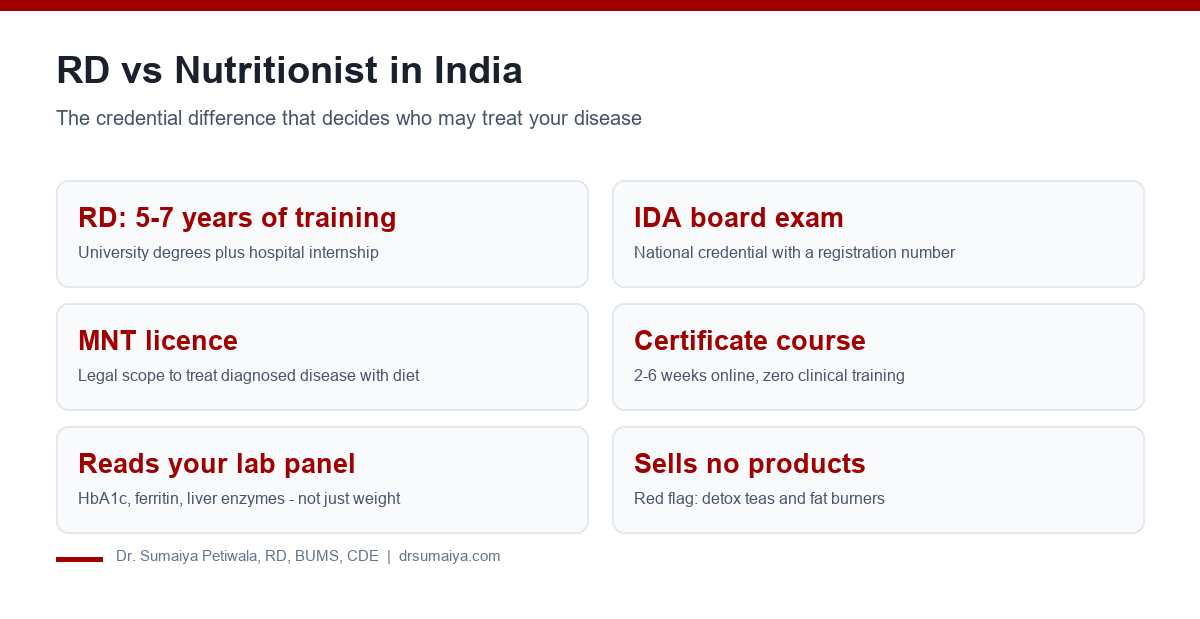
All Registered Dietitians are nutritionists, but not all nutritionists are RDs. In India an RD holds college degrees in nutrition, months of hospital training, and the IDA board credential, and may treat diagnosed disease with diet. A four-week online course makes someone a nutritionist, not a clinician.
What This Guide Covers
- The short answer
- The comparison that matters
- What the RD credential actually requires
- The real medical risks of unverified diets
- The doctor-led difference
- How to verify a dietitian before you pay
- Frequently asked questions
- References
The Short Answer
The title “nutritionist” has no legal rules. Anyone can use it after a weekend course. Or with no course at all. The title “Registered Dietitian” is earned: years of college study in clinical nutrition, months of supervised hospital work in wards that include intensive care, a national board exam, and a strict code of ethics.
Why does this matter to you? A healthy 25-year-old counting gym calories can survive a coach’s advice. A person with diabetes, thyroid disease, kidney disease, or fatty liver cannot. Each of these changes what healthy food even means. The wrong plan does real harm. So this choice is a safety decision, not a style choice.
The Comparison That Matters
| Criteria | Registered Dietitian | Online coach or nutritionist |
|---|---|---|
| Education | Five to seven years of university study | Two to six weeks of online certificates, or self-taught |
| Clinical training | Six to twelve months of hospital internship, including ICU | No ward or patient experience |
| Legal scope | Licensed to deliver MNT for diagnosed conditions | General lifestyle guidance for healthy adults only |
| Lab interpretation | Reads full blood panels and scan reports | Weighing scale and calorie numbers |
| Accountability | Bound by a professional code of ethics | Unregulated; product promotions are common |
What the RD Credential Actually Requires
In India, the road to RD runs through years, not weekends. A science degree leads into a master’s in clinical nutrition and dietetics, then a hospital internship of six to twelve months. Interns rotate through real wards: intensive care, hormone clinics, kidney units, and cancer care. Their diet charts serve patients whose medicines and organs interact.
Then comes the Indian Dietetic Association’s national exam. It grants the RD title and a registration number. Ask to see it. From that day, the dietitian answers to a strict code, just like other clinicians. That is the quiet difference between evidence and opinion.
The Real Medical Risks of Unverified Diets
These are the problems I keep seeing after patients follow untrained plans:
- Nutrient collapse and hair fall. Crash cuts strip vitamins and minerals. The result: sudden hair shedding, falling ferritin, and salt imbalances.
- Worsening fatty liver (fat stored inside the liver). Crash diets flood the liver with fat. Liver enzymes rise, and the plan does the opposite of its promise.
- Dangerous food and drug interactions. Foods change how medicines act. On certain blood-pressure tablets, a sudden potassium surge from fruit-heavy fads can upset the heart’s rhythm.
- Metabolic slowdown and rebound. Crash dieting burns muscle and drops your basal metabolic rate. The yo-yo regain that follows fills my clinic twice a year.
The Doctor-Led Difference
A dietitian who is also a doctor bridges two worlds. Medical training reads your reports like a treating doctor. Dietetic training turns them into food you will actually cook. Plans stay ordinary: dal, sabzi, roti, curd, and a salad, sequenced and portioned to your reports, with breakfast and snack times built around your workday.
Supplements appear only when a blood test shows a real gap, and the goal is always fewer products over time, not more. When metabolic markers improve, the plan adjusts with your physician so medicines can be reviewed safely, never abruptly. For that judgement in detail, read my guides on which vitamins matter in which diseases and natural protein sources over supplements. The iron absorption guide shows what lab-led planning looks like in practice.
How to Verify a Dietitian Before You Pay
- Ask for the RD registration number and the college degrees. A genuine clinician shows both without offence.
- Ask where the hospital internship was done, and in which wards.
- Ask how the plan treats your specific condition, and which blood reports it follows.
- Watch the sales pitch. Proprietary teas, fat burners, and mandatory supplement sales are red flags, not perks.
- Prefer professionals who monitor with re-tests and adjust, rather than hand over a static PDF diet chart.
Want Advice You Can Verify?
Dr. Sumaiya Petiwala is both a clinical physician and a Registered Dietitian with nearly two decades of hospital-grounded practice. Every plan starts from your reports and your kitchen, and every step is accountable to a medical code of ethics.
- Comprehensive Blood & Biomarker Audit (blood sugar, liver panel, iron studies)
- Root-Cause Assessment with Diet Recall and Medication Review
- 100% Customised Indian Meal Protocol with Continuous Weekly Monitoring
In-Clinic at Frazer Town, Bengaluru & Telehealth Pan-India / Globally | Call/WhatsApp: +91 7208660987
Frequently Asked Questions
References
- Indian Dietetic Association. Registered Dietitian (RD) Board: qualification and registration guidelines.
- Academy of Nutrition and Dietetics. Definition of terms: Medical Nutrition Therapy.
- Ministry of Health and Family Welfare, Government of India. National Programme for Prevention and Control of Non-Communicable Diseases: diet and lifestyle guidance.
- Indian Council of Medical Research – National Institute of Nutrition. Recommended Dietary Allowances for Indians. Hyderabad: NIN.