By Dr. Sumaiya Petiwala, RD, BUMS, CDE (Registered Clinical Dietitian & Medical Doctor)
Why Do Routine Heart Risk Calculators Miss Indian Diabetes & Insulin Resistance?
Every week at my clinic, I meet adults who were reassured by a standard heart checkup that their 10-year cardiovascular risk looks “low”—even though they carry central belly fat, high triglycerides, and borderline blood sugar. A new Central Indian study published on November 22, 2026 in Diabetology (ICMR-NIREH Bhopal Study) explains this dangerous blind spot: 54.6% of high-risk Indian adults scored high on the Indian Diabetes Risk Score (IDRS) while still being classified as “Not High Risk” on the Western Framingham Risk Score.
A November 2026 ICMR-NIREH study of 449 Indian adults found that 54.6% of participants with high Indian Diabetes Risk Scores were misclassified as low risk by the Western Framingham Risk Score, despite carrying severe insulin resistance (HOMA-IR 4.05) and abdominal obesity. Dr. Sumaiya’s clinical recommendation: screen HOMA-IR, ApoB, and waist circumference early.
The Pathophysiology: HOMA-IR 4.05 & Atherogenic Dyslipidemia Behind “Normal” LDL
The Western Framingham Risk Score relies heavily on total cholesterol, age, and smoking status, completely ignoring waist circumference and cellular insulin resistance. Yet South Asians develop atherogenic dyslipidemia [a dangerous lipid pattern combining high triglycerides, low protective HDL, and small dense LDL particles] long before total cholesterol looks alarming (Clinical vs. Preclinical Obesity Guide).
Think of your visceral belly fat as an overflowing Liver Storage Warehouse that jams your Insulin Key. In the November 2026 Bhopal cohort (Diabetology 2026), adults in that “discordant” group (IDRS High, Framingham Not High) had a median HOMA-IR (a calculated score measuring how resistant your cells are to insulin) of 4.05—nearly triple the healthy threshold of 1.5—alongside near-universal abdominal obesity and elevated triglycerides (Indian Diabetes Reversal Guide).
| Risk Screening Tool | What It Measures | November 2026 Indian Findings | Clinical Action Required |
|---|---|---|---|
| Framingham Risk Score (FRS) | Age, total cholesterol, HDL, systolic BP, smoking | Classified 54.6% of high-risk Indians as “Not High Risk” (κ = 0.027) | Never rely on FRS alone in South Asians |
| Indian Diabetes Risk Score (IDRS) | Age, waist circumference, physical activity, family history | Achieved 89.0% sensitivity for detecting Type 2 diabetes | Follow IDRS ≥60 with HOMA-IR & OGTT labs |
| HOMA-IR & TG/HDL Ratio | Fasting insulin × glucose; triglycerides ÷ HDL | Discordant T2DM group averaged HOMA-IR 4.05 + high waist fat | Target HOMA-IR <1.5 & TG/HDL <2.0 via MNT |
| 50/25/25 Fiber Brake Protocol | Viscous fiber + protein anchoring + intact grains | Clears hepatic triglycerides and restores insulin sensitivity | Pair kala chana, methi greens & khapli wheat |
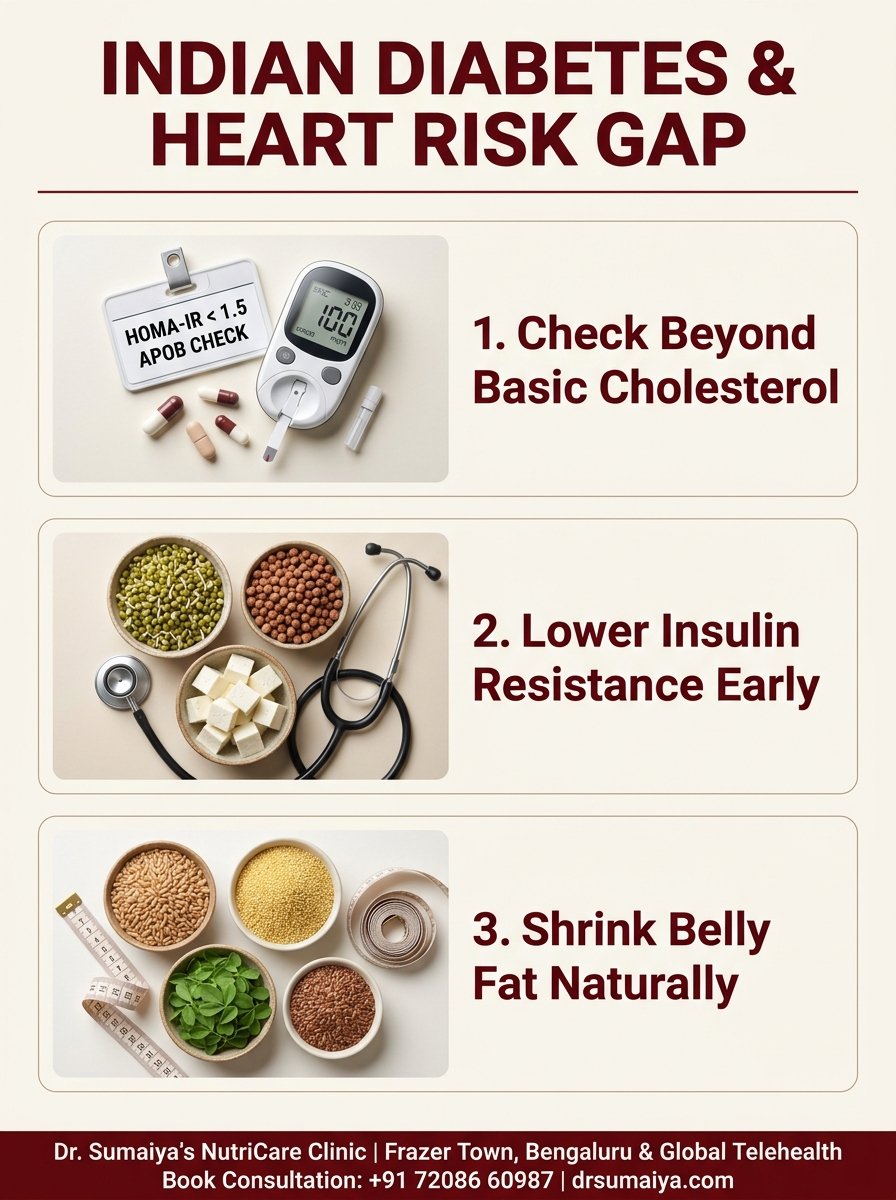
📊 Visual Clinical Summary: Indian Diabetes & Heart Risk Gap: Why 54.6% Fail Routine Screening & Diet Plan (2026) — Dr. Sumaiya NutriCare Clinic.
How to Lower HOMA-IR & Abdominal Fat: 4-Region Actionable Kitchen Guidance
Reversing high HOMA-IR and atherogenic dyslipidemia requires pressing the Fiber Brake Pedal at every meal using The 50/25/25 Plate Architecture (50% non-starchy vegetables, 25% protein, 25% intact whole grains) and The Golden Eating Sequence (Fiber first → Protein second → Carbs last) (Foods That Spike Blood Glucose).
1. Actionable Indian Kitchen Guidance (South Asian & Desi Home Cooking)
- Morning Insulin Reset: Replace plain poha or biscuits with savoury whole moong chillas stuffed with 75g of homemade paneer and fresh methi greens, or vegetable dalia.
- Lunch & Dinner Thali: Eat 50% palak, bhindi, or lauki sabzi first, follow with boiled kala chana or rajma, and finish with one khapli wheat phulka or unpolished foxtail millet topped with 1 teaspoon of roasted flaxseed podi (Choosing the Right Wheat for Blood Sugar).
- Evening Swap: Drink roasted-jeera chaas after lunch and snack on roasted makhana instead of fried namkeen.
2. Actionable US & North American Kitchen Guidance
- Morning Fuel: Swap refined bagels and sugary cereals for warm steel-cut oats with chia seeds and walnuts, or pasture-raised eggs and avocado on sprouted Ezekiel toast.
- Lunch & Dinner Bowl: Begin with a kale-broccoli slaw in apple cider vinegar and olive oil, followed by wild Alaskan salmon or grilled tofu over quinoa and black beans, plus plain 2% Greek yogurt with berries.
3. Actionable European & Mediterranean Kitchen Guidance
- Polyphenol Starter: Open meals with bitter greens (arugula, radicchio) and roasted artichoke or fennel drizzled with cold-pressed extra-virgin olive oil (EVOO).
- Protein & Intact Grain: Pair Atlantic mackerel, sardines, or Puy green lentils and hummus with dense whole-grain rye bread (Rugbrød) and plain Icelandic Skyr.
4. Actionable East & Southeast Asian Kitchen Guidance (China, Singapore, Thailand & Beyond)
- Grain & Broth Swap: Replace polished white jasmine rice and hor fun with unpolished red cargo rice, brown rice, or 100% buckwheat soba paired with clear tom yum or miso-wakame broths.
- Lean Protein & “Kosong”: Choose steamed sea bass with ginger-scallion, silken tofu, edamame, or tempeh alongside bok choy, gai lan, and bitter melon, ordering tea or coffee strictly “kosong” (zero sugar).
The Diagnostic Gap: Check Your True Cardiometabolic Panel
A generic internet diet chart or Western heart-risk calculator cannot detect silent South Asian insulin resistance when your total cholesterol looks borderline. Precision Medical Nutrition Therapy requires measuring your actual insulin and lipoprotein particle burden.
🩺 Dr. Sumaiya’s Clinical Diagnostic Checklist for Indian Cardiometabolic Risk
- Fasting Insulin, Fasting Glucose & HOMA-IR: Detects early cellular insulin resistance years before HbA1c crosses 6.5% (target HOMA-IR: <1.5).
- Apolipoprotein B (ApoB) & TG/HDL Ratio: Counts total atherogenic particles missed by standard LDL-C (target ApoB: <80 mg/dL; TG/HDL: <2.0).
- Waist Circumference & Waist-to-Height Ratio: Screens for South Asian abdominal obesity (target Waist: <80 cm women, <90 cm men; WHtR: <0.50).
- hs-CRP & Liver Panel (SGPT/GGT): Evaluates systemic vascular inflammation (<1.0 mg/L) and hepatic fat spillover (GGT <27.5 U/L).
For physician-supervised Medical Nutrition Therapy tailored to your biomarkers, visit Dr. Sumaiya’s NutriCare Clinic (In-Clinic at Frazer Town, Bengaluru & Global Telehealth across India, the US, UK/Europe, Singapore, and the Middle East), with consultation plans starting at ₹800 (drsumaiya.com/plans-pricing/ | Call/WhatsApp: +91 7208660987 | Email: doc@drsumaiya.com).
🌟 Transform Your Health Today
Takes only 60 seconds to send a booking enquiry.
"Lost 4kgs in one month... plans are simple and effective! She
responds to queries promptly."
– Payal J.
Frequently Asked Questions (People Also Ask)
1. Why did the Framingham Risk Score miss 54.6% of high-risk Indians in the 2026 study?
The Framingham Risk Score relies on total cholesterol and age without measuring waist circumference or insulin resistance. Because Indians develop abdominal obesity and severe insulin resistance (HOMA-IR 4.05) at lower total cholesterol levels, Western calculators often underestimate true cardiometabolic risk.
2. What is a high Indian Diabetes Risk Score (IDRS) and what should I do next?
An IDRS score of 60 or higher indicates high diabetes risk based on age, waist size, sedentary habits, and family history, catching 89% of diabetes cases. If your score is high, test Fasting Insulin, HOMA-IR, HbA1c, and ApoB immediately and start structured Medical Nutrition Therapy.
3. Which Indian foods lower HOMA-IR and triglycerides fastest?
Replacing refined white rice and maida with intact pulses (kala chana, whole moong, rajma), paneer, methi greens, khapli wheat or foxtail millet, and roasted flaxseed podi lowers post-meal insulin demand. Sequencing vegetables and protein before carbohydrates reduces glycemic spikes and hepatic triglyceride output.
About this guide
This guide provides general health information. Your own care depends on your medical history and circumstances. Speak with your treating clinician before changing medicines or treatment.