
By Dr. Sumaiya Petiwala, RD, BUMS, CDE (Registered Clinical Dietitian & Medical Doctor)
How Do High Triglycerides and Metabolic Syndrome Shrink Your Gut Microbiome?
Patients with metabolic syndrome—carrying high triglycerides, borderline blood sugar, and abdominal weight—frequently complain of worsening bloating, sluggish digestion, and unpredictable food reactivity. A cross-sectional multi-amplicon 16S rRNA study published on November 22, 2026 in Nutrients (MDPI Nutrients Study) confirms these gut symptoms are biological, not coincidental: adults with metabolic syndrome had 13.88 fewer detectable gut bacterial genera (q = 0.011), and every single standard-deviation rise in blood triglycerides tracked with 7.82 fewer gut genera (q = 0.00064).
A November 2026 Nutrients study revealed that adults with metabolic syndrome lose nearly 14 gut bacterial genera and exhibit sharp alpha-diversity loss, with each rise in blood triglycerides linked to 7.82 fewer gut genera. Dr. Sumaiya’s clinical recommendation: lower triglycerides and rebuild microbial richness using intact legume fiber, omega-3 seeds, and diverse vegetables.
The Gut–Lipid Loop: Why Probiotic Capsules Alone Cannot Fix Metabolic Dysbiosis
Think of your intestinal tract as a thriving Gut Garden. In the November 22, 2026 study (Nutrients 2026), metabolic syndrome depleted beneficial oxalate- and fiber-fermenting taxa like Oxalobacter and Oscillospiraceae UCG-007 while enriching stress-linked genera like Tyzzerella and Blautia.
When high-sugar, low-fiber meals overflow your Liver Storage Warehouse and spike Triglycerides (circulating blood fats made from excess carbohydrates), bile acid composition shifts and intestinal barrier permeability rises (Best Gut Bacteria for Weight Loss). Popping a single-strain probiotic pill cannot restore 14 missing microbial genera if high triglycerides and refined starches continue starving your colonic ecosystem of fermentable short-chain fatty acids / SCFAs [gut-healing compounds like butyrate that repair the intestinal lining and boost insulin sensitivity] (Resistant Starch & Butyrate Guide).
| Metabolic & Gut Factor | Standard High-Carb / Low-Fiber Diet | Generic Probiotic Pill Only | 50/25/25 Microbiome & Lipid Protocol |
|---|---|---|---|
| Gut Alpha Diversity | Drops by ~13.9 bacterial genera in metabolic syndrome | Supplies 1–5 transient strains without feeding native flora | Rebuilds diverse UCG-007 & butyrate ecosystems |
| Blood Triglycerides | Each 1-SD triglyceride jump tracks with 7.82 fewer genera | Minimal impact on hepatic VLDL triglyceride output | Drops triglycerides below 100 mg/dL via fiber & omega-3s |
| Bile Acid & GLP-1 Signaling | Impaired FXR/TGR5 signaling and afternoon cravings | Inconsistent without fermentable prebiotic substrates | Stimulates natural GLP-1 satiety and lipid clearance |
| Daily Kitchen Foundation | Polished grains, sugary drinks, and fried snacks | Unchanged dietary substrate | Rajma, kala chana, methi greens & flaxseed podi |
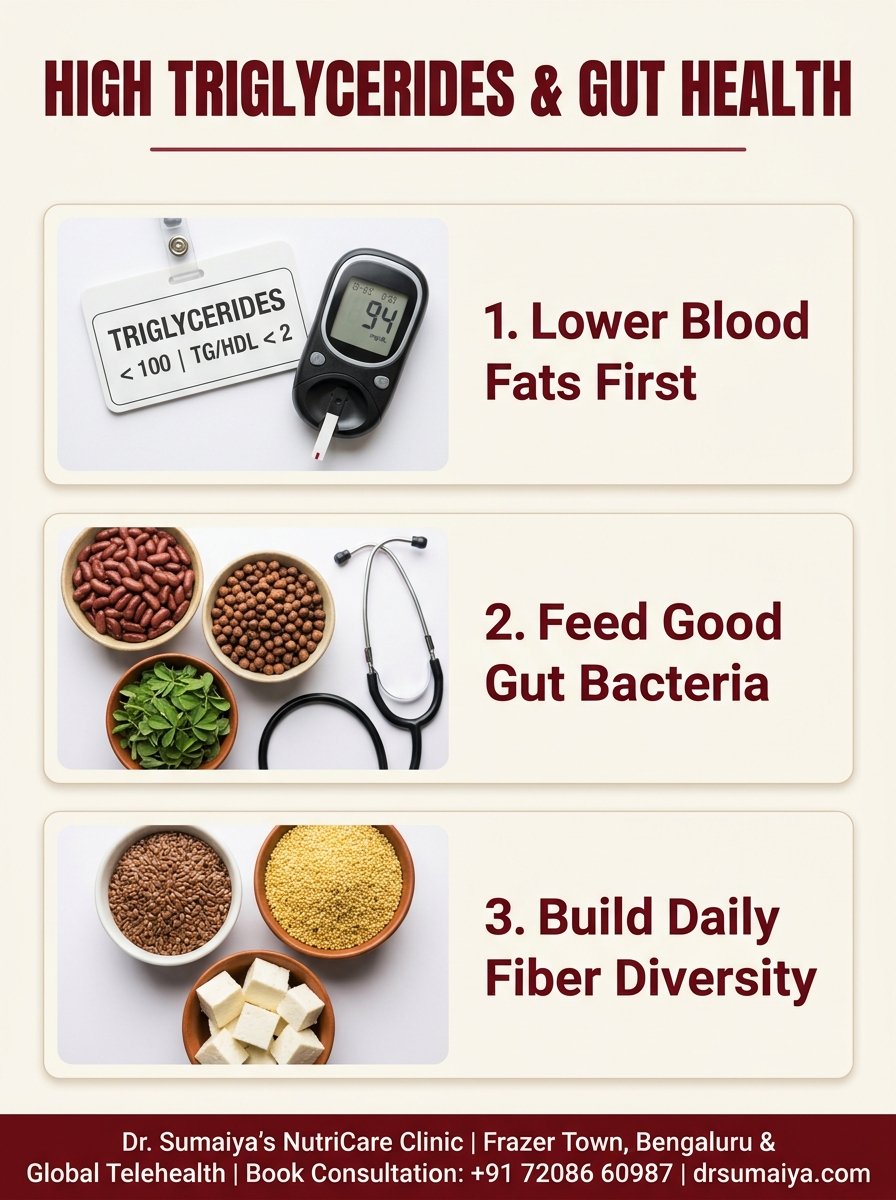
📊 Visual Clinical Summary: High Triglycerides & Gut Microbiome Loss: How Metabolic Syndrome Erases 14 Beneficial Genera (2026) — Dr. Sumaiya NutriCare Clinic.
How to Lower Triglycerides & Rebuild Gut Diversity: 4-Region Kitchen Guidance
Restore your Gut Garden and press the Fiber Brake Pedal by rotating diverse plant fibers alongside bioavailable protein using The 50/25/25 Plate Architecture and The Golden Eating Sequence (Fiber first → Protein second → Carbs last).
1. Actionable Indian Kitchen Guidance (South Asian & Desi Home Cooking)
- Breakfast Microbiome Primer: Swap refined upma or white bread for savoury whole moong chillas with 75g of homemade paneer and fresh methi greens, or vegetable dalia.
- Lunch & Dinner Thali: Start with 50% palak, bhindi, or lauki sabzi; follow with pressure-cooked kala chana or rajma; and finish with khapli wheat phulka or unpolished foxtail millet topped with roasted flaxseed podi (Choosing the Right Rice for Blood Sugar).
- Probiotic & Crunch Swap: Pair lunch with homemade roasted-jeera chaas and snack on roasted makhana instead of processed biscuits.
2. Actionable US & North American Kitchen Guidance
- Omega-3 & Fiber Breakfast: Swap sweetened pastries for warm steel-cut oats topped with chia seeds, hemp seeds, and walnuts, or pasture-raised eggs and avocado on sprouted Ezekiel toast.
- Lunch & Dinner Bowl: Eat a broccoli-kale slaw in apple cider vinegar and olive oil first, then wild Alaskan salmon or tofu over quinoa and black beans, plus plain 2% Greek yogurt with berries.
3. Actionable European & Mediterranean Kitchen Guidance
- Prebiotic Bitter Greens: Open meals with arugula (rocket), radicchio, and roasted fennel or artichoke bulbs drizzled with cold-pressed extra-virgin olive oil (EVOO).
- Lipid-Lowering Main: Pair Atlantic mackerel, sardines, or Puy green lentils and chickpea hummus with dense whole-grain rye bread (Rugbrød) and plain Icelandic Skyr.
4. Actionable East & Southeast Asian Kitchen Guidance (China, Singapore, Thailand & Beyond)
- Grain & Seaweed Broth Swap: Replace white jasmine rice and hor fun with unpolished red cargo rice, brown rice, or 100% buckwheat soba paired with clear miso-wakame seaweed or tom yum broths.
- Protein, Greens & “Kosong”: Anchor meals with steamed sea bass, silken tofu, edamame, or fermented tempeh alongside bok choy, gai lan, bitter melon, and wood-ear mushrooms, ordering drinks strictly “kosong” (zero sugar).
The Diagnostic Gap: Map Your Triglycerides, Liver & Gut Tolerance
Generic “high-fiber” lists backfire when high triglycerides and reduced microbial diversity overlap with IBS or slow gut motility. Clinical Medical Nutrition Therapy phases fiber diversity upward while tracking your exact lipid and inflammatory markers.
🩺 Dr. Sumaiya’s Clinical Diagnostic Checklist for Lipid–Microbiome Recovery
- Fasting Triglycerides & TG/HDL Ratio: Monitors the strongest lipid correlate of gut microbial richness loss (target Triglycerides: <100 mg/dL; TG/HDL: <2.0).
- HbA1c, Fasting Insulin & HOMA-IR: Tracks carbohydrate-driven hepatic VLDL spillover (target HOMA-IR: <1.5).
- Liver Enzymes (SGPT/ALT & GGT) & hs-CRP: Screens for parallel fatty liver stress (GGT <27.5 U/L) and systemic gut-barrier inflammation (<1.0 mg/L).
- Clinical Gut Tolerance & Stool Pattern Audit: Identifies FODMAP sensitivity or SIBO before scaling resistant starch and legume diversity.
To rebuild your gut diversity and lower triglycerides safely under physician-supervised Medical Nutrition Therapy, book your evaluation at Dr. Sumaiya’s NutriCare Clinic (In-Clinic at Frazer Town, Bengaluru & Global Telehealth across India, the US, UK/Europe, Singapore, and the Middle East), with consultation plans starting at ₹800 (drsumaiya.com/plans-pricing/ | Call/WhatsApp: +91 7208660987 | Email: doc@drsumaiya.com).
🌟 Transform Your Health Today
Takes only 60 seconds to send a booking enquiry.
"Lost 4kgs in one month... plans are simple and effective! She
responds to queries promptly."
– Payal J.
Frequently Asked Questions (People Also Ask)
1. How are high blood triglycerides connected to gut bacteria loss?
In a November 2026 Nutrients study, each one-standard-deviation increase in triglycerides was associated with 7.82 fewer gut bacterial genera. High-sugar, low-fiber diets simultaneously raise hepatic triglyceride production and starve protective fiber-fermenting gut microbes.
2. Can taking a daily probiotic pill restore gut diversity in metabolic syndrome?
Commercial probiotics only introduce a handful of temporary strains and cannot reverse a 14-genus diversity deficit on their own. Restoring native butyrate-producing bacteria requires daily prebiotic fibers from intact legumes, whole grains, seeds, and diverse non-starchy vegetables.
3. Which Indian foods lower triglycerides and feed healthy gut bacteria together?
Combining omega-3-rich roasted flaxseed podi with intact legumes (kala chana, whole moong, rajma), methi greens, foxtail millet, and homemade chaas lowers blood triglycerides while nourishing SCFA-producing gut flora. Always ramp up legumes gradually if you experience IBS bloating.
About this guide
This guide provides general health information. Your own care depends on your medical history and circumstances. Speak with your treating clinician before changing medicines or treatment.