

Dr. Sumaiya Petiwala, RD, BUMS, CDE · Registered Clinical Dietitian & Medical Doctor · Evidence-Based Nutrition Guide · November 2026
Every week at my clinic, I meet adults whose Body Mass Index (BMI) looks normal or only mildly high. Yet their belly feels firm, their energy dips after lunch, and their blood tests already show early organ stress. Many ask a fair question: is my weight actually hurting my health?
A landmark global study of 844,108 adults published in Nature and reported on November 12, 2026 (News-Medical Report) gives a clear answer. BMI alone misses up to 8.6% of adults with risky belly fat, while falsely labeling muscular, healthy adults as overweight.
What is the difference between clinical and preclinical obesity?
Preclinical obesity means carrying extra body fat while your organs still work normally. Clinical obesity occurs when deep belly fat actively harms at least one of eighteen vital organ markers. A November 2026 Nature study of 844,108 adults showed clinical obesity raises death risk by 69%. Dr. Sumaiya’s advice: pair waist ratios with blood tests.
Why BMI Fails: The 69% Risk Gap Explained Simply
BMI only compares your total weight to your height. It cannot tell protective muscle apart from visceral fat (deep belly fat packed tightly around your liver, pancreas, and heart). That flaw hits South Asians especially hard, because many Indian adults carry low muscle mass and high belly fat even at a “normal” weight.
To fix this blind spot, doctors now pair BMI with Waist Circumference and Waist-to-Height Ratio (your waist size divided by your height). This combined check—called CAD-obesity—caught 3.3% to 7.4% more adults with hidden belly fat across global groups.
Think of fat under your skin as a quiet storage pantry, while deep belly fat acts like an overflowing Liver Storage Warehouse:
- In Preclinical Obesity: Your storage pantry is full, but your organs still work smoothly. This stage carries a modest 19% higher risk and gives you a golden window to reverse fat gain before damage begins.
- In Clinical Obesity: Fat spills into your liver, heart, and blood vessels. It jams your Insulin Key, triggering insulin resistance (when body cells stop responding well to insulin) and active organ stress. This stage drives a 69% higher risk of early death, with the sharpest jump in women and adults under 60.
Key Numbers from the November 2026 Nature Study (844,108 Adults)
Researchers tracked organ health across 18 clinical signs—including blood sugar, liver fat, blood pressure, kidney function, and joint strain. Over 10 years, only 8.7% to 22.6% of adults with preclinical obesity progressed to clinical obesity. Early diet and lifestyle care can halt organ damage before it starts.
| Health Stage | Waist & BMI Pattern | 18-Organ Health Status | Long-Term Risk (Nature 2026) | Main Nutrition Goal |
|---|---|---|---|---|
| High BMI, Normal Waist | BMI 25–29.9 with slim waist and strong muscle mass | Normal sugar, lipids, liver, and kidney markers | No added risk (over-flagged by BMI in 1.2%–3.1% of adults) | Protect lean muscle; skip crash diets |
| Preclinical Obesity | Wide waist and high waist-to-height ratio (>0.50–0.53) | Extra fat present, but vital organs still work well | +19% higher risk; 8.7%–22.6% progress over 10 years | Trim belly fat early using the 50/25/25 plate |
| Clinical Obesity | Wide waist plus high waist ratio, or BMI ≥40 | Active harm: high HbA1c (3-month average blood sugar), fatty liver (fat buildup inside liver cells), high BP, or kidney strain | +69% higher risk (strongest in women and adults under 60) | Doctor-guided nutrition therapy to heal stressed organs |
| Normal-BMI Belly Fat | BMI under 25, yet waist >80 cm (women) or >90 cm (men) | Hidden sugar spikes, high blood fats, and silent liver fat | Missed by BMI alone in 5.2%–8.6% of adults | Build muscle with daily protein while shrinking waist |
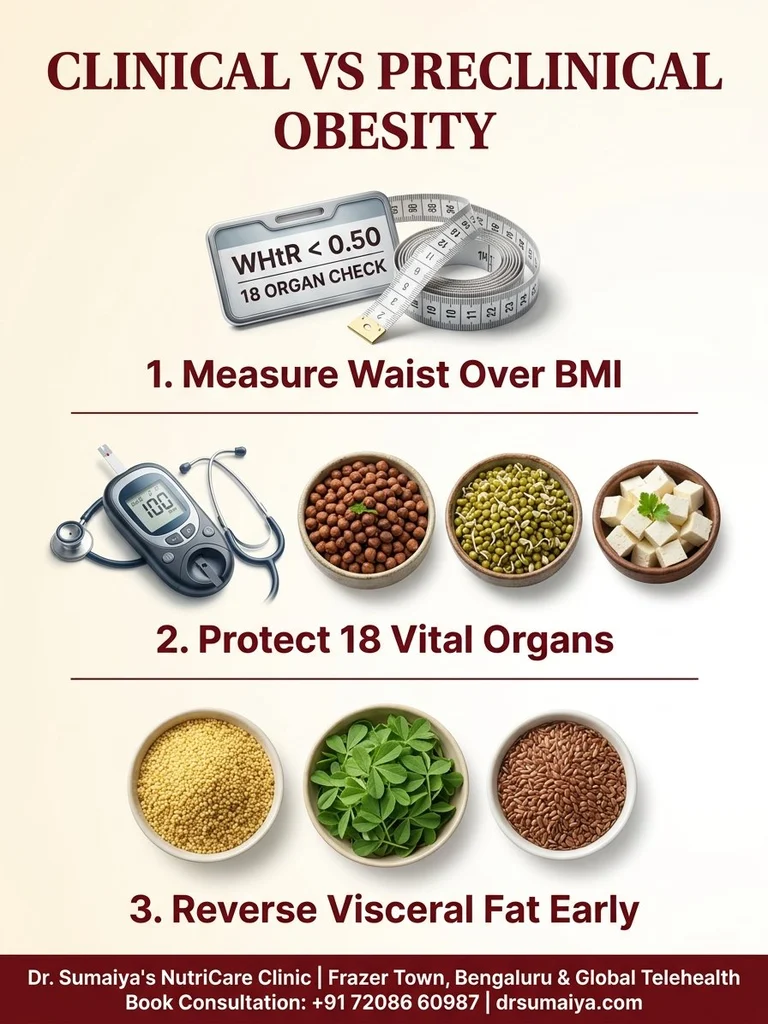
Visual Clinical Summary: Clinical vs. Preclinical Obesity & Waist Ratio Guide — Dr. Sumaiya NutriCare Clinic.
Clinical vs. Preclinical Obesity: What BMI Misses
Dr. Sumaiya Petiwala explains the difference in 30 seconds.
How to Reverse Belly Fat Safely: The Indian Kitchen Blueprint
Stopping preclinical obesity from turning into organ-damaging clinical obesity requires shrinking deep belly fat while keeping your muscles strong. Extreme calorie cutting slows your metabolism and causes rebound weight gain. Instead, apply these four daily habits in your Indian kitchen:
1. Follow the 50/25/25 Indian Plate Rule at Lunch and Dinner
- 50% Non-Starchy Vegetables: Start with a bowl of fresh cucumber-tomato salad plus cooked sabzi like methi greens, palak, bhindi, lauki, or French beans.
- 25% Muscle-Protecting Protein: Include boiled kala chana, sprouted whole moong, rajma, thick dal, fresh homemade paneer, curd, whole eggs, or grilled fish or chicken at every meal.
- 25% Smart Whole Grains: Enjoy one or two soft phulkas made from khapli wheat (emmer) or a modest serving of unpolished foxtail millet or hand-pounded rice, topped with 1 teaspoon of roasted flaxseed podi.
2. Press the Fiber Brake Pedal (The Golden Eating Sequence)
Eat your salad and sabzi first, your dal or protein second, and your roti or rice last. Fiber forms a gentle gel in your gut that slows down sugar absorption, keeping insulin calm so your body burns stored belly fat instead of packing more into your liver.
3. Upgrade Your Breakfast and 4 PM Snacks
Sweet chai with biscuits, bakery rusks, and fried namkeen send extra sugar straight to your waistline. Swap them for roasted makhana, roasted chana, spiced buttermilk (roasted-jeera chaas), or a bowl of plain homemade curd with chia seeds. At breakfast, trade refined poha or white bread for moong dal chilla with paneer or vegetable dalia.
4. Pair Daily Walking with Twice-Weekly Strength Work
Walk for 15 minutes after dinner to help your muscles absorb blood sugar. Add simple bodyweight squats, wall push-ups, or light dumbbell exercises twice a week. Strong muscles act like a sponge for blood sugar and protect you from normal-BMI belly fat.
Dining Out & Global NRI Tips
Whether you live in Bengaluru, London, Dubai, Singapore, or the US, the same plate rule works anywhere. Order grilled greens or a crisp salad first, choose lean protein (paneer tikka, dal, tofu, eggs, grilled fish, or chicken) next, ask for unsweetened tea or coffee, and share rice or flatbread rather than eating a full plate alone.
The Diagnostic Gap: Check Your Organ Health Panel
A bathroom scale cannot tell you if your belly fat is harmless or quietly straining your liver, kidneys, and arteries. Before starting any diet plan, ask your doctor for a simple baseline check:
Dr. Sumaiya’s Clinical Checklist (Preclinical vs. Clinical Obesity)
- Waist & Body Ratios: Measure your waist at belly-button level. Aim for <80 cm in Indian women and <90 cm in Indian men, with a Waist-to-Height Ratio under 0.50.
- Blood Sugar & Insulin Check: Test HbA1c, fasting insulin (the insulin level in your blood after an overnight fast), and HOMA-IR (a score showing how resistant your cells are to insulin; target <1.5).
- Liver & Heart Markers: Check SGPT (a liver enzyme that rises when liver cells hold excess fat), ALT (another name for SGPT), GGT (<27.5 U/L), triglycerides (blood fats made from extra carbs; target <100 mg/dL), HDL, and ApoB (a marker counting artery-clogging fat particles).
- Kidney & Tissue Stress Screen: Check kidney filtration (eGFR), urine protein ratio (UACR <30 mg/g), uric acid (a waste marker linked with sugar and fat overload), and hs-CRP (a blood test showing silent inflammation (ongoing immune tissue stress)).
Frequently Asked Questions
1. What is the difference between preclinical obesity and clinical obesity?
Preclinical obesity means you carry extra belly fat based on waist size, but your organs still work normally. Clinical obesity starts when that fat harms at least one vital organ—causing high blood sugar, liver fat, high blood pressure, or kidney strain—and raises death risk by 69%.
2. Can I have clinical obesity even if my BMI is normal or only slightly high?
Yes. The November 2026 Nature study of 844,108 adults showed that BMI alone missed 5.2% to 8.6% of adults with risky belly fat. Indian adults often build deep organ fat at a BMI of 23 to 26, so checking waist size and blood reports is vital.
3. Does everyone with preclinical obesity end up with clinical obesity?
No. Ten-year follow-up data showed that only 8.7% to 22.6% of adults with preclinical obesity moved into clinical obesity when they managed risk factors early. Using the 50/25/25 plate rule and regular strength exercise protects your organs and trims your waist safely.
4. Why is a 0.50 waist-to-height ratio cutoff not enough on its own?
The November 2026 study found that a single 0.50 waist-to-height cutoff can flag some low-risk adults if used alone. Pairing your waist size with ethnic cutoffs and blood markers like fasting insulin, blood fats, and liver enzymes gives a much clearer picture of your true health risk.
5. How can I lose belly fat without losing muscle mass on an Indian diet?
Avoid crash diets and skipped meals, which burn lean muscle. Anchor every meal with 20 to 30g of protein—such as boiled kala chana, sprouted whole moong, homemade paneer, curd, eggs, or fish—pair it with half a plate of sabzi, and add resistance exercise twice a week.
Clinical Evidence Sources: Multinational validation of clinical and preclinical obesity criteria in 844,108 adults. Nature / News-Medical report, November 12, 2026 (News-Medical). Lancet Diabetes & Endocrinology Commission on Clinical Obesity. ICMR-NIN Dietary Guidelines for Indians (2024).
🌟 Transform Your Health Today
Takes only 60 seconds to send a booking enquiry.
"Lost 4kgs in one month... plans are simple and effective! She
responds to queries promptly."
– Payal J.
About this guide
This guide provides general health information. Your own care depends on your medical history and circumstances. Speak with your treating clinician before changing medicines or treatment.