Four blood markers matter here. HbA1c (your average blood sugar over roughly three months) and fasting insulin (your insulin level after an overnight fast) both worsen with long sitting. Triglycerides (the blood fats that rise when insulin stays high) climb too, and an underactive thyroid (the neck gland that sets your metabolism) makes fat loss harder still.
🩺 Quick Clinical Answer: Does Going to the Gym Cancel Out a Desk Day?
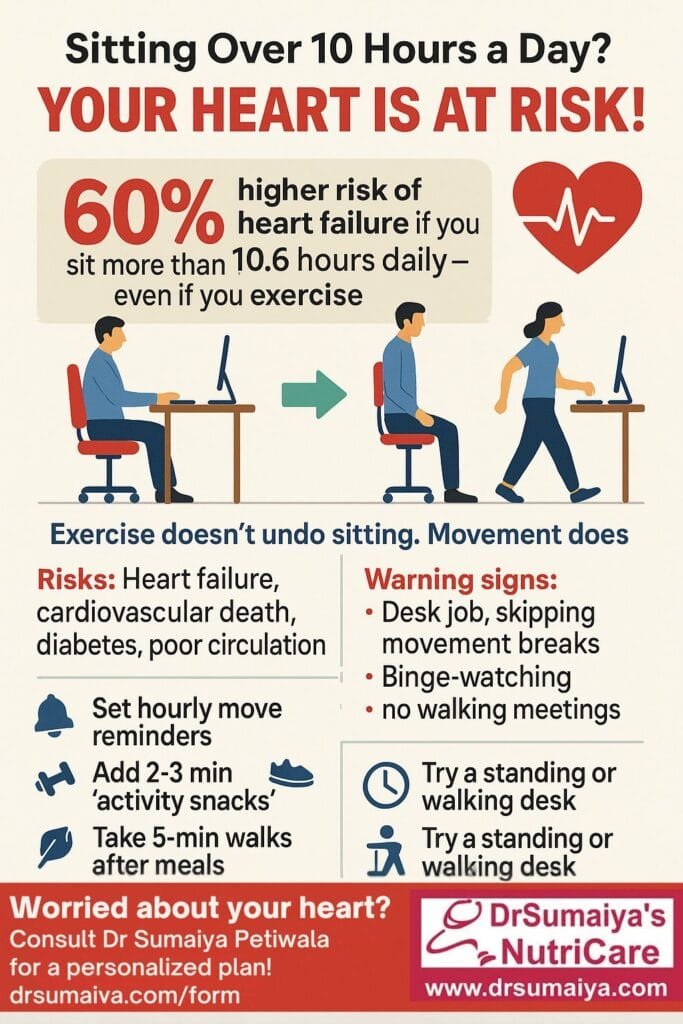
No. A 2025 UK Biobank study of 89,530 adults found that sitting more than 10.6 hours a day raised heart failure and cardiovascular death risk even in people who met the 150 minutes of weekly exercise guidance. Standing is not enough either. Short movement breaks through the day matter more than one evening workout.
Most of us have heard the advice about exercise. The part almost nobody says out loud is that exercise is not the opposite of sitting. They are two separate things, and you can do one well while the other ruins you. If you sit for ten hours and train for forty-five minutes, the arithmetic does not work in your favour.
In my clinic, the patients who struggle most are often the ones who are already doing everything right at the gym. So let me explain what the research actually found, why standing desks are not the answer, and what to change at your desk tomorrow.
What the UK Biobank Study Found
This is one of the more useful studies to come out recently, because it used wrist trackers rather than self-reported questionnaires. That matters, since people are notoriously bad at estimating how long they sit.
- 89,530 adults wore an activity tracker for one week, then were followed for eight years.
- Average sitting was 9.4 hours a day. The upper end of the normal range was 10.6 hours.
- Those sitting beyond about 10.6 hours a day had a 40 to 60 percent higher risk of heart failure and cardiovascular death.
- Over the follow-up, 4.9 percent developed atrial fibrillation (an irregular heartbeat that raises stroke risk), 2.1 percent developed heart failure, and 1.84 percent had a heart attack.
The finding that surprised everyone was the last one. This risk stayed elevated even in people who hit the recommended 150 minutes of moderate activity each week.
| What the study measured | Result over 8 years |
|---|---|
| Sitting above 10.6 hours a day | 40 to 60 percent higher risk of heart failure and cardiovascular death |
| Developed atrial fibrillation | 4.9 percent of participants |
| Developed heart failure | 2.1 percent of participants |
| Had a heart attack | 1.84 percent of participants |
| Also meeting 150 minutes of weekly exercise | Risk stayed elevated, especially for heart failure |
Why Exercise Alone Is Not Enough
Many of my patients assume a good workout earns them the right to sit still all day. The researchers disagree.
Sedentary risk remained even in people who were physically active. This matters because many of us sit a great deal and assume an evening workout cancels it out. It does not.
The reason is that sitting and exercising load the body differently. A workout improves your fitness capacity. Prolonged sitting repeatedly switches off the processes that keep your blood vessels and blood sugar healthy. One does not repair the other.
What Sitting Does to Your Body
While you sit for hours, several things quietly go wrong.
- Muscle activity drops. Your leg and core muscles stop working, so they weaken. Weaker muscles burn less sugar.
- Blood flow slows. Circulation in the legs drops, which affects how well fat is cleared from the blood.
- Energy use falls sharply. Standing and walking burn far more than sitting, even for modest movement.
- Blood sugar control worsens. The mechanisms that regulate sugar and fat breakdown become less efficient.
- Your legs swell. Fluid pools in the lower limbs. In someone who is overweight, long periods of sitting with legs crossed also raise the risk of vein problems.
Over years, those changes feed into high blood pressure, raised triglycerides, and type 2 diabetes. That is the pathway the study was tracking.
Are You in a High-Risk Pattern?
You are in a higher-risk group if your day includes most of these.
- A desk job with eight or more hours of near-continuous sitting.
- No movement breaks at all during the working day.
- Several hours of screen time after work.
- No walking meetings and no standing desk.
- Sitting straight after lunch and dinner.
- A daily total somewhere around 10 hours or more of sitting.
Add up your commute, your desk hours, your meals seated at a table, and your evening at home. Most people reach ten hours without noticing.
5 Strategies That Actually Reduce Sitting
- Set hourly movement reminders. Let your phone or watch prompt you every hour. Even a two-minute interruption to sitting is worthwhile, because it breaks the pattern rather than just adding to your workout.
- Take activity snacks. Two or three minutes counts. Walk a corridor, climb a flight of stairs, stretch at your desk, or do ten bodyweight squats.
- Move after every meal. This is the one I push hardest. A ten-minute walk straight after eating blunts the blood sugar rise, and in India the habit already exists. Take the first step after dinner rather than settling on the sofa.
- Measure before you fix. Use a tracker or your watch and aim to keep total sitting under ten hours. Measurement alone changes behaviour for most people.
- Change your workspace. If you can, alternate between sitting and standing, and keep frequently used items just out of reach so you have to stand up.
Why Standing Desks Are Not the Answer
Standing desks are sold as the fix, and the evidence does not support them on their own. Work from the University of Sydney found that standing beyond two hours a day was not linked to lower cardiovascular risk, and may raise the risk of venous problems such as varicose veins.
What improves heart health is engaging the cardiovascular system, not simply being upright. A standing desk only helps if you actually walk and move while using it.
What Desk Workers Can Change
An eight-hour workday plus commuting plus an evening at home adds up fast. These changes work because they are built into the day rather than added to it.
In Your Own Workspace
- Keep your water bottle small, so refilling it means getting up.
- Hold walking meetings instead of seated ones where the topic allows.
- Set your desk so you change posture every half hour.
- Try an under-desk pedal or a small stepper for a few minutes at a time.
At Work
- Ask for structured movement breaks in meetings longer than an hour.
- Walk to the printer, the rest room, or the canteen instead of calling.
- Use lunch to walk rather than to scroll.
- Walk part of the commute. It is the easiest movement of the day to keep.
Explore Related Clinical Guides
- Why Indians Are Prone to Heart Attacks and Diabetes — the metabolic pattern behind cardiovascular risk at younger ages.
- Meal Sequencing: The Smart Way to Eat — why eating vegetables before roti changes your sugar response.
- Why You Still Crave Sweets After a Meal — the link between sitting, insulin, and cravings.
- Fit and Active but the Scale Will Not Budge — when exercise is not the missing piece.
- 5 Simple Steps to Reading Food Labels — spotting hidden sugar and trans fats quickly.
Fuel and Movement Go Together
Movement is only half the picture. What you eat determines how much glucose your blood carries into those long seated hours, and how much fat your body is asked to store during them.
- Never skip protein. Add dal, paneer, curd, eggs, or soya to every main meal. Protein is what keeps your blood sugar steady while you sit through an afternoon.
- Eat vegetables before roti and rice. Starting a meal with salad and sabzi, then dal, then roti, blunts the sugar spike without changing a single ingredient.
- Do not skip breakfast. Most patients who crash before lunch end up eating biscuits and chai at four, which is a bigger problem than the sitting itself.
- Watch the liquid calories. Sweet tea and packaged drinks land faster than solid food. Cutting them is often the single biggest win for a desk worker.
- Take the walk after the meal. Ten unhurried steps after lunch and dinner are the easiest movement a desk job allows.
Frequently Asked Questions
References
- Ajufo E, et al. Accelerometer-Measured Sedentary Behavior and Risk of Future Cardiovascular Disease. JACC. 2025. https://pubmed.ncbi.nlm.nih.gov/39545903/
- American College of Cardiology. JACC Study Finds Sitting Too Long Can Harm Heart Health, November 2024. https://www.acc.org/latest-in-cardiology/articles/2024/11/13/21/17/sat-sitting-aha-2024
- University of Sydney. Standing time and cardiovascular and cardiometabolic health outcomes, 2024. https://www.tctmd.com/news/standing-alone-will-not-offset-sittings-cvd-risks-study-suggests
- World Health Organization. Guidelines on Physical Activity and Sedentary Behaviour. Geneva: WHO; 2020.
- American Heart Association. Life’s Essential 8: Physical Activity. https://www.heart.org/en/news/2023/05/23/sitting-too-much-may-raise-heart-disease-risk
This guide provides general health information. Your own care depends on your medical history and circumstances. Speak with your treating clinician before changing medicines or treatment.