Medically Verified & Evidence-Based | Authored by Dr. Sumaiya Petiwala, RD, BUMS, CDE (Registered Clinical Dietitian & Certified Diabetes Educator) | Aligned with ICMR-NIN and WHO safety standards | Last Updated: October 2026
Natural Doesn’t Mean Safe: Herbal Toxicity, Heavy Metals & What Your Kitchen Does Better (2026)
“It is natural, so it cannot harm me.” I hear this sentence almost every week in clinic. It is the most expensive assumption in Indian nutrition.
Plants make chemicals to defend themselves. Some of those chemicals are helpful in small amounts. The same chemicals become harmful when they are concentrated into a capsule, powder or slimming drink.
This guide explains what actually goes wrong with unregulated herbal products. It also shows you the safest version of herbal medicine you already own: your own kitchen.
Is “Natural” the Same as Safe?
Quick Clinical Verdict: Debunking the ‘Natural Means Safe’ Myth
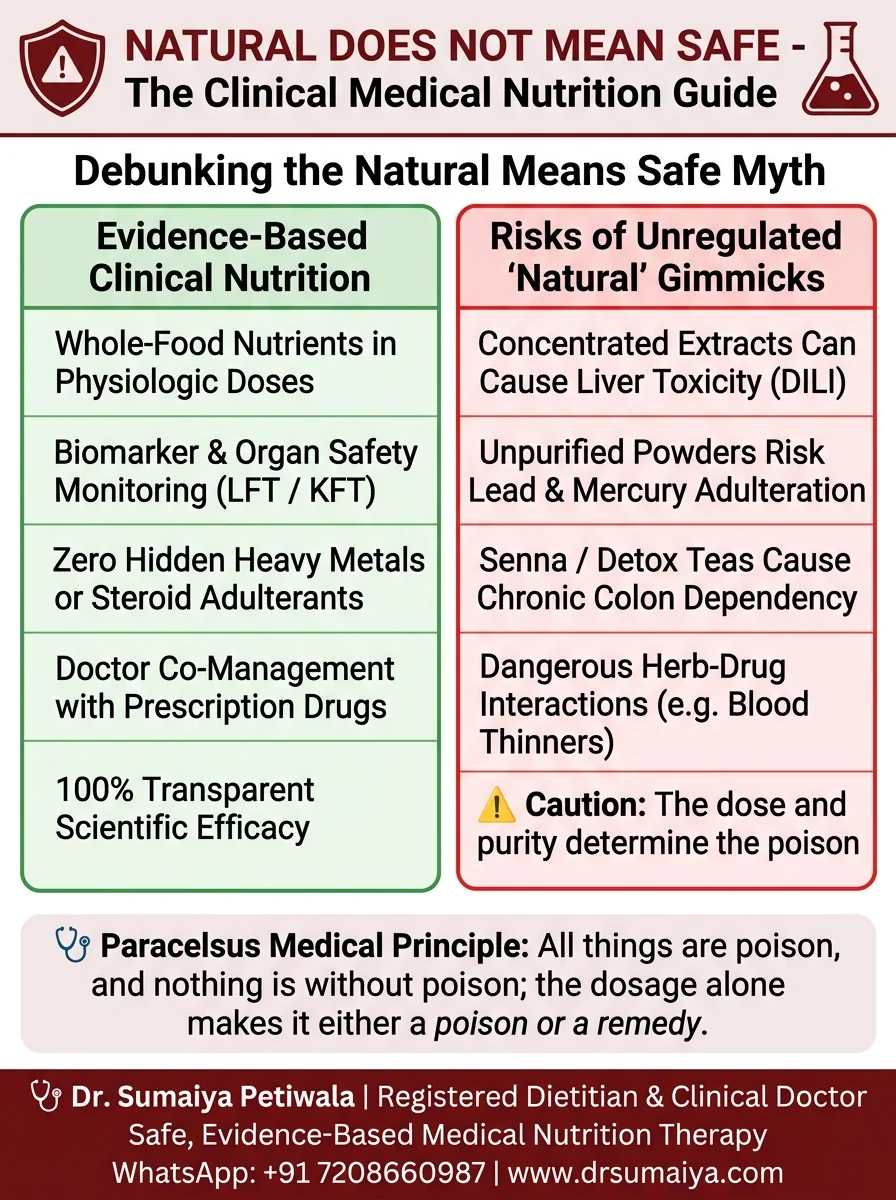
No. Nature produces strong poisons as well as gentle foods, and the dose decides which one you get. Unregulated herbal powders have caused liver injury, kidney damage, heavy metal poisoning and drug interactions. Dr. Sumaiya’s recommendation: keep herbs in food amounts, use medicine doses only under supervision, and check your liver and kidney blood tests.
📋 In This Guide
1. Why the Dose Decides Everything
Doctors have known this rule for 500 years. The dose makes the poison. Water can kill you if you drink it fast enough. Haldi is safe on your dal and risky as a concentrated pill.
Here is the part most people miss. Kitchen amounts and capsule amounts are not similar. A teaspoon of turmeric in sabzi gives you a few milligrams of curcumin. A commercial capsule can give 500 to 1,000 mg.
That jump changes what happens inside your body. Your liver has to process the extra load. Some of it leaves quietly. Some of it damages liver cells, especially when you take it every day for months.
Two more things decide your risk. First, how pure is the powder? Second, what medicine are you already taking? Both answers are missing on most product labels.
2. Five Real Harms I See in Clinic
1. Liver injury
Herbal and dietary supplements are a leading cause of drug-induced liver injury worldwide, and India reports a rising share of it. The warning signs are tiredness, nausea, poor appetite, yellow eyes and dark urine. Blood tests then show a rising SGPT (a liver enzyme test) and SGOT (another liver enzyme test).
2. Kidney damage
Your kidneys filter your whole blood volume many times a day. Heavy metals and concentrated plant acids can scar the tiny filters inside them. Damage is often silent at first. Swelling of the feet, frothy urine or a falling urine output are late signs.
3. Heavy metal contamination
Studies of herbal products sold online have found lead, mercury and arsenic, sometimes at levels that exceed safety limits. Lead poisoning can present as belly pain, constipation, anaemia and nerve tingling. Nobody labels a bottle with “contains lead”.
4. Hidden steroids and drugs
Slimming powders and “muscle gain” herbal blends have repeatedly tested positive for steroids, sibutramine or diuretics. The weight falls quickly, the hormone system takes the hit, and the acne, mood swings and irregular periods are blamed on something else.
5. Herb-drug interactions
Some herbs block the liver enzymes that clear your regular medicines. The medicine then builds up to a toxic level. This matters for blood thinners, thyroid (the gland that sets your body’s speed) tablets, diabetes drugs, anti-epileptics and medicines for heart rhythm.
3. Tested Nutrition vs Untested “Natural” Products
The table below compares what a dietitian-guided plan does with what an unregulated commercial product usually does.
| Safety Area | Dietitian-Guided Nutrition | Unregulated “Natural” Product |
|---|---|---|
| Dose | Physiological amounts from home-cooked food | Concentrated extracts, sometimes 50-100 times stronger than a food serving |
| Purity testing | Standard grocery staples, no industrial powders | Unlisted heavy metals and adulterants are common in testing surveys |
| Baseline blood work | SGPT, SGOT, creatinine and eGFR checked before and after | Usually none, even for daily lifelong use |
| Medicine interactions | Screened against your prescription list | Not screened; the label rarely mentions your tablets |
| Gut effect | Fibre, curd and vegetables build gut bacteria gently | Daily laxative herbs such as senna cause dependence and electrolyte loss |
| Typical monthly cost | ₹1,500-₹4,000 spent on real food | ₹2,000-₹15,000, often with zero monitoring |
4. The Products That Cause the Most Trouble
Risk is not spread evenly. These are the categories I ask about first when a report shows a sudden liver or kidney change.
- Slimming and fat-burner capsules: the highest-risk group, because they are taken daily and are rarely tested.
- High-dose green tea extract: linked to liver injury when taken as a concentrated supplement rather than as a drink.
- Herbal churna mixtures from unverified sellers: a common source of heavy metal contamination.
- Daily “cleansing” teas: often senna based, which the gut learns to depend on within weeks.
- Immunity tonics taken for months: safe for a short season, risky as a permanent habit without a doctor watching.
- Weight-loss drops from social media: almost never tested, almost never refunded.
Notice that the problem is mostly the dose, the duration and the missing quality check. Not the plant itself.
5. How to Use Herbs Safely
- Cook with them freely. Haldi, jeera, dhania, ajwain, methi, tulsi and ginger are safe in everyday food amounts.
- One new item at a time. If something goes wrong, you will know exactly what caused it.
- Ask for a third-party lab certificate. A certificate of analysis (COA) shows heavy metal and microbial testing. No certificate, no purchase.
- Tell your doctor everything you take. Bring the bottle, not just the name. This is how interactions get caught.
- Check your blood work. SGPT, SGOT, creatinine and eGFR before you start and again after 3 to 6 months of daily use.
- Stop at the first warning sign. Nausea, dark urine, yellow eyes or unexplained tiredness means stop today and get tested.
- Pause before surgery, pregnancy and for children. These three groups need a doctor’s decision, not a label’s promise.
Also remember the money angle. A liver injury workup costs far more than the bottle that caused it, and some injuries never fully reverse. That is the real price of a cheap supplement.
6. Your Kitchen Is the Safest Pharmacy
I would rather you spend on food than on unverified powders. Your own cooking gives you the same plant compounds in safe amounts, along with fibre and protein that no capsule can replace.
- Anti-inflammatory cooking: haldi with a pinch of kali mirch and a little ghee in dal. Black pepper improves curcumin absorption naturally.
- The 50/25/25 plate: half salad and sabzi, a quarter protein, a quarter roti or millets. Simple, cheap and safe for daily life.
- Curd as a probiotic (live good bacteria): one katori with lunch supports gut health far more gently than a colon-cleanse product.
- Fibre first: vegetables, whole dal and fruit keep cholesterol, uric acid (a waste product from protein breakdown) and blood sugar in range.
- Water, not tonics: 2.5 to 3 litres a day protects kidney filters without any additive risk.
- Sleep and walking: the two “supplements” with the strongest evidence and the lowest price.
⚠️ Stop the product and see a doctor if you notice
- Yellow eyes or skin, or dark tea-coloured urine.
- Persistent nausea, vomiting or pain under the right ribs.
- Swelling of the feet, puffiness of the face or passing much less urine.
- Unexplained tiredness, anaemia or tingling in the hands and feet.
- Frothy urine, or blood in the urine.
- New bruising or bleeding while on a blood thinner.
Please do not treat this as a warning against all herbal medicine. It is a warning against buying strong medicine without a prescription, a quality certificate or a follow-up test. Used with care, plants remain one of our oldest and kindest treatments.
Taking a Herbal Powder Daily? Get Your Liver and Kidneys Checked First.
Many patients arrive with an unexplained rise in SGPT or creatinine, and a bottle that was never tested. Dr. Sumaiya reviews your reports, screens every product against your medicines, and replaces what is risky with food that works.
- Step 1: Safety Blood Panel — liver, kidney, sugar and lipid markers reviewed before any daily herb is continued.
- Step 2: Product and Interaction Audit — every powder, capsule and tea checked against your prescriptions.
- Step 3: Food-First Replacement Plan — a home-cooked Indian plan that delivers the same benefit without the risk.
In-Clinic at Frazer Town, Bengaluru & Telehealth Pan-India / Globally | Call/WhatsApp: +91 7208660987