

Medically Verified & Evidence-Based | Authored by Dr. Sumaiya Petiwala, RD, BUMS, CDE (Registered Clinical Dietitian & Certified Diabetes Educator) | Aligned with ICMR-NIN and NIH clinical standards | Last Updated: October 2026
Top 10 Healthspan Supplements: What Actually Works (Doctor’s Guide 2026)
Healthspan is the number of years you spend strong and clear-headed. It is not the same as lifespan, which is simply how long you live. Most people want the first one.
Supplement shops promise that both can be bought in a bottle. That promise is far bigger than the evidence. Some capsules do help. Many do very little. A few cause real harm when taken in the wrong dose or with the wrong medicine.
This guide ranks ten popular healthspan supplements by how strong the human evidence really is. You will also find honest dose ranges, the interactions that matter, and the Indian foods that supply the same nutrients.
Do Healthspan Supplements Actually Work?
Quick Clinical Verdict: Top 10 Supplements for Healthspan
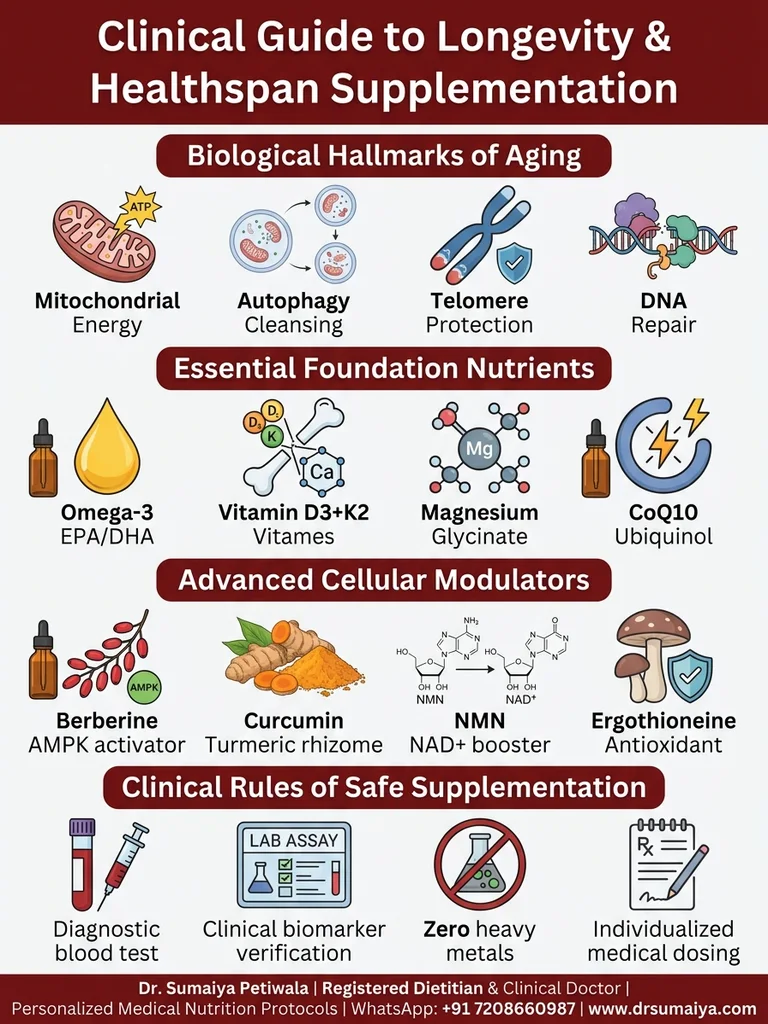
Four supplements have solid human evidence: omega-3 for high triglycerides (a type of blood fat), vitamin D for a proven deficiency, magnesium for a low intake, and CoQ10 for people on statins. The rest range from promising to unproven. Dr. Sumaiya’s recommendation: test your blood first, fix food second, and supplement only what your reports show you actually need.
📋 In This Guide
1. How I Decide Whether You Need a Supplement
I use one simple order for every patient. Test first. Then fix food. Then add a targeted supplement. Then re-test.
Skipping the first step is where most money gets wasted. Nobody knows their own vitamin D, B12 or magnesium level by feeling. A blood report takes an hour and changes the whole plan.
The second step matters just as much. Good food gives you fibre, protein, potassium and hundreds of plant compounds that no capsule copies. A capsule on top of a poor plate is a small patch on a large hole.
| What Matters | Trendy Self-Stacking | Dr. Sumaiya’s Biomarker-Guided Plan |
|---|---|---|
| Why you start | A reel, a friend’s advice, or a big discount pack | A specific gap on your blood report |
| Which form you buy | Cheapest oxide powders and unstandardised herb blends | Chelated minerals such as magnesium glycinate, third-party tested brands |
| Typical cost per month | ₹4,000-₹12,000 on 6-10 products | ₹800-₹3,000 on 2-4 products that are actually needed |
| Recheck interval | Never | 6 months, or sooner if a dose changes |
| Likely outcome | Poor sleep, stomach upset, wasted money | Corrected levels, steady energy, measurable improvement |
2. The Ten Supplements, Ranked by Evidence
Read the evidence badge before the price tag. “Strong” means large human trials agree. “Modest” means small trials show a real but limited effect. “Early” means we have biology and hope, not proof.
1. Omega-3 (EPA and DHA) — Strong for high triglycerides
Omega-3 fats keep cell walls flexible and calm inflammation (the body’s alarm response to irritation). They lower high triglycerides clearly, which is their best-proven job.
2. Vitamin D3 — Strong for deficiency only
Vitamin D helps calcium enter bone and supports muscle and immune function. Most urban Indians are low. Large trials did not show that extra vitamin D prevents disease in people who are already sufficient.
3. Magnesium Glycinate — Modest, useful if intake is low
Magnesium runs more than 300 reactions in your body, including muscle relaxation and blood sugar handling. Many Indian diets fall short because we eat less of the green leafy vegetables, nuts and seeds that carry it.
4. Coenzyme Q10 (as Ubiquinol) — Modest, most useful on statins
CoQ10 helps your mitochondria (the tiny power plants inside every cell) make energy. Statin medicine can lower your natural CoQ10 levels, so this is one case where a supplement makes clear sense.
5. Curcumin (with black pepper) — Modest for joint pain
Curcumin is the yellow compound in haldi. Small trials show better joint comfort and lower markers of inflammation. Plain turmeric powder absorbs poorly, so the extract needs piperine (black pepper extract) or a phytosomal form.
6. NMN and Other NAD+ Precursors — Early: not yet proven
NAD+ is a molecule your cells use for repair. Levels fall with age. NMN raises NAD+ levels on a blood test, but no large trial has shown that this extends healthy years in humans.
7. Berberine — Modest for blood sugar
Berberine is a plant compound from Daruharidra. Short trials show it lowers fasting sugar and HbA1c (your three-month blood sugar average). The effect is real but modest, and it is not a replacement for diabetes medicine.
8. Spermidine — Weak: mostly observational
Spermidine is a compound that helps your cells recycle damaged parts, a process called autophagy (the cell’s own cleaning system). The human evidence so far is small and mostly from population studies, not controlled trials.
9. L-Ergothioneine — Early: biology, not proof
Ergothioneine is an antioxidant (a compound that soaks up cell damage) that your body actively pulls into cells using its own transporter. Mushrooms are the richest source. It is fascinating, but clinical trials in humans are still missing.
10. Resveratrol and Pterostilbene — Disappointing in human trials
These grape-skin compounds excited researchers because they mimicked calorie restriction in animals. Large human trials then failed to show the same benefit. Absorption is also poor.
3. Food First: The Same Nutrients in an Indian Kitchen
Before you buy anything, look at your plate. Most of these nutrients live in foods your grandmother already cooked. This table shows where to find them and what a full day looks like.
| Nutrient | Indian Kitchen Source | Daily Target From Food |
|---|---|---|
| Omega-3 (EPA/DHA) | Bangda or surmai twice a week; alsi powder, walnuts, chia | 2 fish meals a week + 1 tbsp ground alsi |
| Vitamin D | Morning sun on arms and face; eggs, mushrooms, fortified milk | 15-20 minutes sun, 4-5 days a week |
| Magnesium | Palak, methi, rajgira, pumpkin seeds, almonds, whole dal | 1 bowl greens + 1 handful nuts or seeds |
| Protein | Dal, chana, curd, paneer, eggs, fish, chicken | 1 g per kg body weight, spread across meals |
| Gut bacteria support | Curd as a probiotic (live good bacteria); cooked dal and vegetables as a prebiotic (plant fibre that feeds them) | 1 katori curd + 25-30 g fibre a day |
| Polyphenols | Haldi with kali mirch, jamun, black grapes, green tea, salad vegetables | Colour on every plate, twice a day |
Use the 50/25/25 plate to make this easy. Half the plate salad and sabzi, a quarter protein such as thick dal, paneer or fish, and a quarter smart roti, millets or rice. Eat salad and protein first, then the grain last.
4. Safety Rules and Medicine Interactions
Supplements are not automatically safe because they come from plants. Please treat them like weak medicines, with the same caution.
- Blood thinners such as warfarin: omega-3, curcumin, CoQ10 and vitamin K2 all change how these medicines behave. Tell your doctor before you start any of them.
- Diabetes medicines: berberine adds to metformin and insulin, so sugar can drop too low. It needs supervision and a glucometer.
- Fat-soluble vitamins (A, D, E, K): they build up in your body. More is not better.
- Kidney disease: avoid high-dose magnesium and potassium supplements unless your nephrologist approves.
- Liver watch: if you take herbal extracts daily, check SGPT (a liver enzyme test) and your kidney panel every six months.
- Purity: ask for a third-party lab certificate (COA). Cheap herbal powders have been found to contain heavy metals.
- Pregnancy and breastfeeding: no supplement stacks without obstetric approval.
If you take medicine for thyroid (the gland that sets your body’s speed) or for PCOS (a hormone condition that affects periods), keep a two-hour gap between those tablets and any calcium, iron or magnesium supplement.
⚠️ Stop the supplement and see a doctor if you notice
- Yellow eyes or skin, dark urine, or pain under the right ribs.
- Severe stomach pain, persistent nausea or vomiting.
- New muscle aches with weakness, especially on a statin.
- Fainting, shakiness or sweating after a dose (low sugar).
- Rash, swelling of the lips, or breathing difficulty.
- Unexplained bruising or bleeding.
Also remember the base of the pyramid. Sleep, protein at every meal, walking after dinner and a steady fasting window do more for healthspan than any capsule. Supplements sit on top of that base. They never replace it.
Frequently Asked Questions
Medical References
About this guide
This guide provides general health information. Your own care depends on your medical history and circumstances. Speak with your treating clinician before changing medicines or treatment.