

Dr. Sumaiya Petiwala, RD, BUMS, CDE · Registered Clinical Dietitian & Medical Doctor · Evidence-Based Nutrition Guide · November 2026
Many adults visit my clinic feeling stuck. Their morning fasting blood sugar stays at 105 or 115 mg/dL, even when they eat light dinners, walk daily, and start working on their fatty liver (fat buildup inside liver cells). They often wonder what they are missing.
A new multi-organ CT scan study of 270 adults published on November 14, 2026 in the Journal of Clinical Medicine (MDPI JCM Study) explains why. Extra fat does not stop at your liver. It also builds up inside your pancreas and deep core muscles, slowing down insulin release and pushing morning blood sugar above 100 mg/dL.
How does a fatty pancreas cause high morning fasting blood sugar?
A fatty pancreas happens when stored fat builds up inside the pancreas and slows down insulin release, pushing morning fasting blood sugar above 100 mg/dL. A November 2026 scan study found high pancreas fat in 63% of obese adults. Dr. Sumaiya’s advice: clear organ fat with early dinners and intact legume fiber.
The Twin-Cycle Spillover: How Liver Fat Reaches Your Pancreas and Muscles
Your organs share one fuel pipeline. Think of your liver as your body’s main Liver Storage Warehouse. When you eat more refined flour, white rice, or sweet snacks than your muscles can burn, your liver turns that extra sugar into stored fat.
Once your liver warehouse fills up, it starts shipping extra fat out into your bloodstream. These blood fats—called triglycerides (the main type of fat carried in your blood from extra carbs and sugar)—spill into two nearby spots:
- Your Pancreas: Fat droplets collect inside the head and body of the pancreas. This puts stress on beta cells (the tiny cells that make insulin), making them too sluggish to release a quick burst of insulin.
- Your Deep Muscles: Fat also slips inside muscle fibers. Think of insulin as a key—the Insulin Key—that unlocks muscle doors so sugar can enter for energy. Fat inside muscles jams those locks, causing insulin resistance (when your cells stop responding well to insulin).
At night, this double hit causes trouble. Because your pancreas cannot send a strong insulin signal, your fatty liver keeps pouring fresh sugar into your blood while you sleep. You wake up with high morning fasting sugar even though you did not eat all night.
What the November 2026 CT Scan Study Found
In the November 14, 2026 Journal of Clinical Medicine study (JCM 2026), doctors scanned four organs at the same time in 270 adults. High pancreas fat (≥25%) rose sharply with body weight: 12.8% in normal-weight adults, 32.2% in overweight adults, and 63.0% in obese adults.
High pancreas fat linked directly with fasting blood sugar ≥100 mg/dL (p = 0.033) and high blood pressure (p < 0.001). It also tracked closely with liver fat (ρ = 0.34) and psoas muscle fat (ρ = 0.43). In short, high morning sugar is rarely a single-organ problem.
| Organ Fat Site | Rate by Weight Group (JCM 2026) | How It Harms Blood Sugar | Key Blood & Body Checks | Daily Indian Diet Step |
|---|---|---|---|---|
| Liver Fat | 19.0% normal weight → 49.2% overweight → 55.6% obese | Makes too much sugar overnight and ships extra fat out into blood | High SGPT (a liver enzyme that leaks when liver cells are stressed), ALT (another name for SGPT), and blood fats | Cut sweet drinks and fruit juices; eat whole dals and green sabzi daily |
| Pancreas Fat | 12.8% normal weight → 32.2% overweight → 63.0% obese | Stresses insulin cells so they miss the first quick insulin burst | Morning sugar ≥100 mg/dL, high blood pressure, and stressed C-peptide (a test showing how much insulin you make) | Finish dinner 3 hours before bed; keep a 12-to-14-hour overnight food break |
| Muscle Fat | Rises with weight, age, male sex, and high blood pressure (17.1% vs 13.2%) | Jams muscle doors so blood sugar cannot enter after meals | After-meal sugar spikes and high HOMA-IR (a score showing how resistant your cells are to insulin) | Eat 25 to 30g protein per meal and walk 15 minutes right after eating |
| All Three Together | Linked across liver, pancreas, and core muscles (ρ = 0.34–0.43) | Speeds up the shift from prediabetes to Type 2 diabetes | HbA1c (a blood test showing your 3-month average blood sugar) >5.7% and wide waist size | Follow the 50/25/25 plate rule and eat fiber first for 12 to 16 weeks |
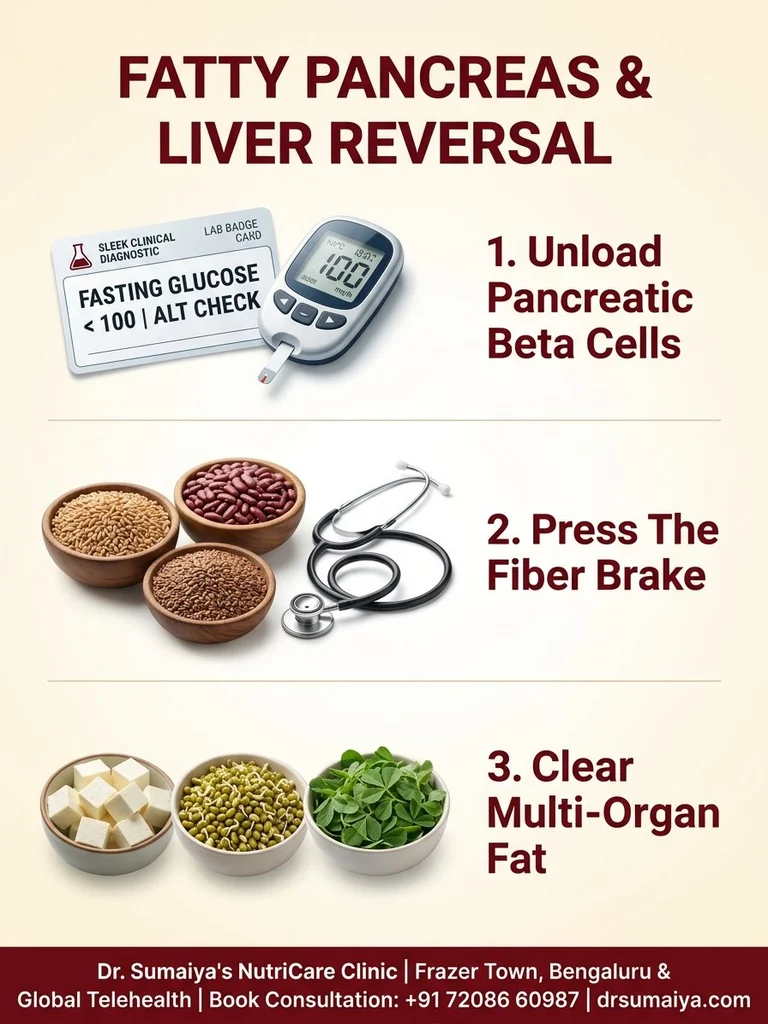
Visual Clinical Summary: Fatty Pancreas & Multi-Organ Fat Reversal Protocol — Dr. Sumaiya NutriCare Clinic.
How to Clear Pancreas and Liver Fat: Practical Indian Kitchen Steps
You do not need crash diets or hunger plans to clear organ fat. Starving yourself makes your body burn lean muscle, which makes muscle fat worse. Instead, steady home-cooked meals stop liver fat spillover and let your pancreas recover.
1. Finish Dinner Early for a 12-to-14-Hour Overnight Rest
Late dinners are the biggest trigger for pancreas fat. When you eat rice, roti, or sweets at 10:00 PM, your liver ships fresh fat into your pancreas all night. Aim to finish dinner by 7:30 or 8:00 PM. A calm 12-to-14-hour overnight pause lets insulin drop so your body starts clearing fat out of your liver and pancreas.
2. Switch to a Protein-First Indian Breakfast
Fast carbs in the morning—like poha, rava upma, white idli, bread toast, or sweet chai with biscuits—hit your blood like a wave. They force your stressed pancreas to work overtime right at sunrise. Pick slower, protein-rich swaps instead:
- Whole Moong Chilla: Make savory crepes from soaked whole green moong. Stuff them with 60 to 75g of fresh homemade paneer and chopped methi leaves.
- Vegetable Dalia: Cook broken wheat with lots of carrots, French beans, peas, and a spoon of roasted peanuts.
- Warm Sprout Chaat: Steam sprouted kala chana or green moong. Toss with cucumber, tomato, lemon juice, and roasted jeera.
- Egg & Sabzi Plate: For non-vegetarians, pair two boiled eggs or a veggie omelette with sautéed palak and one small phulka.
3. Build Your Lunch and Dinner with the 50/25/25 Indian Plate Rule
This simple plate layout stops after-meal sugar spikes while keeping you full for hours:
- 50% Vegetables & Salad: Fill half your plate with cooked sabzi (bhindi, palak, methi, lauki, tori, or beans) plus a katori of crisp cucumber and tomato salad.
- 25% Protein: Add a thick katori of dal with jeera-hing tadka, boiled rajma, kala chana, fresh paneer, curd, eggs, or grilled fish or chicken.
- 25% Whole Grains: Keep grains to one-quarter of your plate. Choose one or two phulkas made from khapli wheat (emmer) or a measured bowl of unpolished foxtail millet. Add one teaspoon of roasted flaxseed podi on top.
4. Use the Golden Eating Sequence (The Fiber Brake Pedal)
Think of vegetable fiber as the Fiber Brake Pedal inside your stomach. Always eat your salad and sabzi first. The fiber forms a soft gel that slows down how fast starch turns into sugar. Eat your dal or protein second, and eat your roti or rice last. Then take a gentle 15-minute walk after dinner to help your muscles soak up blood sugar naturally.
Simple Swaps for Busy Workdays & NRI Kitchens
Trade fried namkeen and biscuits for dry-roasted makhana or roasted chana. Swap packaged juices and sugary tea for chilled roasted-jeera chaas (buttermilk). If you live abroad or eat out often, start with a green salad or grilled vegetables, pick dal, paneer, tofu, fish, or grilled chicken next, and keep bread or rice to a small side portion.
The Testing Gap: 5 Checks Beyond a Basic Ultrasound
A routine scan often mentions Grade 1 liver fat and stops there. It rarely tells you how hard your pancreas is working or whether visceral fat (deep belly fat around your organs) is quietly rising. A generic chart from the internet cannot adjust protein or grain portions to match your lab numbers.
Dr. Sumaiya’s Clinical Lab Checklist for Multi-Organ Fat
- Fasting Blood Sugar & HbA1c: Tracks morning sugar and your 3-month blood sugar average (ideal targets: fasting sugar <95 mg/dL; HbA1c <5.6%).
- Fasting Insulin (the insulin level in your blood after an overnight fast) & HOMA-IR: Reveals hidden insulin resistance years before diabetes shows up (target HOMA-IR <1.5).
- Fasting C-Peptide: Checks how much insulin reserve your pancreas still holds.
- Liver & Fat Spillover Panel: Checks SGPT / ALT, GGT (a sensitive liver stress marker, target <27.5 U/L), and your blood fat to HDL ratio (target <2.0).
- Waist-to-Height Ratio: Divide your waist size by your height in the same unit. Aim to keep this number under 0.50 to guard against deep organ fat.
Frequently Asked Questions
1. What is a fatty pancreas and can you reverse it with diet?
A fatty pancreas happens when extra fat builds up inside the pancreas and blocks insulin release. Yes, steady fat loss of 5% to 10% and a low-sugar Indian meal plan can clear fat from both the liver and pancreas, helping restore healthy morning blood sugar.
2. Can you have a fatty pancreas or fatty liver with a normal BMI?
Yes. The November 2026 Journal of Clinical Medicine scan study found liver fat in 19.0% and high pancreas fat in 12.8% of normal-weight adults. In obese adults, high pancreas fat rose to 63.0%, showing why waist size and blood tests matter more than scale weight.
3. Why does a fatty pancreas cause high morning fasting blood sugar?
When liver fat spills into the pancreas at night, insulin-making cells slow down while the liver keeps pouring sugar into your blood. Eating an early dinner and resting your gut for 12 to 14 hours overnight cuts this fat spillover and calms morning blood sugar.
4. How does fat inside muscles affect a fatty pancreas and liver?
The 2026 CT scan study showed that fat inside deep psoas muscles tracks closely with liver and pancreas fat. Muscle fat blocks sugar from entering your muscle cells after meals, which causes bigger sugar spikes and puts extra strain on your pancreas.
5. What is the best Indian breakfast to protect your pancreas?
Skip fast-digesting breakfasts like poha, rava upma, white idli, or sweet chai with biscuits. Choose whole moong chilla stuffed with fresh paneer and methi leaves, or vegetable dalia with dal. Fiber and protein slow down sugar entry and protect your pancreas.
Clinical Evidence Sources: Multi-organ photon-counting CT analysis of hepatic, pancreatic, and psoas fat fractions. Journal of Clinical Medicine. November 14, 2026;15(22):8924 (MDPI JCM). ICMR-NIN Dietary Guidelines for Indians (2024). American Diabetes Association Standards of Care (2026).
🌟 Transform Your Health Today
Takes only 60 seconds to send a booking enquiry.
"Lost 4kgs in one month... plans are simple and effective! She
responds to queries promptly."
– Payal J.
About this guide
This guide provides general health information. Your own care depends on your medical history and circumstances. Speak with your treating clinician before changing medicines or treatment.