

Dr. Sumaiya Petiwala, RD, BUMS, CDE · Medically Reviewed & Evidence-Based · Updated November 2026
In the modern wellness and aesthetics marketplace, collagen has become a billion-dollar obsession. From social media influencers stirring pearl-white powders into morning lattes to pharmacy shelves lined with premium marine collagen peptides, hyaluronic acid elixirs, and exosome serums, consumers are investing heavily in the promise of youthful skin elasticity, wrinkle reduction, and joint lubrication.
Yet in our clinical nutrition consultations, we frequently evaluate men and women between the ages of 30 and 55 who have diligently consumed expensive collagen peptides for six months or more—only to find that their facial skin looks progressively dull and slack, fine lines continue to etch deeper, joint stiffness lingers in the morning, and systemic inflammation markers refuse to budge. How can a clinically validated peptide supplement fail so completely?
Why do collagen peptide supplements fail when blood sugar is elevated?
Because elevated glucose and fructose react with collagen through non-enzymatic glycation, forming Advanced Glycation End-Products (AGEs). These covalent bonds lock collagen into stiff, brittle cross-links that resist repair, while binding cellular RAGE receptors to activate matrix metalloproteinases that degrade healthy tissue, rendering oral collagen supplements ineffective without glycemic control.
The Collagen Supplement Fallacy: Why Peptides Cannot Outrun Blood Sugar
Oral collagen supplements work by delivering hydrolyzed dipeptides and tripeptides (predominantly prolylhydroxyproline and hydroxyprolylglycine) into the bloodstream. These peptides act as biological signaling molecules, stimulating dermal fibroblasts to synthesize new Type I and Type III collagen fibers.
However, once these new collagen molecules are synthesized and woven into the extracellular matrix, their biological longevity is entirely dictated by the biochemical environment of your bloodstream. If your metabolic milieu is characterized by chronic post-meal glucose spikes, elevated fasting insulin, and high-heat dietary toxins, the newly minted collagen fibers are chemically attacked and cross-linked almost immediately upon formation. You cannot out-supplement a high-glycation metabolism.
| Parameter | Endogenous Glycation (Internal Sugar Damage) | Exogenous Dietary AGEs (High-Heat Cooking) |
|---|---|---|
| Primary Source | Elevated postprandial glucose spikes and reactive fructose in blood | Dry-heat browning: deep-frying, char-grilling, high-heat air-frying, reheated oil |
| Molecular Mechanism | Glucose/fructose reacts non-enzymatically with long-lived collagen and elastin fibers | Maillard reaction between sugars and proteins formed outside the body at high temperatures |
| Primary Biological Impact | Forms irreversible pentosidine cross-links; stiffens arteries and causes dermal sagging | Binds cellular RAGE receptors, triggering systemic NF-κB inflammation and gut barrier distress |
| Diagnostic Clinical Biomarker | Elevated HbA1c (glycated hemoglobin) and continuous glucose excursions | Elevated circulating plasma AGEs and high-sensitivity C-reactive protein (hs-CRP) |
| Clinical Dietary Antidote | Glycemic stabilization with fiber-first meals, protein pacing, and amla vitamin C | Moist-heat Indian cooking (steaming, pressure-cooking, curries) with acidic marinades (lemon/kokum) |
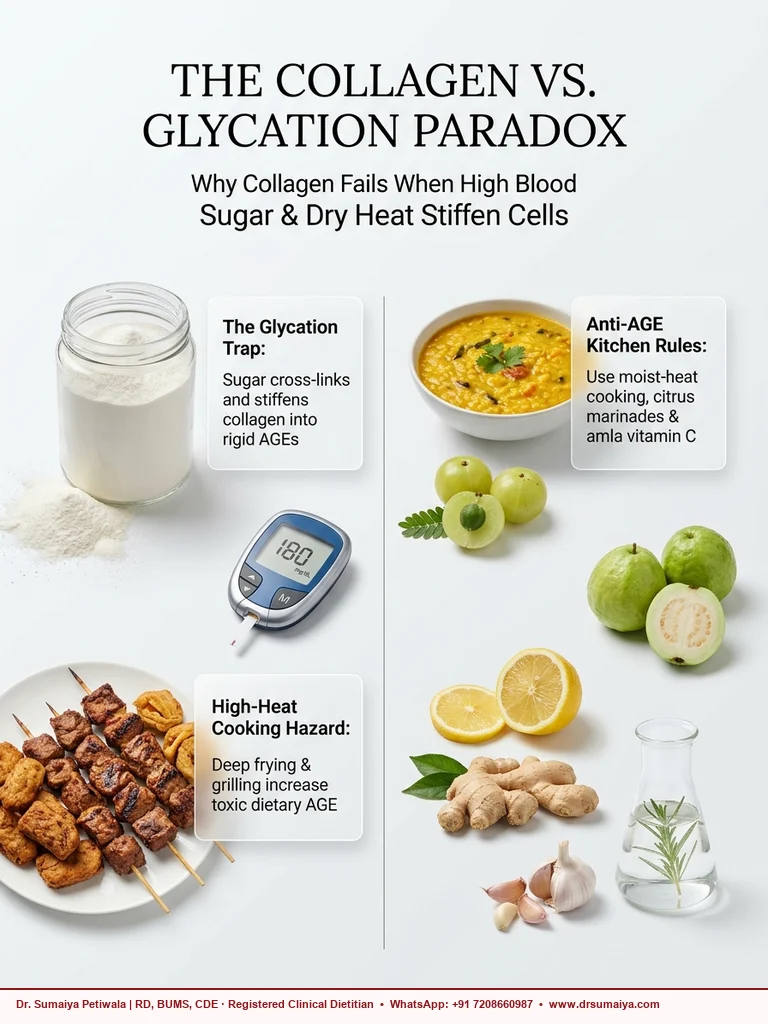
How Sugar & High-Heat Cooking Destroy Dermal and Vascular Collagen: evidence-based clinical protocols from Dr. Sumaiya NutriCare Clinic.
The Maillard Reaction in Human Tissue: What the October 2026 Synthesis Reveals
A comprehensive clinical review synthesized in late October 2026 by leading biomedical researchers and published in News-Medical has mapped out the destructive cellular pathway known as non-enzymatic glycation:
1. The Endogenous Sugar Attack: When blood glucose remains elevated after carbohydrate-heavy meals, or when free fructose floods circulation, these reducing sugars react spontaneously with the amino groups of long-lived structural proteins like collagen and elastin without enzyme regulation. Through a series of chemical rearrangements known as the Maillard reaction, they form irreversible covalent bonds called Advanced Glycation End-Products (AGEs), such as pentosidine, GOLD, and MOLD.
2. Stiffened Cross-Links & The RAGE Receptor: Glycated collagen loses its flexible, resilient triple-helix architecture. It transforms into rigid, brittle cross-links that cannot slide smoothly or bend, manifesting physically as skin sagging, deep wrinkles, and stiff, aching joints. Even worse, circulating AGEs bind to specific cellular receptors termed RAGE (Receptor for Advanced Glycation End-products), triggering an intracellular NF-κB inflammatory firestorm and releasing Matrix Metalloproteinases (MMPs)—destructive enzymes that actively dissolve surrounding healthy collagen.
3 Anti-Glycation Kitchen and Metabolic Upgrades to Protect Your Collagen
1. Shift from Dry-Heat Browning to Moist-Heat Traditional Indian Cooking
Glycation does not only happen inside your blood vessels; it happens on your stovetop. High-temperature, dry-heat cooking methods—such as deep-frying (pakoras, samosas, puri), high-heat air-frying, tandoori char-grilling, and cooking with repeatedly reheated vegetable oils—generate massive quantities of exogenous dietary AGEs that are absorbed into circulation. Transition to traditional moist-heat Indian cooking methods: pressure-cooking, steaming (idli, dhokla), boiling, and gentle simmering of dals and curries. Water boils at 100°C, a temperature that completely halts the thermal Maillard glycation cascade.
2. Utilize Acidic and Polyphenol-Rich Pre-Cooking Marinades
If preparing roasted paneer, chicken, or vegetables, use culinary biochemistry to your advantage. Marinating proteins in acidic liquids before cooking dramatically inhibits AGE formation. Soak foods in fresh lemon juice, kokum water, tamarind extract, or raw apple cider vinegar combined with antioxidant spices: turmeric (curcumin), fresh ginger, crushed garlic, and rosemary. Clinical food chemistry trials show that acidic marinades reduce heterocyclic amine and AGE formation by up to 50% during cooking.
3. Supply Endogenous Pro-Collagen Cofactors (Wild Amla Vitamin C & Zinc)
Your fibroblasts cannot cross-link healthy collagen without specific enzymatic cofactors. The enzymes prolyl hydroxylase and lysyl hydroxylase strictly require vitamin C, zinc, and copper. Rather than synthetic ascorbic acid pills, integrate wild Indian gooseberry (amla) juice or fresh guava daily. Amla contains unique heat-stable tannins that protect vitamin C from oxidation, providing up to 20 times the bioavailable ascorbic acid of oranges alongside roasted pumpkin seeds (zinc) and crushed sesame seeds (copper).
The Diagnostic Gap: What Your HbA1c Reveals About Your Skin and Arteries
Most consumers consider HbA1c (Glycated Hemoglobin) strictly as a diabetes test. In reality, HbA1c is a direct, universal measurement of internal protein glycation: it measures the percentage of your red blood cell hemoglobin that has been permanently bonded to sugar over the preceding 90 to 120 days.
If your HbA1c is 5.7% or higher (prediabetic range), or if your postprandial glucose frequently exceeds 140 mg/dL, your dermal collagen, elastin fibers, retinal microvasculature, and arterial walls are undergoing glycation at the exact same relentless velocity. True longevity and skin vitality are built through metabolic precision, blood sugar stabilization, and anti-glycation culinary science—not another scoop of collagen powder.
Free “Anti-Glycation Kitchen Guide: High-AGE vs. Low-AGE Indian Cooking”
Protect your dermal collagen and joint flexibility from within. Download the complete anti-glycation culinary matrix, acidic marinade formulas, and the 7-day low-AGE meal plan.
- The Cooking Heat Matrix: Why pressure-cooked dals and curries contain 80% fewer toxic AGEs than air-fried or deep-fried snacks.
- Acidic Marinade Formulas: How marinating paneer or chicken in lemon juice, kokum, or vinegar blocks AGE cross-linking by 50%.
- Pro-Collagen Indian Cofactors: Wild amla (vitamin C), guava, pumpkin seeds (zinc), and bone/legume broths for endogenous synthesis.
- The HbA1c-Skin Connection: How to interpret your blood sugar tests as a direct mirror of your skin and vascular aging rate.
Frequently asked questions
Why is my collagen supplement not working for skin elasticity?
Oral collagen peptides are broken down into amino acids (proline, hydroxyproline, glycine). However, if your blood sugar is frequently elevated or you experience post-meal glucose spikes, circulating sugars immediately glycate newly formed collagen, transforming flexible fibrils into brittle, cross-linked Advanced Glycation End-Products (AGEs).
What are Advanced Glycation End-products (AGEs) in Indian cooking?
Dietary AGEs are toxic inflammatory compounds formed when foods rich in proteins or fats are subjected to high-temperature dry heat, such as deep-frying (samosas, pakoras, puri), tandoori char-grilling, high-heat air-frying, or cooking with repeatedly reheated vegetable oils.
How does high blood sugar cause premature skin aging?
High blood glucose initiates non-enzymatic glycation with dermal collagen. These glycated fibers lose their elasticity and cannot be properly remodeled by normal cellular enzymes. Furthermore, AGEs bind to RAGE receptors on skin fibroblasts, releasing matrix metalloproteinases (MMPs) that actively chew up remaining healthy collagen.
What Indian cooking methods produce the lowest levels of AGEs?
Moist-heat cooking methods are exceptionally protective. Pressure-cooking, steaming (idli, dhokla), boiling, and gentle simmering (dals, sambar, stews) generate up to 90% fewer AGEs compared to roasting or frying. Cooking with water limits temperatures to 100°C, preventing the destructive Maillard cross-linking reaction.
How can I naturally protect and rebuild collagen from within?
Flatten your glucose curves by adopting high-fiber meal sequencing (vegetables and protein before carbohydrates). Marinate foods with acidic ingredients like lemon juice, kokum, or apple cider vinegar to inhibit AGE formation, and provide critical pro-collagen cofactors: vitamin C from wild amla, zinc from pumpkin seeds, and copper from sesame seeds.
Sources: News-Medical Life Sciences / International Clinical Review (October 2026): Glycation and Aging: How Sugar Damage Affects Skin Cells and Health. Journal of Investigative Dermatology: Advanced Glycation End-Products and Dermal Matrix Stiffening. American Diabetes Association (ADA): Non-Enzymatic Glycation, RAGE Receptors, and Chronic Tissue Complications.
🌟 Transform Your Health Today
Takes only 60 seconds to send a booking enquiry.
"Lost 4kgs in one month... plans are simple and effective! She
responds to queries promptly."
– Payal J.
About this guide
This guide provides general health information. Your own care depends on your medical history and circumstances. Speak with your treating clinician before changing medicines or treatment.