

Dr. Sumaiya Petiwala, RD, BUMS, CDE · Medically Reviewed & Evidence-Based · Updated November 2026
If you have struggled with chronic digestive distress—frequent bloating, unpredictable bowel movements, abdominal cramping, and post-meal brain fog—you have likely experienced the agonizing journey of the ‘elimination diet.’ It often starts innocently: you cut out dairy milk after feeling gassy, then eliminate paneer and curd, then remove wheat rotis due to suspected gluten sensitivity, and finally begin cutting out lentils, nuts, and fibrous vegetables.
Yet despite eating an increasingly restrictive, bland diet of white rice and boiled squash, your symptoms refuse to resolve. In fact, your digestive tract seems to have become hypersensitive, reacting with intense pain, nausea, and burning to even the smallest accidental exposure. This progressive decline is what clinical gastroenterology identifies as The Food Intolerance Trap.
Can missing gut bacteria cause sudden food intolerances to dairy and wheat?
Yes. An October 2026 McMaster University study published in Gastroenterology demonstrated that chronic gut inflammation depletes protein-degrading bacteria like Bifidobacteriales and Clostridia. Without these specialized microbes, undigested dairy proteins and wheat antigens persist in the lumen, sensitizing mucosal mast cells to release inflammatory mediators that cause severe pain and bloating.
The Elimination Trap: Why Food Avoidance Weakens Your Gut
When food causes abdominal pain, our immediate psychological instinct is to blame the food itself: ‘Wheat is inflammatory,’ ‘Dairy is toxic,’ or ‘My body hates legumes.’ While eliminating an irritating food provides temporary symptom relief by removing the substrate for bacterial gas production, permanent elimination does nothing to heal the underlying biological defect.
The human colonic microbiome relies on a wide diversity of fermentable dietary fibers and food proteins to survive. When you permanently remove entire food groups, you starve and wipe out the specialized bacterial communities responsible for breaking down those exact foods. Over months of severe restriction, dietary tolerance shrinks like an unexercised muscle, leaving you more reactive than when you began.
| Diagnostic Feature | Classical Food Allergy (IgE-Mediated) | Primary Lactase Deficiency | Microbial Depletion Intolerance (2026 Discovery) |
|---|---|---|---|
| Underlying Mechanism | Systemic immune IgE antibodies against specific food antigens | Genetically low brush-border lactase enzyme in small intestine | Depletion of Bifidobacteriales and Clostridia following gut inflammation |
| Target Offending Molecule | Intact intact food proteins (e.g., casein, whey, gluten) | Unabsorbed lactose disaccharide sugar in dairy | Intact beta-lactoglobulin and wheat proteins triggering mucosal mast cells |
| Primary Symptoms | Hives, facial swelling, wheezing, anaphylaxis | Watery osmotic diarrhea, immediate flatulence, lower abdominal cramping | Delayed bloating, visceral hypersensitivity, chronic abdominal discomfort, brain fog |
| Effect of Prolonged Elimination | Protects against dangerous allergic reactions | Resolves symptoms but does not restore lactase enzyme | Further starves beneficial bacteria, progressively shrinking dietary tolerance |
| Clinical Nutrition Therapy | Strict lifelong avoidance of allergen | Lactase enzyme drops or lactose-free dairy alternatives | Mucosal mast-cell stabilization, matrix modification, and microbial rehabilitation |
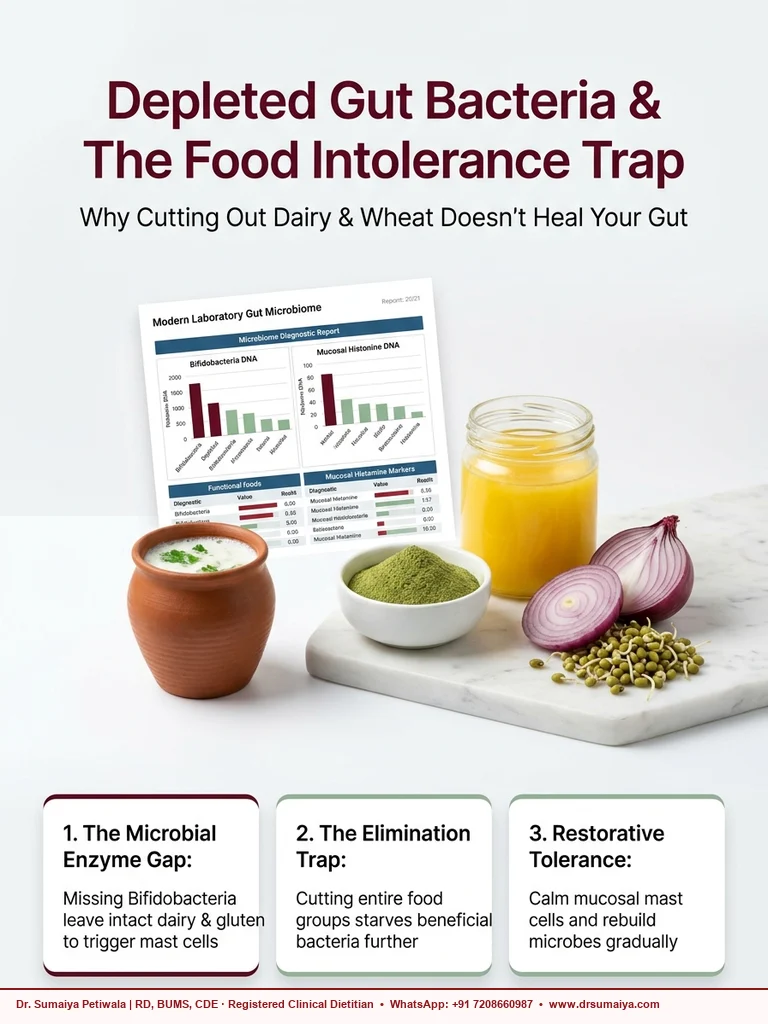
Why Eliminating Food Groups Fails to Solve Depleted Gut Bacteria: evidence-based clinical protocols from Dr. Sumaiya NutriCare Clinic.
The Microbial Enzyme Gap: What October 2026 McMaster Research Discovered
A landmark translational study led by Dr. Alberto Caminero at McMaster University, published in Gastroenterology and spotlighted in the October 2026 issue of the American Gastroenterological Association’s GI & Hepatology News, has provided the missing physiological explanation for chronic food sensitivities:
1. The Depletion of Commensal Microbes: Studying over 1,900 patients, the researchers demonstrated that 85% of individuals with chronic intestinal inflammation or post-inflammatory IBS suffer from persistent food intolerances—even when in complete clinical remission. The root cause was a severe depletion of specific protein-degrading bacteria, predominantly Bifidobacteriales and Clostridia.
2. The Mast Cell Pain Cascade: Under normal conditions, these beneficial bacteria secrete specialized proteases that pre-digest dairy proteins (beta-lactoglobulin and beta-casein) and wheat gluten peptides into harmless fragments. In their absence, large, intact food antigens reach the intestinal mucosa, where they cross-link local IgE antibodies and trigger mucosal mast cells. These activated mast cells degranulate, releasing histamine and prostaglandins that irritate enteric nerves, provoking severe visceral pain and delayed bloating.
3 Clinical Steps to Calm Mucosal Mast Cells and Rebuild Food Tolerance
1. Cease Permanent Elimination and Modify the Food Protein Matrix
Stop cutting out additional food categories. Instead, modify the physical matrix of the food to reduce antigenic load while preserving nutrient density. If commercial pasteurized cow’s milk triggers distress, test traditional 24-hour cultured A2 bilona chaas (buttermilk), in which active lactic cultures have already broken down lactose and pre-digested milk proteins. Alternatively, utilize clarified butter (ghee), which is 99.9% free of whey and casein proteins, before attempting unfermented dairy.
2. Calm Mucosal Mast-Cell Hyper-Reactivity Using Natural Bioflavonoids
Before challenging your gut with complex proteins, you must stabilize the irritable mucosal mast cells lining the intestinal wall. Incorporate natural mast-cell stabilizing phytonutrients: quercetin from red onions and cooked apples (which inhibits mast-cell histamine release), freshly cooked moringa leaves (rich in anti-inflammatory glucosinolates), and curcumin extracted from whole turmeric roots cooked with healthy fats to soothe enteric hypersensitivity.
3. Rehabilitate Bifidobacteria Ecosystems Through Graduated Prebiotic Micro-Dosing
You cannot re-establish missing *Bifidobacterium longum* and *Clostridium sporogenes* colonies overnight; dumping high-dose fiber into an inflamed gut causes severe gas pain. Instead, employ graduated micro-dosing: begin with 1/4 teaspoon of partially hydrolyzed guar gum (PHGG) or a single tablespoon of well-cooked whole moong dal broth, gradually increasing the serving every 4 days. This carefully nourishes commensal bacteria without provoking mast-cell degranulation.
The Diagnostic Gap: The Fallacy of Commercial IgG Food Intolerance Tests
Desperate for answers, thousands of patients spend significant sums on commercial ‘200-food IgG blood panels.’ Major clinical immunology bodies worldwide (including AAAAI and EAACI) have warned that IgG antibodies indicate immunological exposure and tolerance, not allergy or disease. Patients who receive these reports end up eliminating 50 healthy foods, rapidly inducing micronutrient malnutrition and worsening gut dysbiosis.
True clinical resolution requires evaluating fecal calprotectin, comprehensive microbiome sequencing to identify commensal deficiencies, screening for Small Intestinal Bacterial Overgrowth (SIBO), and implementing a physician-guided, staged food reintroduction protocol. Healing your gut is about rebuilding digestive tolerance—not fearing your plate.
Free “Food Allergy vs. Microbial Intolerance vs. Mast Cell Guide”
Stop unnecessarily cutting out staple foods. Identify whether your symptoms stem from true allergy, brush-border enzyme deficiency, or depleted gut bacteria in 2 minutes.
- Intolerance Diagnostic Tree: Clarify why commercial IgG food intolerance tests are unscientific and clinically invalid.
- Dairy Matrix Modification Protocol: How to test 24-hour cultured A2 bilona chaas or clarified ghee before raw milk.
- Natural Mast-Cell Calmers: Quercetin-rich red onions, moringa leaves, and curcumin to settle mucosal hypersensitivity.
- Bifidobacteria Rebuilding Schedule: Graduated micro-dosing of prebiotic fibers to rebuild digestive capacity without gas.
Frequently asked questions
Why am I suddenly intolerant to dairy, wheat, and so many foods?
Sudden onset of multiple food intolerances rarely indicates true new allergies. A landmark October 2026 McMaster University study revealed that prior intestinal inflammation depletes key commensal bacteria like Bifidobacteriales and Clostridia, eliminating the microbial enzymes that normally pre-digest dairy and wheat proteins before they contact the gut lining.
Can missing gut bacteria cause dairy protein and gluten sensitivity?
Yes. When commensal bacteria that degrade proteins like beta-lactoglobulin, beta-casein, and wheat gluten peptides are wiped out, these intact macromolecules persist in the intestinal lumen, binding local receptors and triggering mucosal mast cells to release histamine and inflammatory mediators.
What is the role of mast cells in food intolerance bloating and pain?
Mast cells reside in the intestinal mucosa right next to enteric sensory nerves. When exposed to undigested food proteins in a dysbiotic gut, mast cells degranulate, releasing tryptase, histamine, and prostaglandins that cause visceral hypersensitivity, smooth muscle spasms, and severe delayed bloating.
Why is completely cutting out foods bad for gut healing?
Permanent elimination of diverse whole foods starves the very beneficial bacteria needed to break down those foods. Over months, total avoidance leads to secondary microbial extinction, loss of short-chain fatty acid (SCFA) production, and profound micronutrient deficiencies.
How can I safely reintroduce dairy and wheat without pain?
Begin by modifying the food matrix under clinical dietetic guidance: test 24-hour cultured probiotics like traditional buttermilk (chaas) or clarified butter (ghee) which lack intact whey proteins, while calming mast cells with natural stabilizers (quercetin, moringa) before gradually introducing small portions of sourdough or khapli wheat.
Sources: Gastroenterology / McMaster University & American Gastroenterological Association (October 2026): Research on depleted Bifidobacteriales and Clostridia driving food intolerance and mast-cell activation. World Gastroenterology Organisation (WGO) Global Guidelines: Irritable Bowel Syndrome and Food Intolerances. Clinical Nutrition & Dietary Rehabilitation in Gastrointestinal Remission.
🌟 Transform Your Health Today
Takes only 60 seconds to send a booking enquiry.
"Lost 4kgs in one month... plans are simple and effective! She
responds to queries promptly."
– Payal J.
About this guide
This guide provides general health information. Your own care depends on your medical history and circumstances. Speak with your treating clinician before changing medicines or treatment.