
Dr. Sumaiya Petiwala, RD, BUMS, CDE · Medically Reviewed & Evidence-Based · Updated November 2026
For millions of women navigating the distressing symptoms of Polycystic Ovary Syndrome (PCOS)—from irregular or absent menstrual periods and cystic acne to stubborn visceral weight gain and emotional exhaustion—the promise of natural herbal healing is deeply compelling. Frustrated by standard medical recommendations that offer birth control pills to force an artificial withdrawal bleed or metformin that causes persistent gastrointestinal distress, many women turn to Ayurvedic self-medication.
On social media platforms and wellness forums, Asparagus racemosus, widely known as Shatavari, is routinely hailed as the ultimate ‘queen of female herbs,’ promoted in viral reels as a natural cure for ovarian cysts, hormonal imbalance, and fertility struggles. However, rigorous clinical medicine requires evaluating empirical evidence rather than viral tradition.
Does Shatavari cure PCOS and regulate irregular menstrual cycles?
No. An October 2026 clinical systematic review in IJTM found that Asparagus racemosus (Shatavari) showed no improvement in menstrual cycle regularity over placebo, zero reduction in ovarian volume or testosterone, and no evidence of improving ovulation or fertility. Polycystic ovary syndrome requires addressing root hyperinsulinemia through medical nutrition therapy.
The Shatavari Myth: Why Viral Herbal Self-Medication Fails PCOS
Shatavari has a long, revered history in classical Ayurvedic literature as a rasayana [rejuvenating tonic] and galactagogue [agent that promotes breast milk lactation]. Because of these historical associations with the female reproductive system, modern supplement manufacturers began aggressively marketing powdered Shatavari churna, tablets, and ‘hormone balancing teas’ as an over-the-counter remedy for PCOS.
However, treating PCOS with a general female tonic fundamentally misunderstands the disease’s underlying pathophysiology. PCOS is not an estrogen deficiency state that can be resolved by herbal phytoestrogens; it is a complex neuroendocrine and metabolic disorder. Prescribing or self-administering an unstandardized root powder while ignoring underlying cellular insulin resistance, ovarian theca-cell androgen hypersecretion, and chronic low-grade inflammation leaves the hormonal root cause completely unchecked.
| Clinical Endpoint | Asparagus racemosus (Shatavari) | Evidence-Based Medical Nutrition Therapy |
|---|---|---|
| Ovarian Volume & Follicle Count | No statistically significant reduction over placebo in independent trials | Demonstrated reduction via lowering fasting insulin and LH pulse frequency |
| Serum Free Testosterone | No significant androgen-lowering effect demonstrated in randomized trials | Marked reduction through dietary protein pacing and flaxseed lignan binding |
| Menstrual Cycle Regularity | No proven superiority over placebo in robust multi-center clinical trials | Cycle restoration achieved by correcting the 40:1 Myo to D-chiro-inositol balance |
| Ovulation & Conception Rates | Zero published human clinical trial data on ovulation or live birth | Validated clinical improvement in spontaneous ovulatory cycles and endometrial health |
| Primary Therapeutic Target | Non-specific phytoestrogenic botanical tonification | Cellular insulin sensitization, theca-cell androgen suppression, and visceral fat reduction |
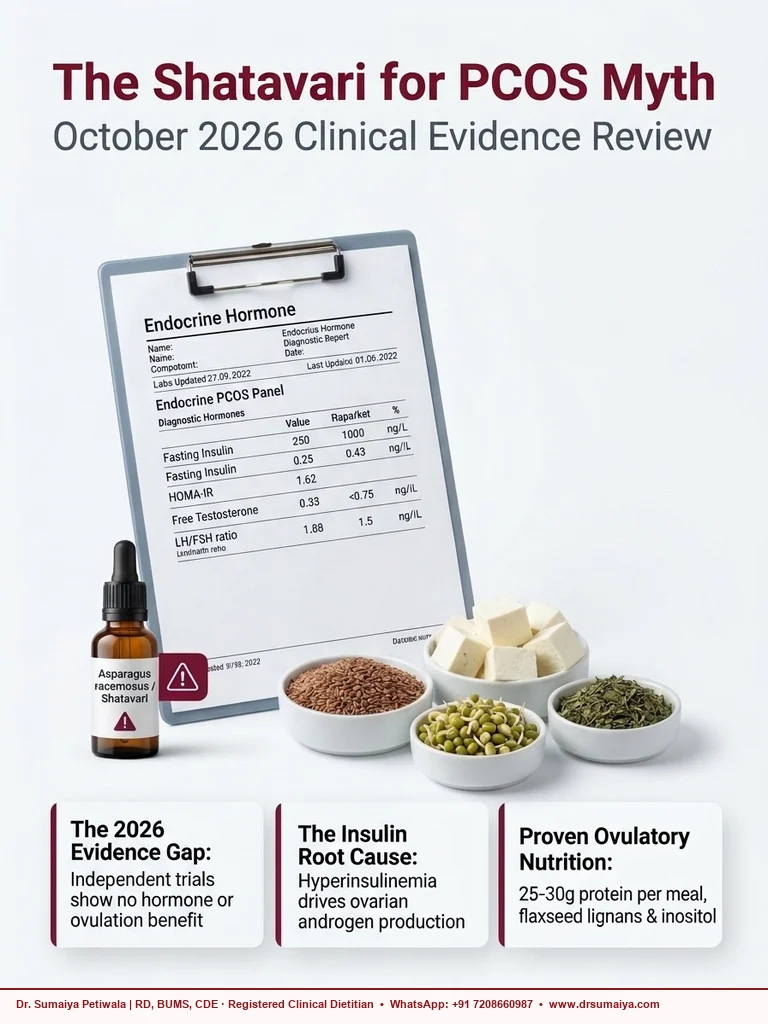
Why Herbal Self-Medication Fails to Treat Hyperinsulinemic PCOS: evidence-based clinical protocols from Dr. Sumaiya NutriCare Clinic.
The Evidence Verdict: What the October 2026 IJTM Systematic Review Revealed
On October 28, 2026, a landmark evidence-tiered systematic review was published in the International Journal of Translational Medicine (IJTM) by clinical researchers from UPES Dehradun and GITAM Bengaluru. The investigative team conducted an exhaustive GRADE assessment of all published clinical trials evaluating Asparagus racemosus in women with PCOS/PMOS (Polyendocrine Metabolic Ovarian Syndrome).
The clinical findings were unequivocal:
1. Methodological Duplication & Sponsorship Bias: Two widely circulated positive clinical studies claiming hormonal benefits were discovered to share an identical commercial sponsor and an identical placebo control arm, severely undermining their scientific validity.
2. Zero Effect on Ovarian Morphology & Androgens: Independent randomized controlled trials (RCTs) demonstrated that Shatavari produced no statistically significant reduction in ovarian volume, no reduction in antral follicle count, and no lowering of serum free or total testosterone compared to placebo.
3. Absent Ovulatory and Fertility Data: To date, there is zero published clinical evidence demonstrating that Shatavari restores spontaneous ovulatory cycles, enhances endometrial receptivity, or improves clinical pregnancy and live birth rates in women with PCOS.
3 Evidence-Graded Nutritional Interventions to Restore True Ovulatory Cycles
1. Target Hyperinsulinemia with 25–30g of Complete Protein per Indian Meal
In up to 80% of South Asian women with PCOS, the master driver of irregular periods is hyperinsulinemia [excessive circulating insulin]. High circulating insulin acts directly on the luteinizing hormone (LH) receptors of ovarian theca cells, stimulating them to overproduce testosterone while simultaneously suppressing hepatic sex hormone-binding globulin (SHBG) production. Pair every main meal with 25 to 30 grams of protein to flatten postprandial glucose curves: fresh paneer, hung curd, pastured eggs, organic non-GMO edamame/tofu, or strategic dal-and-seed pairings.
2. Replace Unverified Herbal Powders with a Validated 40:1 Inositol Ratio
Rather than consuming unstandardized botanical powders that risk heavy-metal contamination or hidden sugars, utilize clinical nutraceuticals with robust multi-center trial validation. A physiological 40:1 ratio of Myo-inositol to D-chiro-inositol acts as a cellular secondary messenger for insulin signaling inside the ovary, improving cellular glucose uptake, restoring follicular maturation, and reducing circulating androgens without pharmaceutical side effects.
3. Lower Free Androgens Using High-Lignan Flaxseeds and Spearmint Infusions
South Asian kitchens contain potent, clinically validated anti-androgenic foods. Consume 2 tablespoons of freshly ground roasted flaxseeds (alsi) daily. Flaxseeds are the world’s richest source of dietary secoisolariciresinol diglucoside (SDG) lignans, which stimulate hepatic synthesis of SHBG, effectively binding excess circulating testosterone. Pair this with 2 cups of pure spearmint tea daily, which has been shown in clinical trials to significantly reduce free androgen index and subjective hirsutism.
The Diagnostic Gap: Why PCOS Is a Polyendocrine Metabolic Syndrome (PMOS)
PCOS is no longer regarded by global endocrinologists as merely a gynecological or ovarian disease; it is an overarching metabolic syndrome now recognized as Polyendocrine Metabolic Ovarian Syndrome (PMOS). Taking a single herb or relying on contraceptive pills to force a withdrawal bleed masks progressive metabolic damage.
Achieving permanent hormonal harmony and spontaneous menstrual regularity requires a comprehensive clinical audit: calculating the HOMA-IR index from fasting insulin and glucose, assessing Free and Total Testosterone, DHEA-S (for adrenal androgen excess), Anti-Mullerian Hormone (AMH), Thyroid Stimulating Hormone (TSH), and Serum Prolactin. Evidence-based Medical Nutrition Therapy treats the underlying cellular physiology—restoring fertility from the inside out.
Free “PCOS/PMOS Root-Cause & Ovulation Blockers Quiz”
Identify your primary PCOS metabolic driver in 2 minutes. Unlock the complete ovulatory protein matrix, the anti-androgenic grocery checklist, and the clinical hormone testing roadmap.
- PCOS Phenotype Audit: Differentiate insulin-resistant PCOS from adrenal, inflammatory, or post-pill subtypes.
- The 30g Protein Anchor Guide: Practical Indian meal templates (paneer, hung curd, eggs, dal-seed combinations) to curb theca-cell androgens.
- Anti-Androgenic Botanical Protocol: Clinically verified food strategies (flaxseed lignans, spearmint infusion) to lower free testosterone.
- Essential Endocrine Lab Checklist: The exact panels (HOMA-IR, Free Testosterone, DHEA-S, AMH, Prolactin) needed before taking supplements.
Frequently asked questions
Does Shatavari cure PCOS and regulate irregular menstrual cycles?
No. A comprehensive October 2026 systematic review published in the International Journal of Translational Medicine analyzed all human clinical trials on Asparagus racemosus (Shatavari) for PCOS and found no statistically significant benefit over placebo for cycle regularity, hormonal normalization, or ovarian morphology.
Can taking Shatavari cause weight gain or hormone disruption in PCOS?
Yes, it can. Many commercial Shatavari formulations are prepared as herbal churnas or syrups containing unlisted sugars or heavy binding excipients. Because up to 80% of PCOS patients suffer from underlying insulin resistance, unregulated herbal powders can exacerbate glycemic spikes and promote visceral weight gain without addressing hyperandrogenism.
What is the true root cause of ovarian cysts and high testosterone in PCOS?
The primary driver in most South Asian women is hyperinsulinemia (excess circulating insulin). High insulin levels directly stimulate ovarian theca cells to overproduce testosterone and simultaneously inhibit hepatic sex hormone-binding globulin (SHBG) synthesis, leaving more free testosterone in circulation to halt follicular maturation.
What evidence-based natural treatments actually work for PCOS?
First-line clinical therapy consists of medical nutrition therapy designed to flatten glycemic excursions: consuming 25 to 30 grams of protein per meal, daily ground flaxseeds for lignans that bind free androgens, spearmint tea to dampen hirsutism, and targeted nutraceuticals such as a 40:1 ratio of Myo-inositol to D-chiro-inositol under medical supervision.
What lab tests are necessary to evaluate PCOS properly?
A thorough clinical evaluation requires fasting insulin and fasting glucose (to calculate the HOMA-IR index), Total and Free Testosterone, DHEA-S, Luteinizing Hormone (LH) and Follicle-Stimulating Hormone (FSH), Anti-Mullerian Hormone (AMH), Thyroid Stimulating Hormone (TSH), and Serum Prolactin.
Sources: International Journal of Translational Medicine (IJTM, October 2026): Systematic Review on Asparagus racemosus for PCOS/PMOS by UPES Dehradun & GITAM Bengaluru. Endocrine Society Clinical Practice Guidelines on Diagnosis and Treatment of Polycystic Ovary Syndrome. International Evidence-Based Guideline for the Assessment and Management of Polycystic Ovary Syndrome (PCOS).
🌟 Transform Your Health Today
Takes only 60 seconds to send a booking enquiry.
"Lost 4kgs in one month... plans are simple and effective! She
responds to queries promptly."
– Payal J.
About this guide
This guide provides general health information. Your own care depends on your medical history and circumstances. Speak with your treating clinician before changing medicines or treatment.