

Dr. Sumaiya Petiwala, RD, BUMS, CDE · Medically Reviewed & Evidence-Based · Updated November 2026
If you find yourself lying awake at 3:00 AM with racing thoughts, feeling an unyielding band of tension across your neck and shoulders, and watching stubborn visceral fat gather around your lower abdomen despite rigorous gym sessions, you are not alone. Social media algorithms are currently inundated with viral videos hailing magnesium glycinate as an overnight miracle cure capable of ‘melting cortisol belly’ and extinguishing chronic insomnia within days.
Driven by these dramatic claims, millions of exhausted corporate professionals and busy parents have begun self-supplementing with over-the-counter magnesium capsules—only to experience disappointing fat-loss results, morning grogginess, or unexpected digestive distress. It is time to separate physiological science from viral wellness marketing.
Does magnesium glycinate reduce belly fat and high cortisol?
No. Magnesium glycinate does not directly burn visceral belly fat. While elemental magnesium acts as an essential cofactor for GABA receptors and modulates hypothalamic-pituitary-adrenal (HPA) axis stress reactivity, visceral midsection adiposity is driven by hyperinsulinemia and sustained cortisol, which require targeted dietary stabilization rather than solitary supplement capsules.
The Cortisol Belly Craze: Dissecting the Viral Supplement Claims
The concept of ‘cortisol belly’ describes the preferential deposition of visceral adipose tissue deep around the liver, intestines, and pancreas under conditions of chronic psychological and physiological stress. Visceral fat cells express up to four times more glucocorticoid receptors and higher levels of the enzyme 11β-HSD1 (which converts inactive cortisone into active cortisol) than subcutaneous fat on the hips or thighs.
While chronic hypercortisolemia [prolonged elevated blood cortisol levels] unquestionably promotes visceral fat storage, no single micronutrient possesses the biochemical ability to directly oxidize or ‘melt’ adipose tissue. Magnesium is an indispensable enzymatic cofactor, but taking a supplement capsule while ignoring underlying circadian dysregulation, nocturnal glycemic drops, and emotional stress will produce zero change on the measuring tape.
| Magnesium Compound | Primary Absorption Channel | Clinical Target | Side Effect Profile |
|---|---|---|---|
| Magnesium Bisglycinate | Dipeptide transporter; highly bioavailable | Neuromuscular relaxation, nocturnal calm, sleep latency | Gentle on bowel; minimal laxative effect |
| Magnesium L-Threonate | Crosses the blood-brain barrier (BBB) | Synaptic density, cognitive anxiety, mental fog | Mild; can cause daytime wakefulness if taken late |
| Magnesium Malate | Organic malic acid chelate | Cellular ATP production, chronic daytime fatigue, muscle ache | Energizing; should be taken in the morning |
| Magnesium Citrate | Ionic osmotic pathway | Constipation relief and acute bowel evacuation | Draws water into bowel; frequent cause of loose stools |
| Magnesium Oxide | Poor elemental absorption (<4%) | Cheap over-the-counter antacid | High osmotic laxative effect, stomach irritation |
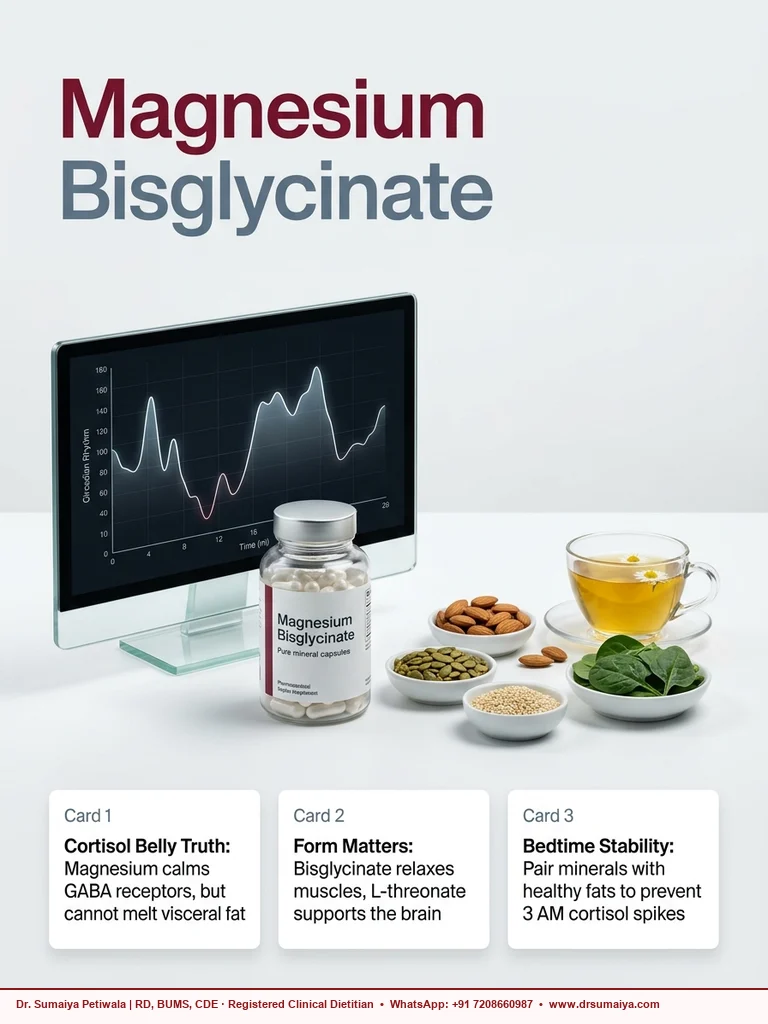
Clinical Bioavailability, Stress Biochemistry & Sleep Architecture: evidence-based clinical protocols from Dr. Sumaiya NutriCare Clinic.
The Neurochemical Reality: What Magnesium Glycinate Actually Does
Clinical evidence synthesized by leading pharmacological reviews demonstrates that elemental magnesium is a vital modulator of the human central nervous system. Specifically, magnesium acts as a physiological NMDA (N-methyl-D-aspartate) receptor blocker and an agonist for GABA (gamma-aminobutyric acid)—the brain’s primary inhibitory neurotransmitter that promotes neuromuscular relaxation and dampens autonomic arousal.
Furthermore, magnesium regulates the sensitivity of the hypothalamic-pituitary-adrenal (HPA) axis, helping terminate the adrenal stress response after acute stressors resolve. When chelated to glycine (an inhibitory amino acid that crosses the blood-brain barrier and lowers core body temperature), magnesium bisglycinate offers superior intestinal absorption through dipeptide transport channels without the harsh osmotic laxative effects typical of cheap inorganic oxides.
3 Clinical Protocols for Managing Nocturnal Cortisol and Sleep Architecture
1. Match the Specific Magnesium Chelate to Your Predominant Pathology
Not all magnesium forms are therapeutically equivalent. If your primary challenge is nocturnal neuromuscular tension, muscle cramps, and sleep latency, pure Magnesium Bisglycinate is the gold standard due to its soothing amino acid profile. If you battle daytime cognitive anxiety, mental exhaustion, and brain fog, Magnesium L-Threonate is the only form clinically proven to cross the blood-brain barrier to enhance synaptic density. For daytime muscular fatigue and fibromyalgia, Magnesium Malate taken in the morning provides Krebs-cycle malic acid for cellular ATP generation.
2. Pair Bedtime Minerals with Low-Glycemic Bedtime Stabilizers
Many patients who awaken jolted at 3:00 AM assume their cortisol spike is purely emotional. In reality, it is frequently triggered by reactive nocturnal hypoglycemia [a sudden midnight drop in blood sugar caused by a high-carbohydrate Indian dinner]. When blood glucose plummets during sleep, the adrenal glands secrete emergency pulses of cortisol and adrenaline to stimulate hepatic gluconeogenesis [liver glucose production], waking you up with a pounding heart. Pair your evening magnesium with a stabilizing evening fat-protein anchor: a tablespoon of raw almond butter or 10 soaked pumpkin seeds with warm chamomile tea.
3. Anchor Your Evening Meals in Magnesium-Dense Culinary Staples
Supplements should complement, never replace, a mineral-dense clinical diet. South Asian kitchens possess exceptional, bioavailable culinary magnesium sources. Incorporate roasted pumpkin seeds (kaddu ke beej, providing 150 mg of magnesium per ounce), toasted black and white sesame seeds (til), lightly steamed palak and methi greens, soaked rajma (kidney beans), and whole moong dal into your evening meal rotation to maintain steady intracellular electrolyte reserves.
The Diagnostic Gap: Why Routine Serum Magnesium Tests Miss True Deficiency
When concerned patients ask their physician to check their magnesium levels, the standard hospital laboratory runs a Serum Magnesium test. This test is almost clinically useless for detecting subtle intracellular depletion: less than 1% of the body’s total magnesium is contained in the blood serum, with 99% tightly compartmentalized inside red blood cells, skeletal muscle, and bone matrix. The body will actively leach magnesium from tissues to keep serum blood concentrations tightly buffered.
To accurately evaluate chronic stress, midsection weight gain, and refractory sleep disturbances, we utilize Red Blood Cell (RBC) Magnesium testing, a 4-point diurnal salivary cortisol rhythm panel, and fasting insulin levels (to calculate HOMA-IR). Visceral fat responds to metabolic precision and nervous system regulation—not to random supplement shopping.
Free “Sleep, Stress & Supplement Matrix”
Discover whether your midsection weight is driven by cortisol or insulin in 3 minutes. Unlock the complete clinical magnesium dosing guide, the bedtime glycemic stabilizer menu, and the 4-point stress biomarker tracker.
- Magnesium Chelate Guide: How to match bisglycinate, L-threonate, and malate to your specific symptom profile.
- Bedtime Glycemic Stabilizers: 3 Indian bedtime pairings (almond butter, pumpkin seeds, chamomile) to stop 3 AM cortisol surges.
- RBC Magnesium vs. Serum Blood: How to test intracellular mineral status that routine hospital labs miss.
- The Visceral Fat Audit: Clinical questions to separate high-cortisol puffiness from true hyperinsulinemic adiposity.
Frequently asked questions
Can magnesium glycinate flatten a cortisol belly?
No supplement can directly burn visceral abdominal fat. Magnesium glycinate helps modulate the autonomic nervous system and dampens excess sympathetic tone, which supports restorative sleep. However, visceral fat reduction requires addressing hyperinsulinemia, chronic caloric surplus, and nocturnal glycemic fluctuations through clinical nutrition therapy.
What is the best time to take magnesium glycinate for deep sleep?
The optimal window is 45 to 60 minutes before intended sleep. Pairing it with a modest stabilizer containing healthy fats or protein (such as 10 soaked pumpkin seeds or a teaspoon of unsweetened almond butter) prevents midnight reactive hypoglycemia that triggers 3 AM cortisol spikes.
Why is magnesium glycinate causing morning grogginess or loose stools?
Morning grogginess often stems from excessive initial elemental doses or taking poorly chelated commercial blends containing hidden magnesium oxide. Loose stools occur when unabsorbed magnesium ions exert an osmotic draw in the colon, which is common with magnesium citrate or oxide rather than pure bisglycinate.
How do I know if I have a real magnesium deficiency?
Standard serum blood tests are clinically misleading because less than 1% of total body magnesium resides in extracellular serum. An accurate clinical diagnosis requires a Red Blood Cell (RBC) Magnesium test, which measures intracellular levels within erythrocytes, alongside symptoms like muscle twitches, restless legs, and palpitations.
What Indian foods provide the highest bioavailable magnesium?
Excellent Indian culinary sources include roasted pumpkin seeds (kaddu ke beej), toasted white and black sesame seeds (til), steamed dark leafy greens (palak, methi), soaked whole almonds, rajma (kidney beans), and whole moong dal.
Sources: GoodRx Health Clinical Review: Cortisol and Weight Gain Mechanisms (2026). Ubie Health Clinical Review: Magnesium for Sleep, Anxiety, and Nervous System Regulation (2026). Superpower Health: Clinical Magnesium Form Bioavailability & Chelation Guidelines. Endocrine Society Guidelines on Hypercortisolemia and Visceral Adiposity.
🌟 Transform Your Health Today
Takes only 60 seconds to send a booking enquiry.
"Lost 4kgs in one month... plans are simple and effective! She
responds to queries promptly."
– Payal J.
About this guide
This guide provides general health information. Your own care depends on your medical history and circumstances. Speak with your treating clinician before changing medicines or treatment.