

Dr. Sumaiya Petiwala, RD, BUMS, CDE · Medically Reviewed & Evidence-Based · Updated November 2026
Few clinical scenarios are more disorienting than stepping off a routine executive health check with a normal body mass index (BMI 19–23 kg/m²), no history of alcohol intake, and an unexpected diagnosis of Grade 1 or Grade 2 Fatty Liver Disease (MASLD [Metabolic Dysfunction-Associated Steatohepatitis]). In Indian clinical practice, we routinely see lean professionals who eat home-cooked vegetarian food yet present with elevated liver enzymes (SGPT/ALT and SGOT/AST) and significant hepatic steatosis [abnormal accumulation of triglycerides inside liver cells].
The assumption that fatty liver is exclusively an obesity disease has left millions of normal-weight South Asians vulnerable to silent fibro-inflammatory progression. You do not need to carry excess subcutaneous body fat to suffer from dangerous intrahepatic inflammation.
Can you get fatty liver disease if you are thin and don’t drink alcohol?
Yes. Up to 40% of Asian patients with metabolic dysfunction-associated steatohepatitis (MASH) have a normal BMI. Preclinical research from Duke-NUS Medical School demonstrates that excess dietary sodium alters hepatic fat transport and activates inflammatory scarring pathways directly, causing progressive liver inflammation and fibrosis even without obesity or alcohol consumption.
The Normal BMI Paradox: Why Lean Indians Develop Severe Liver Inflammation
For decades, standard medical guidance suggested that fatty liver was merely a downstream complication of caloric excess and overt obesity. However, clinical epidemiological registries in Asian populations reveal that up to 40% of non-alcoholic steatohepatitis cases occur in individuals who are non-obese by conventional BMI criteria. This distinct clinical phenotype is termed Lean MASH (formerly Lean NASH).
In South Asian physiology, visceral adiposity [fat stored deep within the abdominal cavity around vital organs] frequently develops even when the waistline appears slim. Furthermore, routine bathroom scales fail to distinguish between metabolically protective skeletal muscle and silent visceral fat depots. When liver cells (hepatocytes) become overwhelmed by circulating lipid loads that they cannot package or export, cellular lipotoxicity [damage caused by toxic lipid accumulation] triggers cellular swelling and immune activation.
| Clinical Parameter | Classic Obese MASLD | Lean MASH (Normal BMI Phenotype) |
|---|---|---|
| Primary Driver | General visceral adiposity and systemic insulin resistance | Hepatic lipid dysregulation, high dietary sodium, and impaired VLDL export |
| Body Mass Index | BMI > 25 kg/m² with noticeable abdominal obesity | BMI 19–23 kg/m² (“thin outside, metabolically challenged inside”) |
| Role of Dietary Salt | Contributes to fluid retention and arterial hypertension | Directly alters hepatic lipid metabolism and activates inflammatory macrophages |
| Standard Weight Loss Advice | 7–10% total body weight reduction recommended | Dangerous; triggers sarcopenia and muscle wasting without healing liver |
| Clinical Nutrition Priority | Calorie-restricted whole-food Mediterranean/Indian balance | Sodium-to-potassium correction (<5g salt), methyl donors, and choline loading |
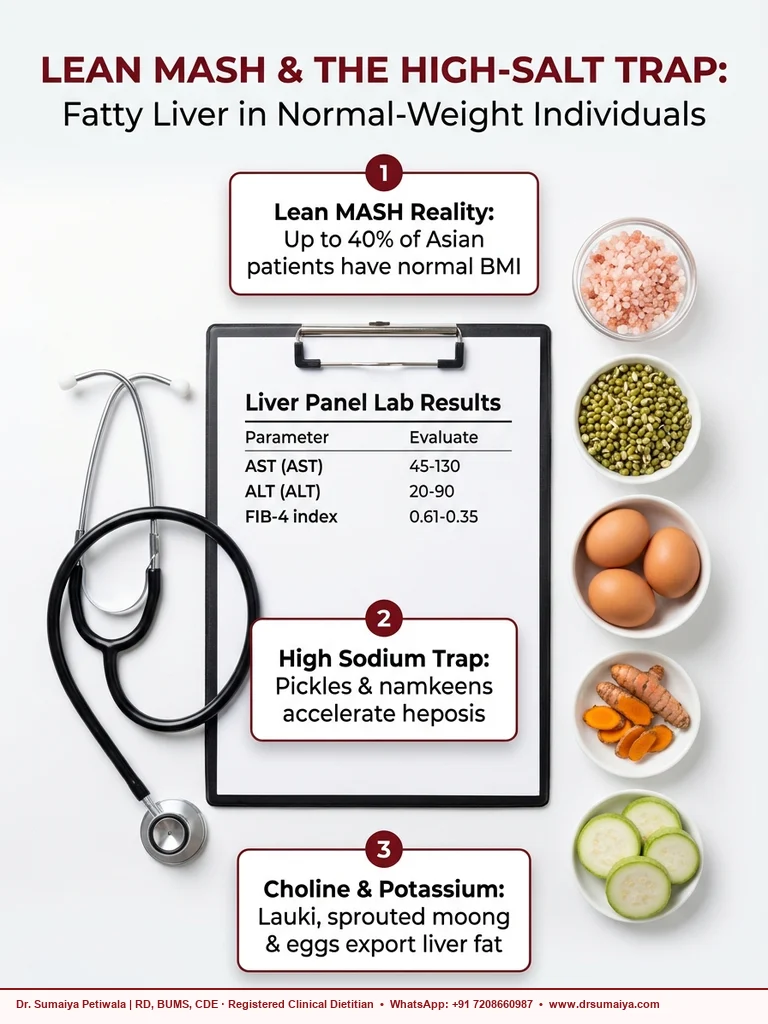
Why Normal-Weight Indians Develop Severe Hepatic Inflammation: evidence-based clinical protocols from Dr. Sumaiya NutriCare Clinic.
The High-Salt Mechanism: What the October 2026 Duke-NUS Preclinical Study Reveals
A ground-breaking preclinical study published in Molecular Metabolism by researchers at Duke-NUS Medical School (reported in October 2026) has uncovered a direct, non-caloric driver of lean fatty liver: excess dietary sodium. The researchers demonstrated that high salt consumption fundamentally alters hepatic lipid metabolism, accelerating intracellular fat accumulation and directly triggering fibro-inflammatory signaling pathways in lean subjects independent of body weight.
The cellular mechanism is profound: excess dietary sodium alters hepatic osmotic gradients and activates intrahepatic inflammatory cascades. This stimulates hepatic macrophages (Kupffer cells) and hepatic stellate cells—the primary drivers of collagen deposition and liver fibrosis [scar tissue formation]. In traditional Indian households, daily sodium intake routinely surpasses 10 to 12 grams (far above the ICMR recommended limit of 5 grams per day) through cumulative exposure to mango and lemon pickles (achar), roasted or fried papads, commercial savoury namkeens, and sodium-dense restaurant gravies.
3 Liver-Targeted Clinical Nutrition Upgrades for Normal-Weight Patients
1. Rebalance the Sodium-to-Potassium Ratio in Your Kitchen
Rather than obsessing over calorie restriction, your primary lever is dietary mineral balance. Cap cooking salt at less than 5 grams per day (approximately one level teaspoon) and completely eliminate high-sodium condiments like commercial pickles, instant papad, and salted mixtures. Simultaneously, flood your diet with potassium-rich, liver-protective whole produce: tender bottle gourd (lauki), ridge gourd (turai), fresh spinach (palak), fresh unsweetened coconut water, and unpolished whole moong dal. High dietary potassium counteracts sodium-induced intrahepatic cellular stress and supports vascular endothelial relaxation.
2. Replenish Dietary Methyl Donors to Facilitate VLDL Fat Export
The liver cannot simply burn off stored fat on command; it must package triglycerides into very-low-density lipoproteins (VLDL) and export them into the bloodstream for utilization. This biochemical packaging requires phosphatidylcholine and methyl donors (betaine and choline). If your diet lacks bioavailable choline, fat remains trapped inside hepatocytes. Include pastured whole eggs (for non-vegetarians) or organic non-GMO tofu, edamame, sprouted kala chana, and cruciferous vegetables like cabbage, cauliflower, and mustard greens (sarson) daily to provide the enzymatic precursors needed for hepatic lipid clearance.
3. Eliminate Liquid Fructose and Hidden Industrial Sweeteners
Unlike glucose, which can be metabolized by nearly every cell in the human body, fructose is processed almost entirely by the liver. When consumed in liquid form—such as packaged fruit juices, sweetened cold-pressed beverages, or high-fructose syrups in commercial snacks—fructose bypasses regulatory phosphofructokinase checkpoints. It directly drives hepatic de novo lipogenesis [the liver’s rapid synthesis of new fat from sugar] without triggering satiety signals. Replace all fruit juices with whole, high-fiber fruits (guava, green apple, amla) consumed with their skins intact.
The Diagnostic Gap: Why Standard Weight Loss Advice Is Dangerous for Lean MASH
The most common and hazardous medical mistake made with lean fatty liver patients is handing them a generic handout instructing them to ‘lose 7% to 10% of their body weight.’ For an individual who is already at a BMI of 21 kg/m², severe caloric restriction induces sarcopenia [accelerated loss of skeletal muscle mass]. Because skeletal muscle is the primary disposal site for circulating blood glucose, losing muscle exacerbates peripheral insulin resistance, funneling even more metabolic stress back into the liver.
Reversing Lean MASH requires precision diagnostic tracking. Routine ultrasound often fails to detect early fibrosis. In our clinical practice, we evaluate the FIB-4 Index (a validated biomarker score derived from age, AST, ALT, and platelet count), high-sensitivity C-reactive protein (hs-CRP), fasting insulin, and transient elastography (FibroScan) to assess liver stiffness. True hepatic recovery is achieved by reducing intrahepatic lipotoxicity and calming fibro-inflammatory pathways, not by shrinking an already-lean frame.
Free “Lean Fatty Liver & Visceral Risk” Audit
Assess your hidden hepatic inflammation markers in 2 minutes. Unlock the complete FIB-4 calculation guide, the Indian low-sodium kitchen checklist, and the 5-point hepatoprotective grocery matrix.
- FIB-4 Risk Calculation Guide: Plain-language scoring using routine AST, ALT, and platelet counts to detect early fibrosis.
- Low-Sodium Kitchen Swaps: Specific culinary hacks to replace commercial achar, papad, and packaged namkeens without losing flavor.
- Choline & Methyl-Donor Matrix: Targeted Indian food sources (pastured eggs, sprouted moong, edamame, tofu) that accelerate VLDL fat export.
- Sarcopenia Prevention Protocol: Protein pacing guidelines to heal liver steatosis without shedding metabolically vital skeletal muscle.
Frequently asked questions
Can you get fatty liver disease if you are thin and do not drink alcohol?
Yes. Up to 40% of Asian individuals with metabolic dysfunction-associated steatohepatitis (MASH) have a normal BMI and zero history of alcohol consumption. This condition, known as Lean MASH, is driven by genetic lipid handling variations, high sodium intake, and visceral fat accumulation around internal organs rather than visible subcutaneous body fat.
How does excess salt cause liver inflammation in normal-weight people?
The landmark October 2026 Duke-NUS Medical School study revealed that excess dietary sodium directly disrupts hepatic fat processing and intrahepatic lipid breakdown. High salt intake triggers intrahepatic osmotic and inflammatory signaling, recruiting immune cells and activating hepatic stellate cells that produce collagen scarring and fibrosis independent of obesity.
Should lean people with fatty liver try to lose weight?
No. Standard clinical advice urging 7% to 10% weight loss is potentially harmful for patients with a normal BMI (19–23 kg/m²). Severe calorie restriction in lean individuals causes sarcopenia (skeletal muscle wasting), which worsens peripheral insulin resistance. Clinical therapy focuses on liver-targeted medical nutrition, sodium-to-potassium balance, and hepatoprotective micronutrients rather than weight loss.
What foods help export fat out of the liver?
The liver exports triglyceride stores into circulation via very-low-density lipoproteins (VLDL). This transport mechanism requires dietary methyl donors and phosphatidylcholine. Key food sources include pastured whole eggs, organic tofu, edamame, sprouted kala chana, cruciferous vegetables (broccoli, cabbage), and soaked sunflower seeds.
What tests detect lean fatty liver and liver scarring early?
Routine liver function tests (LFT) can appear normal even when inflammation is active. Essential assessments include the FIB-4 index (calculated using age, AST, ALT, and platelet count), transient elastography (FibroScan) to quantify liver stiffness, fasting insulin, and high-sensitivity C-reactive protein (hs-CRP).
Sources: Duke-NUS Medical School / Molecular Metabolism (October 2026): Preclinical investigation on high-salt dietary drivers of lean MASH and hepatic fibrosis. Indian Council of Medical Research – National Institute of Nutrition (ICMR-NIN) Dietary Guidelines for Indians (Sodium and Potassium Ratios). American Association for the Study of Liver Diseases (AASLD) Practice Guidance on MASLD/MASH in Non-Obese Populations.
🌟 Transform Your Health Today
Takes only 60 seconds to send a booking enquiry.
"Lost 4kgs in one month... plans are simple and effective! She
responds to queries promptly."
– Payal J.
About this guide
This guide provides general health information. Your own care depends on your medical history and circumstances. Speak with your treating clinician before changing medicines or treatment.