

Dr. Sumaiya Petiwala, RD, BUMS, CDE · Draft for clinical review · Updated 20 October 2026
If you weigh every serving, log every bite and still feel stuck, it is understandable to wonder whether your body is absorbing “extra” calories. Food labels are useful estimates—not a precise measurement of the energy every person extracts from every meal. But one recent microbiome study does not mean calories stopped counting, nor does it prove that gut bacteria are secretly preventing your weight loss.
Can gut bacteria change how many calories you absorb?
Yes. Gut microbes ferment some carbohydrates that human enzymes do not fully digest, producing short-chain fatty acids that the body can use. A 2026 mathematical model estimated differences in usable energy between food patterns with different fiber structures. It does not predict an individual’s weight loss or make calorie balance irrelevant.
Tracking carefully—and still seeing a plateau
A weight plateau can be frustrating, especially when your app shows a consistent deficit. Yet the app’s number is an estimate, and so is the energy value on a package. Portion measurement, cooking methods, restaurant meals, label rounding, water retention, medication effects, sleep, activity and changes in body size can all affect the picture. A plateau is not proof that you lack discipline—or proof of a “damaged metabolism.”
The practical question is not whether calories matter; they do. It is how accurately a number represents the energy available to your body, and whether the eating pattern is nourishing, satisfying and sustainable.
What the 2026 DAMM model actually found
The Digestion, Absorption, and Microbial Metabolism (DAMM) model, published in PLOS ONE on May 27, 2026, combines digestion and absorption estimates with microbial fermentation. Researchers applied it to data from an earlier controlled diet comparison. The paper discusses an estimated difference of about 116 kilocalories per day between the diet conditions, related to how food structure and fermentable material affect energy availability.
That is a model-based estimate—not a new October 12 trial, not a guaranteed 116-calorie “fiber deficit” for each person, and not evidence that someone will automatically lose weight without hunger. The study helps explain why two meals with similar label calories may not deliver identical metabolizable energy in every context. It does not replace the broader evidence that long-term energy intake and expenditure matter.
| Food pattern | What may happen | What to keep in mind |
|---|---|---|
| Finely milled or highly processed | Smaller particles may be digested more quickly and make some foods easier to eat rapidly. | Processing varies; this does not mean every processed food causes weight gain. |
| Intact grains, legumes and vegetables | Cell walls and fiber can slow access to some starch and support fullness and bowel regularity. | Effects depend on food, preparation, tolerance and the whole eating pattern. |
| Cooked, cooled starch | Cooling can increase some resistant starch (starch less readily digested in the small intestine). | It does not subtract a predictable calorie amount; safe storage matters. |
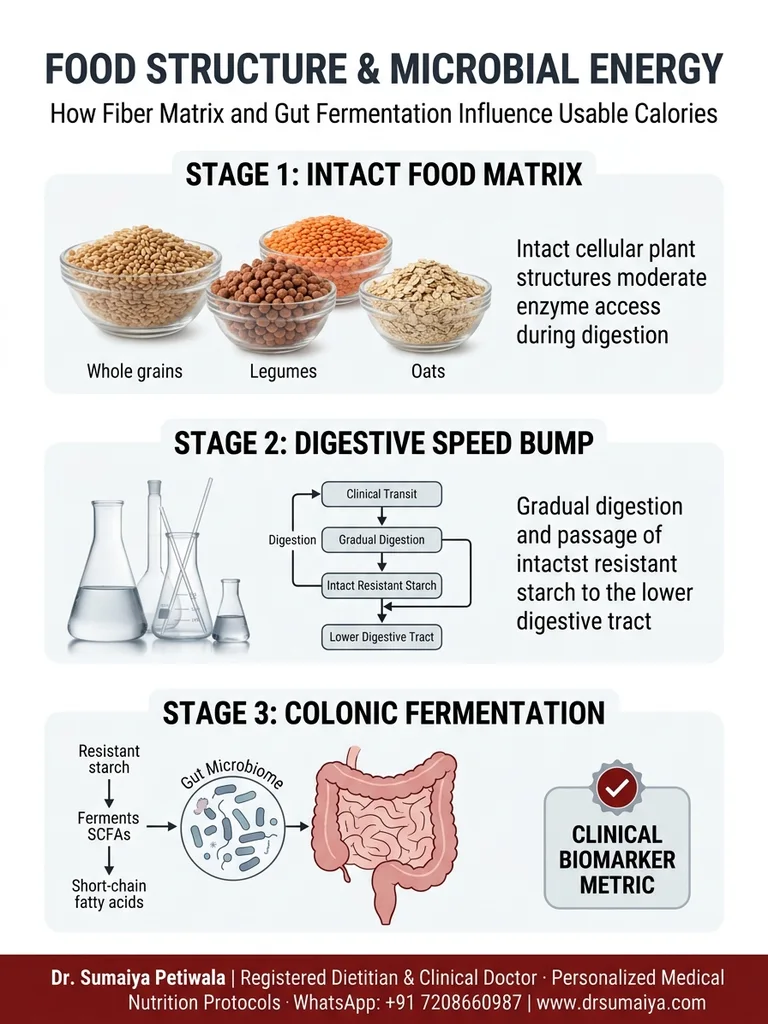
Food structure and microbial energy extraction: how intact cellular plant matrices and colonic fermentation influence usable calories without breaking energy balance.
How food structure and gut microbes fit together
Digestive enzymes break down accessible starches and sugars in the small intestine. Some fiber and resistant starch pass onward to the colon, where microbes ferment part of that material into short-chain fatty acids (SCFAs)—small compounds that the colon can absorb and use. So “not digested in the small intestine” does not mean “zero energy.” Microbes influence energy extraction, but the amount varies and is not a personal calorie calculator.
Intact food structure may also support fullness by requiring more chewing and slowing eating. Think of fiber as a speed bump, not a force field: it can change the pace and route of digestion, but it does not cancel a meal’s energy.
Three food-structure upgrades to try
1. Choose less-milled options more often
When tolerated, rotate instant oats with steel-cut oats, finely milled flour with less-refined whole-grain options, and blended drinks with meals that include chewable produce and protein. Indian choices might include whole jowar or bajra, hand-pounded rice, kala chana, rajma and whole moong. These are practical swaps for satiety and dietary variety—not a promise of extra fat loss.
2. Add cooled-and-reheated starch safely
Cooked rice, potatoes and legumes can form some type 3 resistant starch (RS3) during cooling. Try cooking a portion, cooling leftovers promptly in a shallow container in the refrigerator, then reheating thoroughly once. Refrigerate within two hours; never leave cooked rice at room temperature overnight. Research on resistant starch is promising but varied, and the effect on glucose or weight is not guaranteed for everyone.
3. Build fiber variety gradually
Include a mix of vegetables, fruit, pulses, nuts, seeds and whole grains. Increase fiber gradually and drink adequate fluids if medically appropriate; a sudden jump can worsen gas or discomfort. A target such as 30–35 grams per day may suit some adults, but needs vary with energy intake, health conditions and tolerance. If you have a gut disorder or ongoing symptoms, ask a clinician for an individualized plan rather than forcing a number.
Constipation, methane and the diagnostic gap
Free “Why Is My Calorie Deficit Failing?” Gut & Food Structure Audit
Evaluate your kitchen staples and digestive transit in 3 minutes. Unlock the complete 20-food clinical matrix, the step-by-step resistant starch (RS3) preparation protocol, and the 5-point methane motility self-audit.
- 20-Food Structure Matrix: Usable calorie extraction & digestion velocity ratings for 20 Indian staples.
- RS3 Cooking & Cooling Protocol: Time-and-temperature kitchen rules to increase resistant starch without food safety risk.
- Microbial SCFA & Fiber Pacing: Step-by-step titration schedule (15g to 35g/day) to prevent bloating and gas.
- 5-Point Methane & Motility Audit: Symptom screening checklist for constipation, IMO, and when to request breath testing.
Methanogens are methane-producing archaea (microorganisms distinct from bacteria). Intestinal methane is associated with constipation and slower gut transit; clinicians may consider breath testing for intestinal methanogen overgrowth (IMO) when symptoms and history fit. However, constipation or a weight plateau alone cannot diagnose IMO. Evidence does not establish that methanogens routinely “hyper-extract” calories and cause stubborn weight gain. Bloating has many possible causes, and evaluation should be guided by symptoms—not online microbiome tests alone.
Why cutting calories further may not solve the problem
Reducing intake sharply can make a plan harder to sustain and may leave you undernourished. It is not accurate to claim that every low-calorie diet “tanks” thyroid hormone conversion or inevitably causes constipation. If you are cold, exhausted, constipated or struggling despite careful tracking, review the full context with a qualified clinician: intake and portion assumptions, medications, sleep, activity, bowel pattern, thyroid symptoms and relevant metabolic risks. Thyroid tests and other investigations should be selected by your clinician, not ordered as a blanket panel.
Frequently asked questions
Why am I not losing weight in a calorie deficit?
A calculated deficit may differ from actual intake or needs. Portion estimates, water fluctuations, activity changes, medications and health conditions can all matter. Review trends over time with a clinician rather than cutting calories drastically.
Do gut bacteria change how many calories I absorb?
Yes, microbes ferment some carbohydrates into compounds the body can absorb. The size of this contribution varies; current models do not provide a precise personal calorie adjustment.
Does cooled rice reduce calories by 116 per day?
No. The 116-kilocalorie estimate in the DAMM paper describes a modeled difference between diet conditions, not a guaranteed effect of cooling rice or an individual daily calorie reduction.
Can methane-producing microbes cause constipation and weight gain?
Intestinal methane is associated with constipation and slower transit, but this does not prove methanogens cause weight gain through extra calorie extraction. A clinician can decide whether evaluation for IMO is appropriate.
Should I eat 30–35 grams of fiber every day?
That range may be reasonable for some adults, but needs and tolerance differ. Increase fiber gradually and seek individualized advice if you have persistent digestive symptoms or a medical condition.
Does resistant starch guarantee weight loss without hunger?
No. Resistant starch can support dietary variety and may affect digestion or fullness, but evidence does not guarantee weight loss or freedom from hunger for each person.
Sources: Davis TL et al. “Modeling the microbial contribution to human energy balance using the Digestion, Absorption, and Microbial Metabolism (DAMM) model.” PLOS ONE, May 27, 2026. doi:10.1371/journal.pone.0347668. American College of Gastroenterology, clinical guideline on small intestinal bacterial overgrowth, including methane testing. Guideline. Resistant starch evidence includes small studies and does not establish a universal weight-loss effect.
🌟 Transform Your Health Today
Takes only 60 seconds to send a booking enquiry.
"Lost 4kgs in one month... plans are simple and effective! She
responds to queries promptly."
– Payal J.
About this guide
This guide provides general health information. Your own care depends on your medical history and circumstances. Speak with your treating clinician before changing medicines or treatment.